


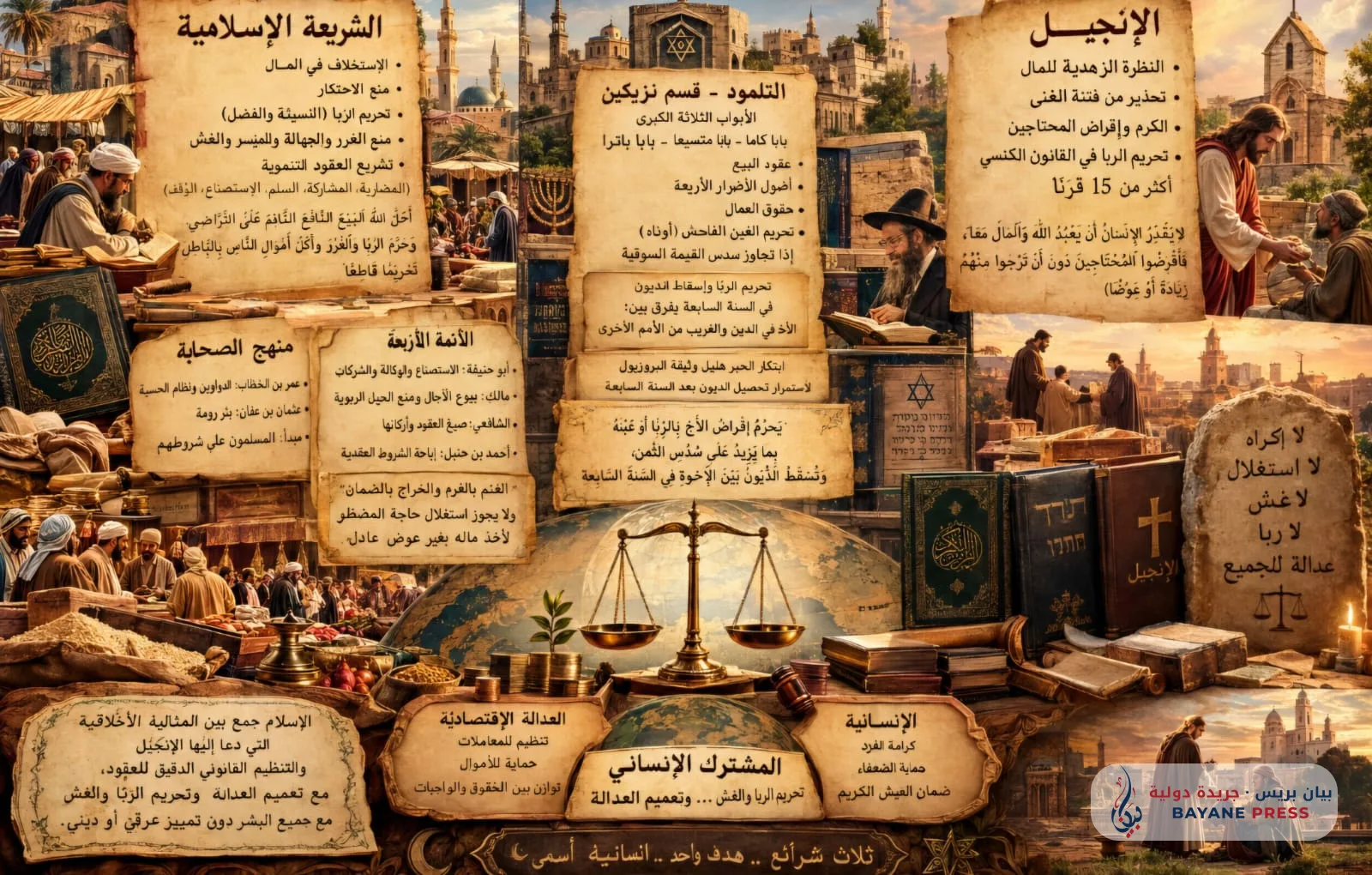
The three Abrahamic religions were not limited to the realm of devotional rituals, but extended to regulate financial and economic transactions, protecting assets from illicit circulation and achieving social justice among societal classes.
In Islamic Sharia, the economy was founded upon the principle of stewardship (istikhlaf) of wealth and the freedom of legitimate ownership, limited by the prohibition of monopoly, the prohibition of usury (riba) in its two forms—riba al-nasi'ah in debts and riba al-fadl in the six usurious commodities which are gold, wheat, barley, dates, and salt—the prohibition of fraud, uncertainty (gharar), gambling (maysir), and deception in sales, as well as the legislation of development contracts such as mudaraba, musharaka, salam, istisna', and charitable waqf; the Quranic texts and prophetic hadiths have consolidated this economic balance into a strict legislative rule:
«God has permitted profitable trade based on mutual consent, and has strictly prohibited usury, gharar, and the wrongful misappropriation of people's wealth»
The companions applied this methodology in the management of markets and the treasury (Bayt al-Mal); thus, Umar ibn al-Khattab (may God be pleased with him) established the diwans and the hisba system to supervise markets and prevent monopoly, Uthman bin Affan donated the Ruma well for the Muslims, and the companions determined in their financial rulings the proverbial principle: «Muslims are bound by their conditions in financial contracts, except for a condition that permits the prohibited or prohibits the permitted».
The four imams grounded the jurisprudence of financial transactions with absolute precision; Abu Hanifa excelled in organizing istisna' contracts, agency, and partnerships, Malik detailed the rules of credit sales and the prevention of usurious loopholes, Shafii regulated contract formulas and their pillars, and Ahmad bin Hanbal expanded the permissibility of contractual conditions, establishing in his great jurisprudential rules: «Gain entails risk and return entails guarantee, and it is not permitted to exploit the need of the needy to take their property without fair compensation».
When comparing with the Talmud in the section of Nezikin—which includes the three major gates of Bava Kamma, Bava Metzia, and Bava Batra—we find detailed financial regulations regarding sales contracts, the four principles of damages, workers' rights, and the prohibition of excessive fraud called ona'ah if it exceeds one-sixth of the market value of the good; however, the Talmud differentiates in the prohibition of usury and the remission of debts in the sabbatical seventh year between the brother in faith and the foreigner of other nations, with the invention by Rabbi Hillel of the legal document Prosbul to continue debt collection after the seventh year, based on the rabbinical interpretation stating: «It is forbidden to lend to a brother with usury or to defraud him by more than a sixth of the price, and debts between brothers are remitted in the seventh year», although the Talmud emphasizes at the same time the prohibition of falsifying scales and the obligation to pay the worker's wages before sunset.
Conversely, the Gospel viewed wealth from an ascetic perspective that warns against the temptation of opulence and the enslavement of wealth over the human heart, calling for absolute generosity and lending to the needy without expecting reward or interest, which laid the foundations for the prohibition of usury in canon law for more than fifteen centuries, proclaiming the decisive evangelical principle: «No one can serve God and wealth at the same time; therefore, lend to the needy without expecting from them increase or compensation». From this it follows that Islam combined the moral idealism called for by the Gospel with the rigorous legal regulation of contracts, generalizing justice and prohibiting usury and fraud to all humanity without ethnic or religious distinction.




Comments (0)
No comments yet. Be the first to react!