


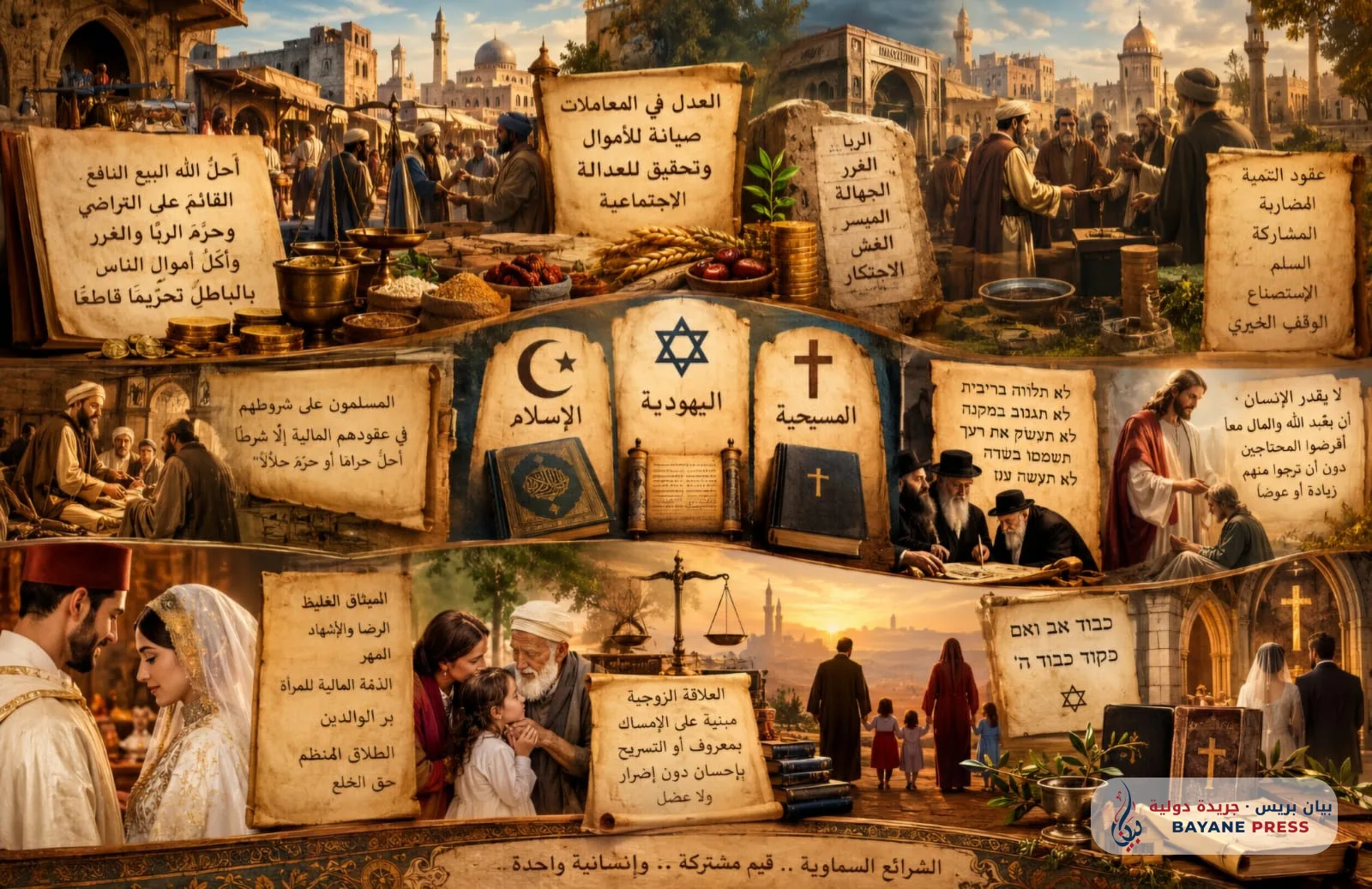
The family is considered the primary nucleus of human society; therefore, the legislative sources of the three religions have given it primordial attention to protect descent, consolidate filial piety, and organize the conjugal relationship on the basis of affection, mercy, and responsibility.
In Islamic legislation, the marriage contract has been described as a solemn covenant, and the Sharia conditioned its validity on consent, the testimony of two upright witnesses, and the exclusive dower for the woman as a symbol of honor. Likewise, it granted women full financial independence, prohibited female infanticide, and regulated inheritances through established mandatory shares (such as half, a quarter, an eighth, two-thirds, one-third, and one-sixth) that no one has the authority to suppress. Similarly, it placed filial piety alongside monotheism and limited divorce to three separate pronouncements, preceded by the arbitration of two family members for reconciliation, while simultaneously granting the woman the right to khul'.
The best of people are those with the best character and the kindest to their families, and women are the sisters of men in dignity, rights, and duties.
The noble companions, such as Umar ibn al-Khattab, Ali ibn Abi Talib, and Zaid ibn Thabit (may God be pleased with them), engaged in family jurisprudence and inheritances, affirming in their traditional rulings:
The woman has her own independent estate and her enshrined right in inheritance and dower; neither the widow nor the virgin may be married without her consent.
The four Imams detailed the rules relating to the family —including proposal, marriage, maintenance, custody, and inheritances— and established strict rules for divorce. Imam Malik, for example, authorized judicial divorce for harm, prolonged absence, or dissension to protect the woman, based on the legal rule established by the four jurists:
The conjugal relationship is based on retaining [the wife] with equity or letting her go with kindness, without causing harm or oppression.
In comparison with the Talmud, in its section Nashim —comprising seven legal treatises, among which Kiddushin, Ketubot, Gittin, and Yebamot stand out—, we observe that marriage in Judaism is contracted through one of three methods: money, document, or cohabitation. It is documented through the Ketubah contract, which guarantees the virgin wife two hundred silver zuzim and the widow one hundred zuzim in the event of divorce or death. Likewise, the Talmud includes the legislation of levirate marriage (Yibbum), which obliges the brother to marry the widow of his deceased brother without descendants, or else to perform the Chalitzah rite (removing the shoe) to exempt him. The Talmud granted the right to dictate divorce through the Get document exclusively to the husband, before Rabbi Gershom, around the year 1000 CE, issued a decree prohibiting polygamy and divorce without the wife's consent among Ashkenazi Jews. Similarly, the Talmud granted the firstborn son a double portion in the inheritance and deprived daughters of it when male children existed, although it obliged the estate to cover their maintenance and dower, strictly emphasizing the veneration of parents in accordance with the rabbinic rule:
Honoring father and mother is equivalent in the balance to honoring the Creator, and the Ketubah contract is a secure bulwark for the wife's financial rights.
On the other hand, in the Gospel, the conjugal bond was elevated to the category of a sacred sacrament in which the spouses become an indissoluble one flesh; polygamy was prohibited, and divorce was strictly restricted, except in the case of adultery, in application of the explicit evangelical legislation:
What God has joined together in the sacred bond of matrimony, let no man put asunder; honor your father and your mother, and love your neighbor as yourself.
Thus, the three legislations coincide in sanctifying the family and magnifying the rights of parents, while Islamic legislation stands out for a realistic flexibility that preserves the sanctity of the conjugal bond, grants the woman her assigned share in the inheritance and her absolute financial independence, and opens the path toward an orderly separation when life together becomes impossible.




Comments (0)
No comments yet. Be the first to react!