


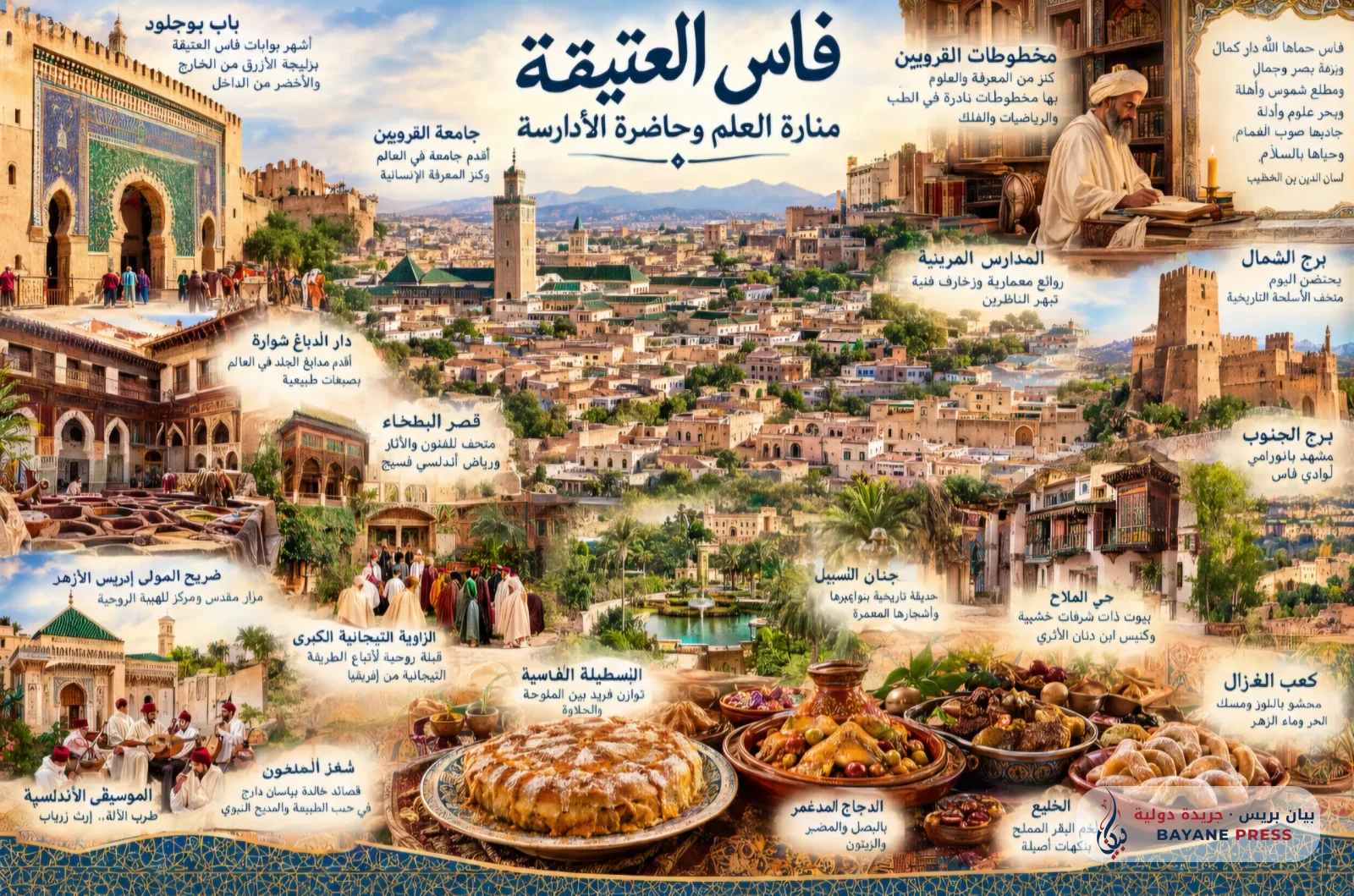
The city of Fes was founded in the year 172 AH (corresponding to the year 789 CE) on the right bank of the Fes River (the Andalusian shore) by the hand of Imam Idris ibn Abdallah, founder of the Idrisid dynasty, thus laying the foundations of the first independent Islamic state in the Extreme Maghreb. Subsequently, his son Idris II continued in the year 192 AH (corresponding to the year 808 CE) with the foundation of the Qarawiyyin shore on the left bank, unifying both halves into a single metropolis that soon grew and expanded thanks to two crucial historical migrations that shaped its civilizational identity: the first, the migration of hundreds of Andalusian families from Córdoba fleeing after the suppression of the suburb revolt; and the second, that of Kairouan families originating from Ifriqiya. Thus, refined Andalusian artistic and architectural taste merged with Kairouan scientific discipline and commercial skills. Through the evolution of the dynasties, and especially during the Marinid era which witnessed the construction of "Fes el-Jdid" in the 7th century AH as an integrated royal and administrative quarter, Fes consolidated itself as the scientific and spiritual capital of the Maghreb, home to scholars, jurists, and nobles, and a bastion of legal policy, protected by hills brimming with springs and the shade of olive groves.
"Fes el-Bali" is considered the largest preserved historical urban complex to this day, completely free of motor vehicles, where a network of narrow alleys intertwines, exceeding nine thousand alleys, encircled by imposing defensive walls pierced by immortal historical gates, crowned by "Bab Bou Jeloud", which captivates the gaze with its double cladding of Fes blue ceramic tiles on its outer face and emerald green on its inner face. At the very heart of this millennial city beats the Al-Qarawiyyin Mosque and University, founded by the wise lady Fatima al-Fihri Umm al-Banin in the year 245 AH (859 CE) and cataloged by UNESCO and the Guinness Book of Records as the oldest continuously degree-granting university institution in the world. Al-Qarawiyyin, with its prized library hoarding rare manuscripts in medicine, mathematics, and astronomy, constituted a sanctuary from which great thinkers of humanity drank, such as Ibn Khaldun, Averroes, Maimonides, Ibn al-Khatib, and Pope Sylvester II (Gerbert of Aurillac), who introduced Arabic numerals to Europe. Around Al-Qarawiyyin are scattered the sumptuous Marinid madrassas: the Bou Inania madrassa astounds observers with the mastery of its wooden lattices, its checkered tiles, and its historic wall hydraulic clock (Dar al-Magana); next to it stands the Al-Attarine madrassa with its symmetrical arcades, the Al-Saffarin madrassa—considered the first of the Marinid madrassas—and the As-Sahrij madrassa with its serene rectangular pool.
Fes overflows with other secular monuments such as the "Funduq al-Najjarin", built in the 18th century CE to serve as a caravanserai for merchants of precious goods, standing today as a museum of traditional woodworking arts with its sculpted ceiling and mosaic-tiled fountain; and the El Batha Palace, built in the Hispano-Moresque style, transformed into a museum of arts and antiques and a spacious Andalusian riad. On the outskirts of the city stand the defensive fortresses erected by the Saadians, such as "Borj Nord", which today houses the museum of historical weapons, and "Borj Sud", which commands a panoramic view of the Fes valley. The city also preserves its legendary artisanal activity in the "Chouara Tanneries", the oldest tanneries in the world, with their circular stone pits using purely natural raw materials such as saffron, pomegranate peels, and indigo to dye goat and cattle leather, in addition to the historical garden of "Jnan Sbil" with its admirable waterwheels and centuries-old trees, and the "El Mellah" neighborhood with its characteristic wooden and iron balcony houses and the historic "Danan" synagogue, dating back to the 17th century.
Fes captivated the hearts of travelers and chroniclers; Ibn al-Khatib wrote about it in *Nafadhat al-Jirab*, stating:
"Fes—may God protect it—is a dwelling of perfection, a delight to the gaze and beauty, a dawn of suns and crescent moons, a sea of sciences and evidences; may the downpours of the clouds water it and greet it with peace."
The historian Abd al-Rahman ibn Khaldun stated in his *Muqaddima* that Fes had reached the pinnacle of urban civilization and refinement, describing the precision in the division of its souks and the prosperity of its industries. The French orientalist and novelist Pierre Loti wrote in his work *Morocco*, describing his entry into the alleys of ancient Fes as a penetration into the depths of a static Middle Ages immune to the roars of modernity, fascinated by the closed wooden doors concealing behind them riads through which crystal-clear waters flow. Meanwhile, the Swiss Muslim thinker Titus Burckhardt devoted much of his life to studying the spirit of Fes in his work *Fes: City of Islam*, considering it the most complete living model of the medieval Islamic city, embodying the unity between spiritual faith, artisanal architecture, and the daily practice of life.
Fes hosts the mausoleum of its founder, the monarch Moulay Idris II, which constitutes a sacred sanctuary and a center of spiritual prestige. Likewise, within its bosom sits the "Great Zawiya Tijani", founded by Sheikh Ahmed al-Tijani, which makes Fes an annual spiritual magnet for hundreds of thousands of visitors and devotees coming from sub-Saharan African countries such as Senegal, Nigeria, and Mali, reinforcing the Kingdom's African spiritual projection. This spiritual singularity is accompanied by ancestral traditions in the art of Andalusian music (*Tarb al-Ala*), with its modes and *nubas* inherited from Ziryab, besides being the bastion of the great poets of *Malhûn*, who composed the most exquisite poems dedicated to the love of nature, prophetic praise, and the arcana of divine love in an eloquent vernacular tongue.
The mastery of Moroccan gastronomy in Fes reaches the peak of luxury and virtuosity. The "Fassi Pastilla" is its universal ambassador par excellence: a refined Andalusian dish that fuses the savory and the sweet in a fascinating chemical balance, where thin and fragile *warqa* dough sheets are handmade and layered to enclose a rich filling of squab or tender chicken cooked with white onion, pure saffron, ginger, turmeric, and a tied bouquet of cilantro and parsley. Subsequently, the concentrated broth is bound with fresh farm eggs until achieving a velvety and consistent texture, to which is added a generous layer of blanched almonds, fried in oil and coarsely crushed with powdered sugar, stick cinnamon, and a touch of artisanally distilled orange blossom water. It is baked until it acquires a brilliant golden tone and decorated with a geometric lattice of ground cinnamon and confectioner's sugar. Alongside it, Fassi cuisine stands out for the preparation of *Jli'a*, where cured beef (*qadid*) is seasoned with dry cilantro, cumin, garlic, and salt, dried under the sun of the Saïss plain, and subsequently cooked for hours in a mixture of kidney fat and olive oil until its water evaporates completely, preserved in clay jars to be consumed with eggs in the morning. This banquet is crowned with the tagines of "*daghmar* chicken" with onion, preserved lemon, and olives, and the "gazelle horns" pastries filled with almond paste flavored with mastic and kneaded with orange blossom water, wrapped in a layer of ultra-thin dough chased with traditional pincers (*mnqach*).
Comments (0)
No comments yet. Be the first to react!