


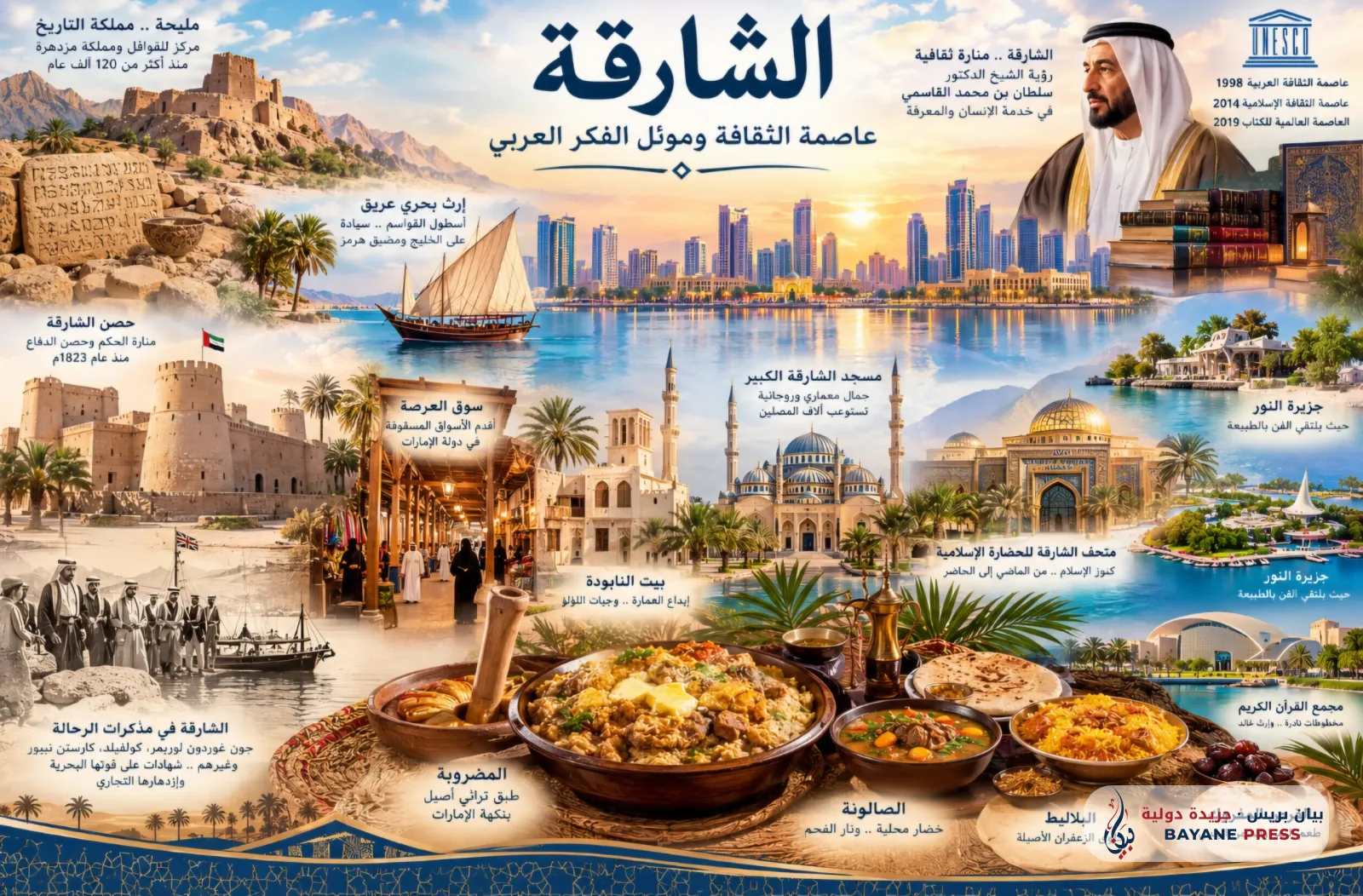
Sharjah possesses a rich civilizational heritage dating back more than 120,000 years, as attested by archaeological discoveries in Jebel Faya and the historic region of "Mleiha," which served as a caravan hub and a prosperous kingdom where writing in South Arabian and Aramaic alphabets flourished, alongside coin minting in the 3rd century BCE. Sharjah's name was linked in early Portuguese and Dutch sources as one of the most important regional ports. Since the 18th century, it has been ruled by illustrious sovereigns of the "Qawasim" dynasty, who built a vast maritime and commercial empire extending their influence over the Strait of Hormuz, the coasts of the Persian Gulf, and the Arabian Sea, boasting a colossal naval fleet that rivaled major maritime powers and fought heroic battles in defense of Arab water sovereignty against the armadas of the British East India Company. Thanks to the pioneering cultural vision of its ruler, His Highness Sheikh Dr. Sultan bin Muhammad Al Qasimi, who made arts, letters, and sciences the foundations of human development, Sharjah was crowned by UNESCO as the Arab Cultural Capital in 1998, the Capital of Islamic Culture in 2014, and the World Book Capital in 2019, preserving its Islamic authenticity and unique heritage fabric.
Sharjah stands as an oasis of museums and human heritage preservation, whose heart beats in the historic "Heart of Sharjah" district, one of the most ambitious architectural restoration projects in the region. There stands the imposing "Sharjah Fort," built in 1823 with coral stone and marine rock to serve as the seat of government and an impregnable defensive bastion, notable for its three towers: Al Mahras, Al Makbous, and the circular tower. The heritage zone houses the "Al Arsah Souq," the oldest covered wooden market with coral alleys in the United Arab Emirates, which historically served as a meeting point for pearl merchants and desert woodcutters. Nearby lies "Beit Al Naboodah," embodying the ultimate expression of mastery in pearl merchant house architecture, with its sculpted stucco columns and spacious courtyards cooled by the natural movement of the wind. The city also shines with the "Sharjah Mosque," featuring magnificent Moorish and Ottoman facades with a capacity for thousands of worshipers; the "Sharjah Museum of Islamic Culture," located in the historic Al Majarrah souq, with its golden dome decorated with mosaics and rare collections of Qurans, astrolabes, and Islamic coins; "Noor Island," which fuses contemporary architectural art with the beauty of tropical nature; and the headquarters of the "Holy Quran Complex," housing priceless manuscripts from every corner of the globe.
Sharjah has been repeatedly mentioned in travelers' chronicles, orientalist works, and records of British officials. John Gordon Lorimer, in his work "Guide to the Gulf," described it as the royal capital, the largest demographic and commercial center of the entire Trucial Coast during the 19th century, documenting the expansion of its markets, the diversity of its industries, and its status as the seat of the British political agent. British Lieutenant Caulfield, in his campaign reports during the 1809 expedition, highlighted the prestige of the Qawasim, their naval valor, and their strict defensive organization around the creek and the town. Likewise, the Danish traveler and orientalist Carsten Niebuhr recorded it in his maps and publications in the second half of the 18th century, highlighting its naval power and political independence. In the modern era, Sharjah has won the admiration of European thinkers and orientalists for its extraordinary interest in historical documentation and the preservation of rare manuscripts and documents, published by Dr. Sultan Al Qasimi in his profound research and historical works that have debunked colonial fallacies.
The civilizational wealth of Sharjah is reflected in the precision of its traditional cuisine, spearheaded by the iconic dish of "Al Madrouba." This is a heritage, dense, and nourishing dish prepared by cooking pieces of chicken, tender beef, or dried fish with abundant amounts of oats or crushed wheat and rice, to which exact proportions of fresh tomatoes, caramelized onions, garlic, green cilantro, chili peppers, and the aromatic Emirati spice blend "Bazar" are added, releasing fragrances of cardamom, cinnamon, and powdered dried black lemons. The preparation is left to simmer on very low heat for hours with constant stirring until the meat fibers break down and blend with the grains; then, the mixture is beaten with a wide traditional wooden tool called "Al Masdama" or stirrer until it acquires a smooth, compact, and thick porridge-like consistency. It is served in wide platters, decorated on the surface with a generous spoonful of melted clarified butter, to be eaten hot with the hands. Sharjah is equally famous for its local vegetable "Salona" cooked over firewood, the sweet "Balaleet" with pure saffron, and the crunchy bread "Al Qars Al Mafrouk," made from whole wheat flour kneaded with dates and pure butter.
Comments (0)
No comments yet. Be the first to react!