

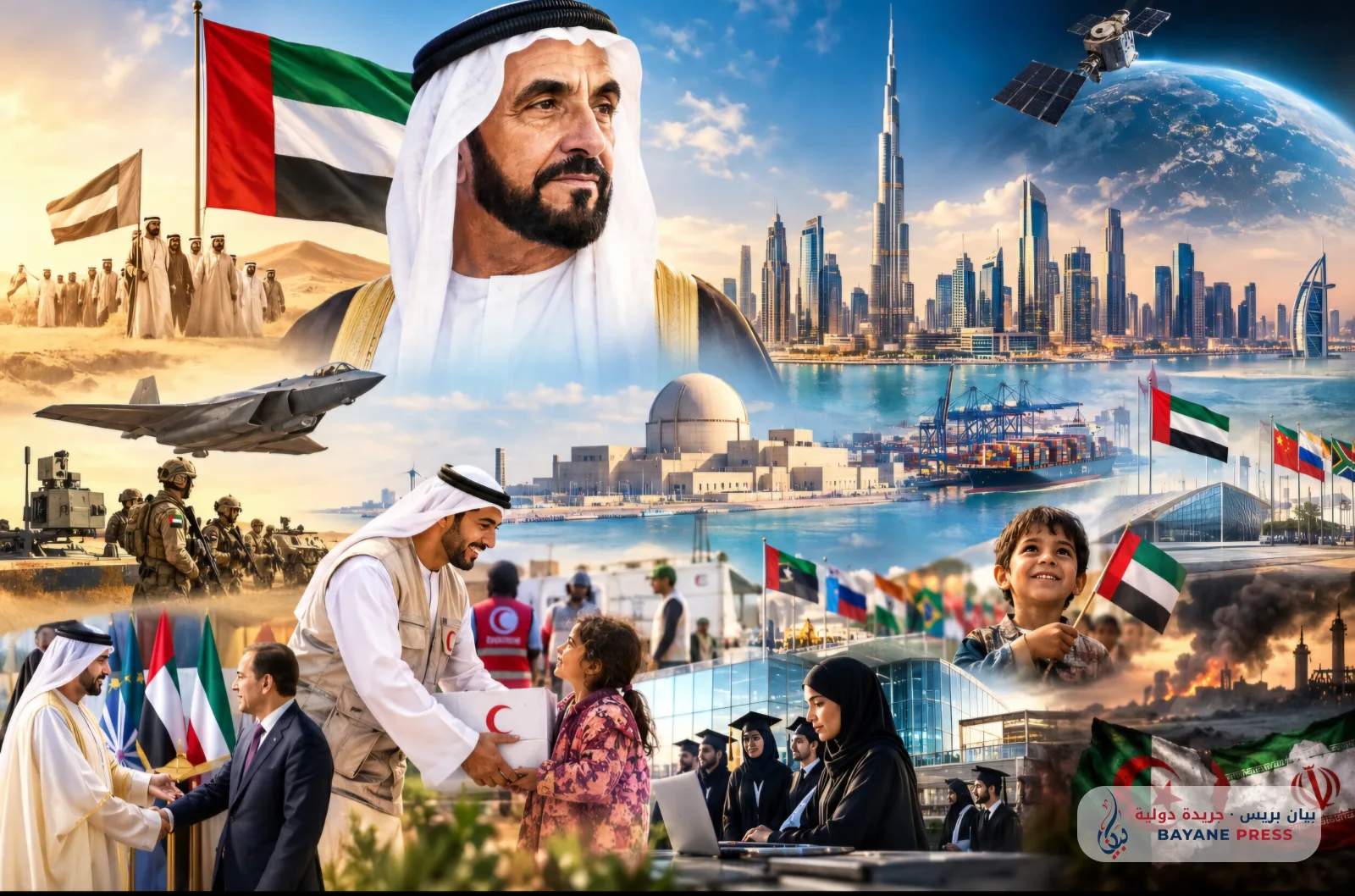
When Sheikh Zayed bin Sultan Al Nahyan, may God rest his soul in peace, along with his brother Sheikh Rashid bin Saeed Al Maktoum and the other rulers of the Emirates, proclaimed the establishment of the United Arab Emirates on December 2, 1971, not even the most optimistic in orientalist and Western research centers expected this nascent union to survive long in a hostile desert environment and a region plagued by geopolitical conflicts. However, the firm political will possessed by the founding fathers transformed the desert sands into one of the greatest experiences of development and civilizational construction in contemporary history. Sheikh Zayed understood from the very first moment that oil wealth was not an end in itself, but a means to build the human being, establish infrastructure, and consolidate the state of institutions and law. Thus, in a few decades, the country transitioned from an economy based on pearl fishing and simple trade into a major economic, technological, and industrial power that tops global competitiveness indices and leads the transition towards the knowledge economy through the development of sovereign artificial intelligence models like "Falcon", the operation of the first peaceful nuclear energy plant in the Arab world in "Barakah", and deep space exploration through the "Hope Probe", in parallel with the construction of an advanced military shield and the localization of advanced defense industries through the "EDGE" group, which has become one of the twenty-five largest military manufacturers in the world. Thus, the Emirati experience in Abu Dhabi, Dubai, and the rest of the emirates has become a role model on how to master geography and forge the future.
This comprehensive renaissance was not isolated from a prudent diplomatic vision that made the voice of the Emirates heard and respected in all international forums. The Emirati leadership—from the era of the foundation, through the empowerment stage during the tenure of the late Sheikh Khalifa bin Zayed, to the strategic leadership of Sheikh Mohamed bin Zayed Al Nahyan—succeeded in transforming the country from a mere energy provider into a vital and indispensable node in the global economic system. Emirati sovereign wealth funds, headed by the Abu Dhabi Investment Authority (ADIA), Mubadala, ADQ, and the Dubai Corporation for Investments (ICD), manage assets close to two trillion dollars across all continents of the world, while national companies such as "DP World" and "Abu Dhabi Ports Group" control more than ten percent of global container movement and supply chains, making the security and stability of the Emirates an inseparable part of international economic security. Abu Dhabi has invested this financial and logistical weight in formulating a political doctrine based on strategic equilibrium and building partnerships that transcend sharp polarizations, managing to join the "BRICS" block alongside China, Russia, and India, while maintaining a close defense and technology partnership with the United States and the West. This has allowed it to become a capital for complex international mediations, such as its repeated success in carrying out prisoner exchanges between Russia and Ukraine, its hosting of the global climate summit, its sponsorship of the Human Fraternity Document that brought together the Grand Imam of Al-Azhar and the Pope on its territory, in addition to constantly leading globally as the largest donor of humanitarian and developmental aid in proportion to its gross domestic product, without religious, ethnic, or political distinction.
However, this prestigious position, accompanied by open hands to succor peoples and support the stability of nations, encountered—in a flagrant historical paradox—campaigns of political hostility by the Algerian regime, and military and security aggressions by the Iranian regime and its regional proxies, despite the noble stances towards the Algerian and Iranian peoples held in the historical archive. In the Algerian section, historical records document that the relationship between the two countries was founded on sincere solidarity from before the creation of the federation, when Sheikh Zayed bin Sultan supported the Algerian liberation revolution morally and materially. When Algeria gained independence, close fraternal relations united Sheikh Zayed with the late President Houari Boumediene, and later with Chadli Bendjedid, which reached their climax at the Arab summit in Algiers in November 1973, being the first Arab summit attended by Sheikh Zayed after the founding of the federation. There, the strategic oil alliance between Abu Dhabi and Algeria was consolidated after the October War, where the Emirates injected their funds and political weight to support the Arab front, and Sheikh Zayed reiterated his famous phrase that Arab oil is not more valuable than Arab blood. This support did not stop in the foundational era, but extended to the darkest circumstances that Algeria went through during the so-called "Black Decade" in the 1990s, as the Emirates refused to participate in the international isolation of Algeria and insisted on supporting its stability. Subsequently, Emirati investments flowed with billions of dollars during the new millennium to modernize Algerian infrastructure; "DP World" developed the ports of Algiers and Djen Djen, the giant tourist project "Dunya Park" was launched, and the partnerships of "Mubadala" and "Aabar" companies expanded in the energy and industrial sectors, opening thousands of employment opportunities for Algerian youth and transferring the latest administrative expertise to the Algerian market.
However, this legacy full of affection was met in recent years with unprecedented official and media ingratitude from Algeria, translated into retaliatory measures that harmed the Algerian economy itself by rescinding port contracts and freezing investment projects, reaching the point where the Algerian presidency and its High Security Council deviated from diplomatic norms in 2023 and 2024 by issuing official statements accusing the Emirates of hostile acts without presenting a single material proof. The real reasons behind this hostility lie in geopolitical shifts and the inability of the ruling system in Algeria to keep pace with regional transformations. Among these reasons stands out the firm and historical stance of the Emirates supporting the full sovereignty of the Kingdom of Morocco over its Sahara, a stance that Abu Dhabi translated practically by becoming the first Arab country to inaugurate a consulate general in the city of Laayoune in the Moroccan Sahara in November 2020, which was considered by Algeria as a devastating blow to its separatist thesis. To this is added the participation of Emirati sovereign wealth funds in financing and supporting the major strategic projects led by Morocco on the African continent, at the forefront of which is the Nigeria-Morocco gas pipeline project, and the Royal Atlantic Initiative to enable landlocked African Sahel countries to access the ocean, major development projects that the Algerian regime considers a threat to its traditional monopoly on the gas market towards Europe and a diminishment of its influence in the Sahel, Mauritania, and Libya. Furthermore, there is a radical divergence between the Emirati approach, based on modernization and economic integration, and the approach of the Algerian regime, which remains imprisoned by Cold War slogans and constantly needs to manufacture an external enemy to justify its development failures and export its internal crises. This was answered by the Emirati side with the doctrine of "strategic silence" and a diplomatic high-mindedness that distinguishes between the fraternal Algerian people and transient political practices.
On the other hand, on the eastern shore of the Arabian Gulf, the record of relations between the UAE and Iran embodies the highest degrees of self-control and humanitarian nobility in the face of ideological expansion. Ever since Iran proceeded to occupy the three Emirati islands—Greater Tunb, Lesser Tunb, and Abu Musa—on November 30, 1971, barely two days before the announcement of the federation, and the fall of the first martyr in the modern history of the UAE, the policeman Salem Suhail Khamis Al-Dahmani, who was martyred defending the national flag on the island of Greater Tunb against the Iranian military landing, the Emirates demonstrated that they paid the blood tax in defense of their land. Nevertheless, Sheikh Zayed and his successors opted for state wisdom rather than the recklessness of adventures, clinging for more than five decades to the sovereign right of the UAE through peaceful channels, bilateral negotiations, or resorting to the International Court of Justice. Moreover, Abu Dhabi systematically refused to allow its territory or airspace to be used as a platform for any military action against Iran. Despite this open sovereignty wound, the Emirates—particularly through the ports of Dubai—remained the only economic and commercial lung for the Iranian people, as non-oil trade exchange between the two countries exceeded the barrier of twenty billion dollars annually in several periods, preventing a collapse in the living conditions of the Iranian people under the weight of Western sanctions, while welcoming hundreds of thousands of Iranians living and working with dignity and security in the country. The humanitarian archive records with golden letters that the Emirates Red Crescent was the first to arrive to succor Iranian victims after the devastating earthquake in the city of Bam in 2003. Likewise, the Emirates sent urgent aid worth tens of millions to rescue those affected by the catastrophic floods in the Iranian provinces of Lorestan and Khuzestan in 2019, at the height of political tension. When the COVID-19 pandemic broke out in early 2020 and the Iranian health sector collapsed, the Emirates established a medical air bridge under the direct directives of Sheikh Mohamed bin Zayed Al Nahyan to supply the Iranian people with tons of medical aid, followed by the return of its ambassador to Tehran in 2022 to consolidate the principle of "zeroing problems" and prioritizing geographical neighborhood.
However, the Iranian regime and its militia arms reciprocated this extended hand with treachery and aggression. Emirati territorial waters and vital interests suffered sabotage operations directed against oil tankers off Fujairah in 2019, followed by attacks on civil facilities in the heart of Abu Dhabi in early 2022 using drones and missiles launched by the Iran-backed Houthi group, culminating in constant threats to the security of navigation and the Gulf. The real secret behind this Iranian aggression is due to two main factors: the first, political and military, related to the decisive role of the Emirates within the Arab coalition in Yemen to thwart the Iranian project aimed at controlling the Bab el-Mandeb strait and besieging the Arabian Peninsula; and the second, a deeper ideological and civilizational one, as the State of the United Arab Emirates, with its economic success, religious tolerance, and the well-being of its citizens and residents, represents the exact opposite of the project of "Velayat-e Faqih" (Guardianship of the Islamic Jurist), which has produced for its people and the region nothing but sanctions, militias, and acute subsistence crises. The existence of a modern and prosperous Arab state on the opposite shore of the Gulf lays bare the bankruptcy of the Iranian revolutionary discourse before its own people, who are avid for a dignified life; therefore, Tehran and its proxies have attempted to strike at the security and stability reputation that constitutes the cornerstone of the Emirati economic miracle.
A careful reading of the history of the United Arab Emirates and the stances of its rulers demonstrates that this country has not built its glory on convulsed reactions or populist slogans, but has erected it on a strategic vision that combines a deterrent military force protecting national sovereignty and development achievements, with a political dream and humanitarian generosity that does not expect thanks or change its principles according to the political moods of regimes. While Abu Dhabi continues to consolidate its position as a key and irreplaceable piece in the equation of international economy, technology, and politics, Algerian media campaigns and Iranian aggressions remain mere storms crashing against the rock of an internally cohesive state, shielded by a network of major international alliances and convinced that history does not immortalize bearers of empty slogans or exporters of crises, but writes its brightest chapters for those who build homelands and create hope for all humanity.
Comments (0)
No comments yet. Be the first to react!