


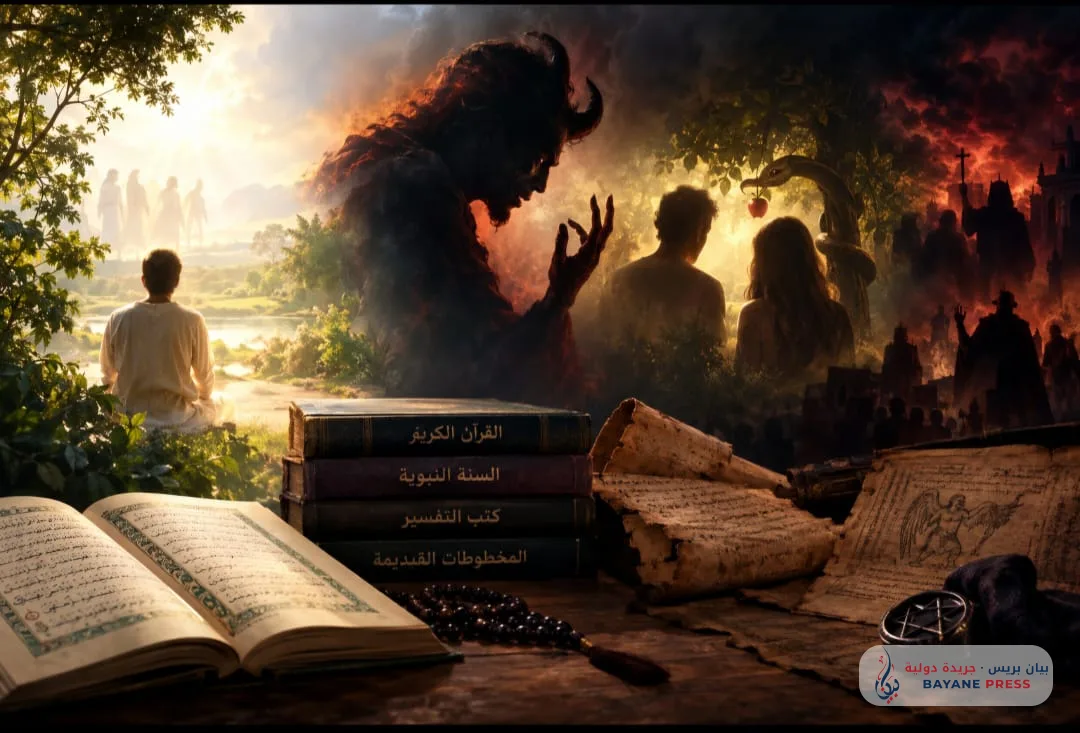
The story of Iblis is not merely the account of a creature that disobeyed God's command, nor is it simply a narrative about an ancient enmity between Satan and human beings; it is a profound tale where questions of existence, will, pride, freedom, responsibility, and destiny intertwine. From the moment Iblis refused to prostrate himself before Adam —peace be upon him—, he declared his enmity toward humanity, and the chapters of seduction, whispering, and beautification began. These chapters repeat themselves in the lives of human beings every day, whether in the form of hidden arrogance, unbridled desire, deliberate injustice, or despair before God's mercy.
However, investigating the story of Iblis from its beginning to its end requires distinguishing between what is mentioned in the glorious Quran, what is authenticated from the Prophet Muhammad —may God's peace and blessings be upon him—, what is transmitted by books of exegesis and chronicles of former nations, and what appears in Jewish, Christian, and ancient manuscript texts. These sources do not hold the same authority, and it is incorrect to transform popular tales or stories attributed to jinn and demons into religious truths simply because they are ancient or appear in an archaeological manuscript.
The first truth that must be established is that the Holy Quran does not mention the date of birth of Iblis, nor the names of his father and mother, nor his exact age, nor the place where he grew up, nor the details of his life before the creation of Adam. Therefore, whoever narrates these details as categorical truths goes beyond what Islamic texts establish. Nevertheless, the Quran and Sunnah reveal the origin of his creation, the reality of his disobedience, the motives for his rebellion, the methods he uses to seduce human beings, and his destiny in the afterlife, just as ancient texts provide us with important material to understand the evolution of Satan's image in religious tradition over the centuries.
The Holy Quran establishes that Iblis belongs to the jinn, and that the jinn were created from fire. The Almighty says: ﴿And We created the jinn before from scorching fire﴾ [Quran, Al-Hijr: 27]. And the Almighty says, recounting the words of Iblis: ﴿You created me from fire and created him from clay﴾ [Quran, Al-A'raf: 12]. The Quran confirms the nature of Iblis by stating: ﴿Except for Iblis, who was of the jinn and disobeyed the command of his Lord﴾ [Quran, Al-Kahf: 50].
This verse is one of the clearest texts explaining the true nature of Iblis, even though scholars have debated how his presence among the angels was when the command to prostrate before Adam was issued and how he came to be included in that command. As for the claim that he was an angel and later transformed into another genus, it is not supported by any explicit Quranic text; rather, the apparent meaning of the aforementioned verse establishes that he was of the jinn.
But when was Iblis born? Who were his father and mother? Did he have another name before being called Iblis? These are questions raised by books of exegesis and narratives, although the Quran and authentic Sunnah do not offer a definitive answer. Some traditional books mention the names "Al-Harith" and "Azazel", and transmit accounts regarding the worship of Iblis in remote times or his status among the angels; however, these narratives vary in their chains of transmission and it is not permissible to assert categorically that one of those names was his original one or that the details of his origins were authenticated by the Prophet —may God's peace and blessings be upon him—.
Likewise, stories spread concerning the parents of Iblis, his wife, and his children, assigning specific names to each of them and predetermined functions in the seduction of human beings. However, the Quran does not detail these particulars, but rather refers to his offspring in the words of the Almighty: ﴿Then will you take him and his descendants as allies other than Me while they are your enemies?﴾ [Quran, Al-Kahf: 50]. As for the names of his offspring and the details of their lives, they should not be presented as established truths without accredited evidence.
Some books of exegesis recount that Iblis attained an elevated position due to the abundance of his worship and that he was extremely diligent in obedience, but that pride corrupted him when he considered himself superior to Adam. These accounts hold an admonitory significance, but they do not become historical truths simply by circulating. The principal moral is firmly established in the Quran itself: Iblis rejected God's command and then justified his refusal by comparing his own origin of creation with the origin of Adam's creation.
When God created Adam —peace be upon him—, He informed the angels that He was going to place a khalif (successor) on earth, as mentioned in Surah Al-Baqarah; then He taught Adam the names and showed him what He had granted him of knowledge. After that, He commanded the angels to prostrate before Adam as a prostration of honor and submission to God's command, not as a prostration of worship, for worship is directed only to God, praised be He.
God, the Almighty, says: ﴿And when We said to the angels, "Prostrate before Adam," they prostrated, except for Iblis. He refused and was arrogant and became of the disbelievers﴾ [Quran, Al-Baqarah: 34].
And in Surah Al-A'raf, the Quran reveals the argument presented by Iblis to justify his stance when he said: ﴿I am better than him. You created me from fire and created him from clay﴾ [Quran, Al-A'raf: 12].
Here arises one of the most important rules for understanding the personality of Iblis: he turned the difference in the origin of creation into a criterion for judging value, and believed that the material from which he was created granted him the right to reject the divine command. His argument was not proof of superiority, but a fallacious syllogism in which he made fire evidence of preeminence and clay evidence of deficiency, ignoring that God is the Best Knower of His creation and that true nobility is not determined by the material of which a creature is composed, but by what God determines through His wisdom.
His error was not simply ignorance of the command, but arrogance before submission. His objection was not a fleeting slip followed by repentance, but transformed into a permanent stance toward the human being whom God honored. Here manifests the difference between one who commits an error, acknowledges it, and seeks to amend it, and one who clings to his error and seeks justifications that protect his vanity.
From the set of verses, it is inferred that Iblis was among the assembly addressed by the command to prostrate, but the Quran explicitly declares in Surah Al-Kahf that he was of the jinn. Scholars have debated the nature of his presence among the angels before his disobedience; however, the chronicles determining his previous rank, the number of years he spent in worship, or the names of his offices in heaven do not reach a uniform degree of authenticity. Modern academic studies have addressed this matter, clarifying the various Islamic readings and the evolution of the image of Iblis in religious tradition.
Following his refusal, the divine decree came down to expel him from the position he occupied. The Almighty says: ﴿He said, "Descend from it [Paradise], for it is not for you to be arrogant therein. So get out; indeed, you are of the humiliated"﴾ [Quran, Al-A'raf: 13]. But Iblis did not stop at disobedience nor did he retract his stance, but rather asked for respite until the Day of Resurrection. The Almighty said: ﴿He said, "Reprieve me until the Day they are resurrected." [God] said, "Indeed, you are of those reprieved"﴾ [Quran, Al-A'raf: 14-15].
The respite granted to Iblis does not signify God's complacency with his action, nor does it indicate that he possesses a power that competes with that of the Creator; rather, it unfolds in accordance with God's will and wisdom. Iblis is a limited creature, nothing escapes God's dominion, and he cannot impose his seduction upon a human being against their will.
Instead of repenting for his error, Iblis proclaimed his purpose to seduce the children of Adam. The Almighty says, quoting his words: ﴿He said, "Because You have put me in error, I will surely sit in wait for them on Your straight path. Then I will come to them from before them and from behind them and on their right and on their left, and You will not find most of them grateful [to You]"﴾ [Quran, Al-A'raf: 16-17].
This declaration reveals the transformation of Iblis from one who disobeyed into an adversary who deliberately seeks to lead others astray. His concern was no longer merely to save himself, but he wanted to drag the human being into sin and make their downfall a means to prove that man, despite having been honored, can also go astray. And he announces that he will lie in wait for human beings on their straight path, which means that attempts at seduction are not limited to the negligent and those far from religion, but can target those who strive for obedience, attempting to corrupt their intention, introduce vanity into their hearts, or turn their worship into a means to boast before others.
Nevertheless, the Quran does not present Iblis as a force equal to God nor as His peer, but emphasizes that Satan has no absolute power over the sincere servants of God. The Almighty says: ﴿Indeed, over My servants you will have no power, except for those who follow you of the deviators﴾ [Quran, Al-Hijr: 42]. This verse constitutes a fundamental key to understanding the entire story: Satan can incite sin and beautify it, but he does not nullify human responsibility nor rob man of his capacity of choice.
Next, Iblis moved on to his first practical experience of seduction, which took place with Adam and his wife in Paradise. This event reveals that his principal weapon is not material force, but the ability to present error under the guise of benefit, disobedience as salvation, and yielding to desire as an unrepeatable opportunity.
God, the Almighty, says in Surah Ta-Ha: ﴿Then Satan whispered to him; he said, "O Adam, shall I direct you to the tree of eternity and dominion that will not deteriorate?"﴾ [Quran, Ta-Ha: 120]. Iblis targeted two deeply rooted desires in the human psyche: permanence and immortality, and power that does not vanish. He did not appear before Adam in the form of an enemy wishing his destruction, but as someone offering him a secret to make his desire to endure a reality.
And in Surah Al-A'raf, the Quran adds another detail when the Almighty says: ﴿And he swore [by Allah] to them, "Indeed, I am to you from among the sincere advisors"﴾ [Quran, Al-A'raf: 21]. Iblis resorted to an oath to confer upon his words the appearance of advice. This is one of the most dangerous methods of seduction: that he who desires your ruin speaks in the language of one seeking to save you, clothing deception in the garment of solicitude and making falsehood appear as knowledge that others ignore.
The verses clarify that Adam and his wife ate from the tree that had been forbidden to them, whereupon their private parts became apparent to them, and they began to fasten together leaves from Paradise to cover themselves. However, the Quranic narrative does not conclude with their fall into error; for the Almighty says: ﴿Then his Lord chose him and turned to him in forgiveness and guided [him]﴾ [Quran, Ta-Ha: 122].
Here manifests the decisive comparison between Adam and Iblis: Adam committed an error and then repented, whereas Iblis disobeyed and clung to his justification. The lesson is not that a human being never commits errors, but that they know how to face their error—whether they repent and amend, or turn disobedience into a stance they defend.
It is important not to attribute to the Quran details that it does not mention. The Quran does not call the tree of Paradise an apple, nor does it make Eve the sole cause of the fall, but speaks of Satan's whispering to both of them. The Almighty says: ﴿And Satan whispered to them﴾ [Quran, Al-A'raf: 20]. This highlights their shared responsibility in the choice, unlike some ancient religious narratives that placed a greater responsibility for the fall upon woman.
Ever since that event, Satan became a declared enemy of the human being, not because he can compel them to every act, but because he attempts to push them to renounce their moral discernment. Seduction perhaps does not begin by demanding a grave crime, but with a small step, making the next step seem less dangerous, until the individual finds themselves on a path they never imagined treading.
The narrative expands in the Quran to reveal that seduction can stem both from demons among the jinn and among men. The Almighty says: ﴿And thus have We made for every prophet an enemy - devils from mankind and jinn, inspiring one another with decorative speech in delusion﴾ [Quran, Al-An'am: 112]. This text is of utmost importance because it links seduction with what human beings themselves manufacture when they spread lies, beautify injustice, turn corruption into a habitual practice, or use beautiful language to conceal perverse intentions.
Therefore, not every evil in the world is a supernatural event, and not every human being who commits an error is guaranteed to have had a specific demon order it. Rather, the Quran informs us about whispering, seduction, and beautification, about human beings who assume responsibility for their choices, and about a social environment that can help evil spread when deceptive speech becomes more attractive than the truth.
As for the methods of Iblis in seducing the human being, they can be understood from Quranic and prophetic texts as an integrated system. The first of them is whispering (al-waswasah), which consists of casting thoughts and instigating doubts and internal conflicts. The Almighty says: ﴿From the evil of the retreating whisperer - Who whispers [evil] into the breasts of mankind﴾ [Quran, An-Nas: 4-5]. Scholars have interpreted the retreating whisperer (al-jannas) as one who retreats and conceals himself, and among the meanings of this is that he whispers and then withdraws when God is mentioned.
This does not mean that every evil thought is proof of corrupted faith, nor that every fleeting question or doubt should frighten the believer. Abu Hurairah —may God be pleased with him— reported that the Prophet —may God's peace and blessings be upon him— explained how Satan persists with a man in questioning until he ends up asking: "Who created God?", and advised seeking refuge in God and stopping to continue down that path. This hadith is recorded in Sahih Muslim, in the Book of Faith. The purpose here is not to prohibit scientific inquiry or sincere questioning, but to warn against exhausting persistence in endless whispers that exhaust the spirit.
The second method of seduction is beautification. Satan does not always present evil with its repulsive face; rather, he adorns it so that it appears desirable. The Almighty says: ﴿And Satan made their deeds pleasing to them﴾ [Quran, An-Nahl: 63]. This can manifest in illicit money when presented as a quick path to wealth, in revenge when it appears as a recovery of dignity, in backbiting (gossip) when exposed as a revelation of truth, or in arrogance when the one afflicted by it imagines it to be a display of personal strength and confidence. What unites these images is that the individual does not see the action as it is, but through the desire driving them.
The third is false promises. Iblis promised Adam immortality and a dominion that does not deteriorate, and the matter concluded with their expulsion from Paradise. In another passage, the Quran says: ﴿Satan promises them and arouses desire in them. But Satan does not promise them except delusion﴾ [Quran, An-Nisa: 120]. The human being may sacrifice a firm principle for an imagined benefit, only to discover later that the promise was greater than reality and that immediate gain brought along long-term loss.
rThe fourth is intimidation and discouragement. Satan may push the human being into sin by tempting them, and then attempt to prevent their repentance by persuading them that their faults are too great to be forgiven. This is why despair before God's mercy constitutes a dangerous door. The Almighty says: ﴿Say, "O My servants who have transgressed against themselves [by sinning], do not despair of the mercy of Allah"﴾ [Quran, Az-Zumar: 53]. The goal of seduction is not always solely to push the human being to commit sin, but also to convince them that return is no longer possible, so that they persist in error instead of beginning to amend their life.
The fifth is stoking enmity among people. The Almighty says: ﴿Satan only wants to cause between you animosity and hatred﴾ [Quran, Al-Ma'idah: 91]. This method can manifest in family disputes, estrangement, hasty accusations, the instigation of discord, and the magnification of small errors until they turn into prolonged enmities. This does not mean that every disagreement has its origin in Satan —since divergences can also arise from real psychological and social causes—, but the text warns against exploiting these to feed resentment and widen the breach.
The sixth is disruption in worship. Uthman ibn Abi al-As —may God be pleased with him— complained to the Messenger of God —may God's peace and blessings be upon him— that Satan was coming between him and his prayer and recitation, confusing him; whereupon the Prophet instructed him to seek refuge in God from him. This was transmitted in Sahih Muslim. The hadith teaches us that resistance to whispering does not consist of chasing every thought nor in turning prayer into an exhausting battle against ideas, but in seeking refuge in God, returning to worship with serenity, and not granting distraction more space than it deserves.
One of the most dangerous forms of seduction is for Satan to strive to distract the human being from what benefits them. The Almighty says: ﴿Satan has overcome them and made them forget the remembrance of Allah﴾ [Quran, Al-Mujadila: 19]. It is not intended to indicate that every forgetfulness is caused by Satan, but that negligence regarding God and responsibility can become a permanent state when the individual becomes so occupied with their passions and interests that they lose the ability to examine their own conscience.
Likewise, the prophetic Sunnah clarifies that Satan attempts to disrupt the human being in everyday life situations. It is authenticated that the Prophet —may God's peace and blessings be upon him— said that Satan flees upon hearing the call to prayer (adhan), and then returns after it finishes to cast thoughts into the one praying until he confuses him regarding the number of cycles (rak'at) performed. This hadith is found in Sahih Muslim. Its meaning demonstrates that the remembrance of God (dhikr) and worship help the human being regain focus and anchor their heart against dispersion.
The seventh is vanity regarding one's own pious deeds. The human being may begin by performing a good deed, but then the feeling of being better than others infiltrates them, looking down on them, belittling their repentance, or considering that their status grants them immunity against criticism. At this point, the individual returns, without realizing it, to the origin of Iblis's error: "I am better than him." Arrogance is not merely boasting of wealth or lineage; rather, it can hide under the form of an arrogant religiosity, knowledge that admits no revision, or a permanent sense of entitlement.
For this reason, the story of Iblis not only teaches us to guard against desire and anger, but also teaches us to distrust ourselves when we begin to justify error, to distinguish between personal dignity and contempt for others, and between firmness in truth and obstinacy in an opinion simply out of a refusal to admit a mistake.
The Quran reveals in Surah Al-Isra the breadth of Satan's means to influence the human being, when the Almighty says: ﴿And incite [to error] whoever you can among them with your voice and assault them with your horses and foot soldiers and share in their wealth and children and promise them." But Satan does not promise them except delusion﴾ [Quran, Al-Isra: 64]. Exegetes interpreted Satan's voice as invitation and seduction, his horses and foot soldiers as his followers and helpers, and sharing in wealth and children as a warning against forms of corruption and deviation. This does not mean that every wealth or child has a relation to Satan, but the warning points to preventing important spheres of life from turning into means of corruption when they are disassociated from ethics and truth.
From here arises a question that has preoccupied people since ancient times: Can the human being seek the help of Iblis or the demons? Has history known people who claimed to communicate with them or ask them for the fulfillment of their needs? Do ancient manuscripts exist that speak of invoking evil spirits or closing pacts with them?
The answer requires separating what revelation establishes, what historical texts attest regarding human beliefs and practices, and what charlatans relate about their own experiences without independent evidence of the truth of their claims.
In the Islamic worldview, there are demons among the jinn, and the Quran establishes that some human beings might seek the help of the jinn, and that such assistance only increases them in fear and straying. The Almighty says: ﴿And that there were men from mankind who sought refuge in men from the jinn, so they [the jinn] increased them in burden [sin/fear]﴾ [Quran, Al-Jinn: 6]. This verse is one of the fundamental texts for understanding certain practices linked to seeking succor from the jinn within Islamic belief. However, it does not prove that everyone who claimed to communicate with them truly succeeded, nor does it grant charlatans proof of the truth of their pretensions.
Likewise, the Quran mentions magic in the story of Moses —peace be upon him—, in the mention of the teaching of magic in Babylon, and in the subjugation of the jinn to Solomon —peace be upon him— by God's will. Nevertheless, these events are not one and the same thing. The magic that leads people astray, the subjugation of the jinn that God granted exclusively to Solomon, and the contemporary pretension of invoking Iblis are different concepts that should not be confused.
In the story of Solomon, an explicit text appears rejecting the attribution of disbelief to him, when the Almighty says: ﴿And Solomon did not disbelieve, but the devils disbelieved, teaching people magic﴾ [Quran, Al-Baqarah: 102]. Then the verse mentions Harut and Marut, warning against learning that which harms and does not benefit, and against using that which separates a spouse from their partner. The opinions of exegetes have multiplied regarding the details of this story, making it necessary to adhere to the limits of the text and not construct a complete narrative about the relationship between Harut and Marut and Iblis based on unauthenticated chronicles.
As for Solomon —peace be upon him—, God the Almighty said regarding his matter: ﴿And of the jinn were those who worked before him by the permission of his Lord﴾ [Quran, Saba: 12], and mentioned that the demons worked for him by divine leave. Such subjugation is an exceptional matter linked to the Prophet Solomon, and it is not proven that magic or divination grants human beings that same power.
In later eras, accounts spread claiming that Solomon possessed a magic ring with which he controlled demons, or that certain secret names granted their possessor authority over them. Some of these stories penetrated popular tradition and magical literature, but not all of their details appear in the Quran or authentic Sunnah, so it is not correct to present the magic ring or the rituals attributed to it as confirmed historical truths.
In Jewish and Christian tradition, Solomon also occupies a prominent place in literature addressing wisdom and control over spirits. One of the most celebrated texts linked to this is the "Testament of Solomon", a work of ancient religious literature not included in the canons accepted by major Jewish and Christian traditions. This text portrays Solomon interrogating demonic beings, learning their names and functions, and using a special ring of power to subdue them.
However, the existence of this book does not prove that Solomon practiced historical rituals in the manner the text describes; it is testimony to the evolution of religious beliefs and myths in antiquity, and not a reliable historical record of everything that occurred. Likewise, we should not attribute to Islam the names of spirits, their descriptions, or the methods to subdue them appearing therein, since it does not constitute an Islamic source nor a binding revelation for Muslims.
Connected to this literature is a set of texts describing the names of demons and their natures, linking some of them to diseases, catastrophes, or the seduction of the human being. Some people used these texts in magical practices, while researchers studied them as documents revealing ancient societies' perceptions of the unseen world. There is a great difference between claiming that an ancient manuscript includes a description of how to invoke a spirit and pretending that such invocation succeeded in reality or that the mentioned spirit is Iblis himself.
Moving on to Jewish and Christian texts, we find that the image of Satan was formed through multiple historical stages, and did not appear in all ancient texts with the unified image that became familiar in some late religious exegeses. The word "Satan" in Hebrew carries the meaning of adversary or opponent, and can be used in some texts with a general sense, while in other passages it appears as a celestial figure who accuses or opposes the human being. For this reason, it cannot be assumed that every time the term appears it necessarily alludes to the same personality in the theological sense that evolved later.
In the Book of Job, for example, the Accuser appears on the celestial scene and challenges the motives of Job, the righteous, suggesting that his devotion is linked to the blessings he enjoys. The text permits him to test Job within limits fixed by God. This image differs from the conception that turns Satan into a force independent of God or His equal. Meanwhile, in the Book of Zechariah, chapter three, Satan manifests as an adversary standing to accuse the High Priest Joshua.
In the Book of Genesis, chapter three, the narrative speaks of the serpent that seduces the woman to eat from the forbidden tree, but the text does not explicitly name the serpent as Iblis in that passage, although some later Christian interpretations linked it to Satan. In the Book of Isaiah, chapter fourteen, the image of the fall of the morning star appears, although the literary context relates to the arrogant king of Babylon; later, some Christian exegetes connected this image with the fall of Satan. Something similar occurs in Ezekiel 28, where the context is associated with the king of Tyre, and later some commentators read in his haughtiness the reflection of the story of the fall of a celestial creature.
As for the New Testament, it presents a clearer image of Satan as the tempter and adversary. In the Gospel of Matthew, chapter four, Satan attempts to tempt Christ —peace be upon him— by appealing to hunger, power, and the manifestation of wonders, while Christ rejects the temptation by relying on the word of God. In the Gospel of Luke 10:18, the image of Satan falling from heaven like lightning is exposed, and in the Book of Revelation 12, the ancient dragon, called Iblis and Satan, is glimpsed waging combat against celestial forces.
Nevertheless, the particulars regarding the origin of Satan and his history prior to the fall are not narrated in biblical books in a single, integrated narrative. Later Christian conceptions were formed from reading a set of texts and interlinking them, coupled with the influence of non-canonical Jewish and Christian literature. Academic studies point out that understanding the figure of Satan in these texts requires taking into account the diversity of eras, contexts, and literary genres, rather than treating them as if they were a single, homogenous narrative.
One of the most important aspects deserving pause for consideration is the Dead Sea Scrolls, discovered near Qumran in the 20th century, which group ancient Jewish religious texts, some dating from centuries before our era and others from the beginnings of the Christian era. These texts reveal a strong presence of the idea of the struggle between the forces of light and darkness, and of figures linked to evil, among whom "Belial" stands out, appearing in some texts as the leader of forces hostile to God or as a symbol of evil and deviation.
In the Damascus Document, one of the texts preserved among the Qumran finds, "the three nets of Belial" are mentioned in the context of a warning against traps leading human beings to deviation. Studies address this image within a broader conception of moral and religious transgression. Here, a similarity in general themes is noted with Islamic texts warning against the seduction of the human being through desires, wealth, and alienation from the sacred, but such resemblance does not imply the identity of the characters or dogmas.
Others

Comments (0)
No comments yet. Be the first to react!