


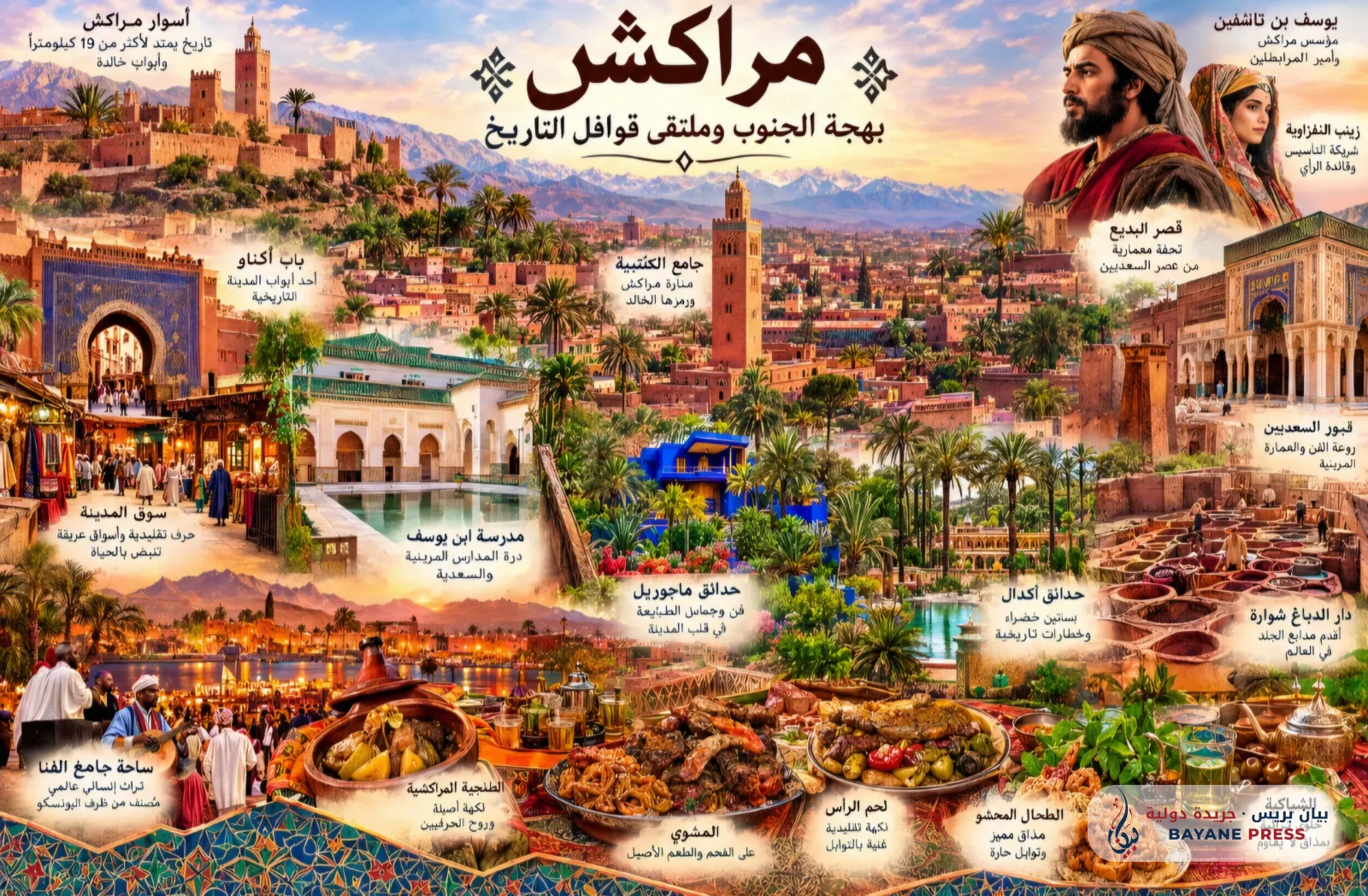
Marrakech emerged in the final third of the 5th century AH, specifically around the year 462 AH, which corresponds to the year 1070 AD, on the open plains of the Al Haouz region at the foot of the imposing northern foothills of the High Atlas. There, the Emir of the Muslims and Almoravid leader Youssef Ibn Tachfine laid its foundations, under the advice and strategic management of his wife Zaynab an-Nafzawiyya, that prominent personality whom historians immortalized with the title "she who sustains her kingdom" due to her sound judgment and sharp political insight. The initial nucleus of the city was formed as a military camp and a settlement for trans-Saharan caravans connecting Aoudaghost and Timbuktu in the Western Sudan with the northern metropolises of al-Andalus. In a few decades, it transformed into the capital of a vast empire whose domains stretched from the shores of the Senegal River in the south to the vicinity of the Henares River in the Iberian Peninsula in the north. The clay extracted from the surface of the Al Haouz plain gave its defensive walls and ramparts an earthy, reddish, and luminous hue, leading travelers over the centuries to dub it "the Red City." When the Almoravid star waned, the Almohads inherited their realm, redesigned the city, and erected towering architectural monuments that laid the foundations of Moorish art, followed by periods of ups and downs until the city reached its second golden age under the Saadian dynasty during the 10th century AH, especially during the reign of Sultan Ahmad al-Mansur, who turned it into a resplendent metropolis brimming with the fruits of military victories and the riches of the gold trade, remaining through the ages the political center of gravity and the home of sultanic prestige in the Far Maghreb.
The architectural monuments of Marrakech stand as living testimonies to the genius of engineering innovation and ornamental harmony. At the forefront of these is the minaret of the Koutoubia Mosque, which rises to seventy-seven meters. It is the Almohad tower built during the caliphate of Yaqub al-Mansur to serve as an architectural model emulated by the Hassan Tower in Rabat and the Giralda in Seville, with its proportional mass, turquoise tile friezes, and varied lobed openings. Next to it are the remains of the Almoravid Dome, known as the dome of the Almoravids or the Baariyin, which constitutes the oldest preserved architectural vestige from the era of Ali Ibn Youssef Ibn Tachfine; its overlapping domes and interlaced arches reflect exceptional skill in water drainage techniques, ventilation, and carved stucco engineering. Meanwhile, the El Badi Palace, built by Al-Mansur following his historic victory at the Battle of Ksar el-Kebir using fine Italian marble imported from Carrara, African gold nuggets, ebony wood, and rare elephant ivory, stands with its vast courtyards and sunken pools as a testament to a palace that contemporaries described as the eighth wonder of the world before its treasures were removed in later centuries. Close by rest the Saadian Tombs, which remained hidden behind walls for centuries until rediscovered in the early 20th century. They house the sumptuous Hall of the Twelve Marble Columns, with its delicate stucco decorations and cedarwood honeycomb and gilded ceilings, where the sultans of the dynasty and their dignitaries rest.
Architectural wonders continue at the Ben Youssef Madrasa, the jewel of Marinid and Saadian madrasas in the Islamic West, which welcomes visitors with its marble courtyard and central pool, surrounded by hundreds of student cells, where stucco carvings and colored tiles intertwine with Kufic and Andalusian Quranic inscriptions in perfect harmony. Falling little short in splendor are Dar Si Said and the Bahia Palace complex, commissioned by Vizier Ba Ahmed in the early 14th century AH to be an expansive and sprawling residence housing lush Andalusian gardens, decorated rooms, and wooden galleries painted with the *zouak* technique, in addition to the Mouassine complex with its grand historic fountain, hammam, and skillfully sculpted public fountain. The medina is surrounded by imposing ramparts stretching over nineteen kilometers, punctuated by grand historical gates such as Bab Agnaou, with its interlaced Almohad horseshoe-shaped stone carvings, Bab Doukkala, Bab Aylan, and Bab El Robb. The city's water landscape is completed by the reservoirs of the historic Menara basin and the vast olive groves of the Agdal, irrigated since the Almohad era through a complex network of *khettarat*, underground water channels descending from the slopes of the Atlas mountains. Added to this are the historic Mellah neighborhood with its "Slat Al Azama" synagogue, which recounts pages of cultural and religious coexistence, and the artistic Majorelle Garden, rehabilitated by Yves Saint Laurent to harmonize cobalt blue with rare desert plants.
It is the most beautiful place in all the world to spend the sunset hour; there, the snowy peaks shine with a crimson tone over the palm groves and ancient walls
Throughout its history, Marrakech has inspired caravans of historians, great Orientalists, and writers. Ibn Battuta described it in his masterwork as «one of the most beautiful cities, of wide horizons, spacious, full of goods, and with admirable mosques,” while Leo Africanus detailed the organization of its souks and artisans. In the modern era, British Prime Minister Winston Churchill was captivated by its sunlight and the diffused light over the Atlas mountains, often spending weeks at the historic La Mamounia hotel with paintbrush in hand, writing to President Franklin D. Roosevelt to describe it thus: «It is the most beautiful place in all the world to spend the sunset hour; there, the snowy peaks shine with a crimson tone over the palm groves and ancient walls.” Meanwhile, British writer George Orwell wrote in his famous 1939 essay «Marrakech” observing the details of daily life and the toil of the humble among palm groves and earthen alleys. American writer Edith Wharton captured in her book «In Morocco” her fascination with the imposing majesty of its walls rising from the dust like legendary castles, while Nobel Prize-winning writer Elias Canetti dedicated his work «The Voices of Marrakech” to it, reflecting on the astonishing human depth in Jemaa el-Fnaa square, where the voice of the storyteller blends with the hiss of snake charmers and the ancestral rhythms of tambourines, a square classified by UNESCO as the first Masterpiece of the Oral and Intangible Heritage of Humanity.
The spiritual history of Marrakech is inextricably linked to the system of the «Seven Saints» (*Sab‘atu Rijāl*), the seven poles of Sufism whose visits established a solid religious and cultural tradition during the Saadian and Alawite eras. At their head is Sidi Youssef ben Ali as-Sanhaji (Moul El Ghar), followed by Qadi Ayyad ben Moussa, Abu al-Qasim al-Suhayli, Abu al-Abbas al-Sabti, Muhammad ben Slimane al-Jazuli, Abdelaziz al-Tabbaa, and finally Abdallah al-Ghazwani (Moul El Ksour), with various forms of social solidarity and popular festivities linked to these patron saints. To the rhythm of this spiritual depth, Gnawa music takes root in the city with its thousand-year-old African legacy, where the notes of the *guembri* lute resonate and blend with the clashing of iron castanets (*qraqeb*) in the purifying rituals of the «lila”, expressing the fusion of Sufi fervor with shared human heritage.
The uniqueness of Marrakech is manifested in its unique traditional cuisine, crowned by the «Marrakchi Tanjia” as a traditional dish historically linked to the artisans and single workers of the ancient souks; pieces of young beef, taken mainly from the leg or shank, are placed in a pear-shaped clay jar, seasoned with precise measures of freshly ground cumin, strands of pure saffron, peeled garlic cloves, pieces of preserved lemon (*hamid mosir*), traditional rancid butter (*samen*), and a generous glass of virgin olive oil, with a little water. The mouth of the tanjia is sealed with sturdy parchment paper, tied tightly with string, and pierced with small holes. It is then taken to the *fernatchi*, the traditional furnace responsible for heating the public hammam water by burning sawdust and carpentry waste, to be buried there among the glowing embers for long hours until the meat is perfectly tender, absorbs its own fat, and its broth thickens like caramelized, thick honey. Traditional souks also stand out for *mechoui* prepared in underground clay pits, steamed sheep's head seasoned with cumin and coarse salt, and spleen stuffed with liver and spicy spices. This feast is completed with glasses of fresh mint green tea and *chebakia* pastries soaked in honey, orange blossom water, and cinnamon.
Comments (0)
No comments yet. Be the first to react!