


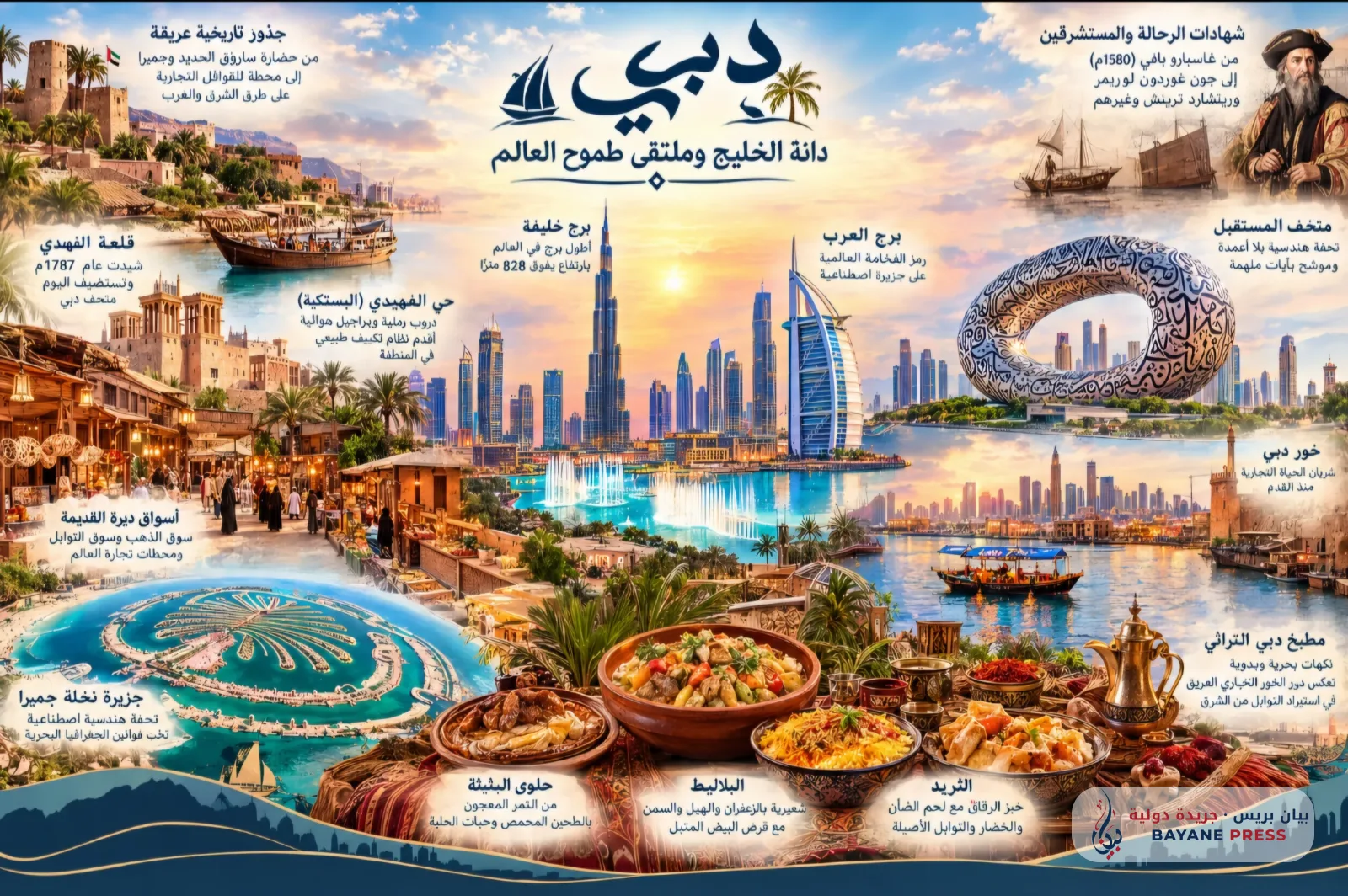
The origins of Dubai and the vestiges of its human settlement date back to the civilizations of Saruq al-Hadid and Jumeirah during the Islamic era, when it was a vital station for commercial caravans connecting the coasts of Oman and Mesopotamia. Its name appeared explicitly in the works of Abu Ubaid al-Bakri in the geographical dictionary Mu'jam ma Ista'jam during the 5th Islamic century. However, the dawn of the modern emirate began in 1833 when the Al Bu Falasa clan, originating from the Bani Yas confederation and led by Sheikh Maktoum bin Butti Al Maktoum, settled on the banks of Dubai Creek (Khor Dubai), founding an independent government that laid the foundations of a free commercial city open to the world with unprecedented audacity. Thanks to the wise policy of its rulers since the early 20th century, under the mandate of the late Sheikh Saeed bin Maktoum Al Maktoum, Dubai abolished customs tariffs and opened its port to merchants arriving from the ports of Persia, India, and East Africa, transforming the creek into a maritime artery crowded with traditional dhow and sambuk vessels. Subsequently, the late Sheikh Rashid bin Saeed Al Maktoum continued this pioneering vision of development by deepening the creek and inaugurating Port Rashid and Jebel Ali Port, thus propelling Dubai, under the patronage of His Highness Sheikh Mohammed bin Rashid Al Maktoum, toward global horizons and turning the sand dunes into a major capital of finance, business, and future innovation.
Dubai surprises its visitors with an architectural mosaic that fuses heritage memory with the most imposing skyscrapers on the planet, led by the iconic Burj Khalifa, the tallest man-made structure in history at over 800 meters high, which rises toward the sky imitating the desert flower Hymenocallis and is surrounded by the Dubai Fountain lake. Next to it shines the Burj Al Arab hotel on an artificial island with its majestic design inspired by the sail of a traditional Arab vessel plying the seas. The futuristic architecture is completed by the Museum of the Future, an engineering masterpiece of oval shape and without interior columns, completely adorned with Arabic calligraphy in the Zulf script that captures the memorable sayings of Sheikh Mohammed bin Rashid. On the other hand, the banks of the creek preserve the authenticity of the Al Fahidi Fort, built in 1787 to protect the city and which today houses the Dubai Museum, as well as the historic Al Fahidi neighborhood (Al Bastakiya) with its shaded sandy alleys and imposing traditional wind towers (barjeel), considered the oldest and most innovative natural air conditioning system in the region. All of this is complemented by the ancient Deira souks, such as the gold souk and the traditional spice market, and the artificial island of Palm Jumeirah, an engineering marvel that defied the laws of marine geography.
The testimonies of travelers and orientalists immortalized Dubai's privileged commercial location. In 1580, the Venetian jeweler and traveler Gasparo Balbi noted in his memoirs the pearl banks in the waters of Dubai, describing the abundance of their production and the purity of their gems. At the beginning of the 20th century, the British historian John Gordon Lorimer detailed Dubai's markets, stating in his Gulf Gazetteer that it had become the most dynamic and active port of the entire Trucial Coast, attracting merchants of all beliefs and creeds thanks to its flexible commercial policy and solid internal security. Sir Percy Cox and British political representatives wrote frequent official letters and reports expressing their astonishment at the rapid growth of the city and the flow of diverse goods through its waterways. For his part, the British traveler and writer Richard Trench recorded in his field studies how Dubai, thanks to the cunning of its sailors and the bravery of its tribes, transformed from a peaceful village of fishermen and divers into a global commercial artery where the civilizations of East and West converge.
The traditional cuisine of Dubai throbs with authentic marine and Bedouin flavors that reflect the historical role of the creek in importing the most exclusive Indian and Arab spices. Its table is led by the traditional dish of Thareed, an ancient Arab delicacy prepared by making a lamb or chicken broth saturated with pieces of yellow pumpkin, zucchini, potatoes, and fresh tomatoes, seasoned with the distinguished blend of Emirati spices (Bazar), turmeric, ginger, and the penetrating aroma of dried desert lime (Loomi), until the broth thickens and the vegetables soften. Then thin Ruqaq bread, baked on a hot iron plate called Tawawa, is added, placing it at the bottom of the ceramic container in successive layers and pouring the hot broth over it so that the bread absorbs the essence of the meat and spices. The pieces of meat and vegetables are arranged on top to serve a hearty dish where the crunchy texture melts into juicy softness. Breakfasts are famous for Balaleet, a sweet noodle cooked with saffron water, cardamom, and ghee, topped with a fine egg omelet seasoned with salt and black pepper in a pleasant contrast between sweet and savory, in addition to the Batheetha dessert, prepared with dates kneaded with toasted flour, fenugreek seeds, and the transparent sweet Sago.
Comments (0)
No comments yet. Be the first to react!