


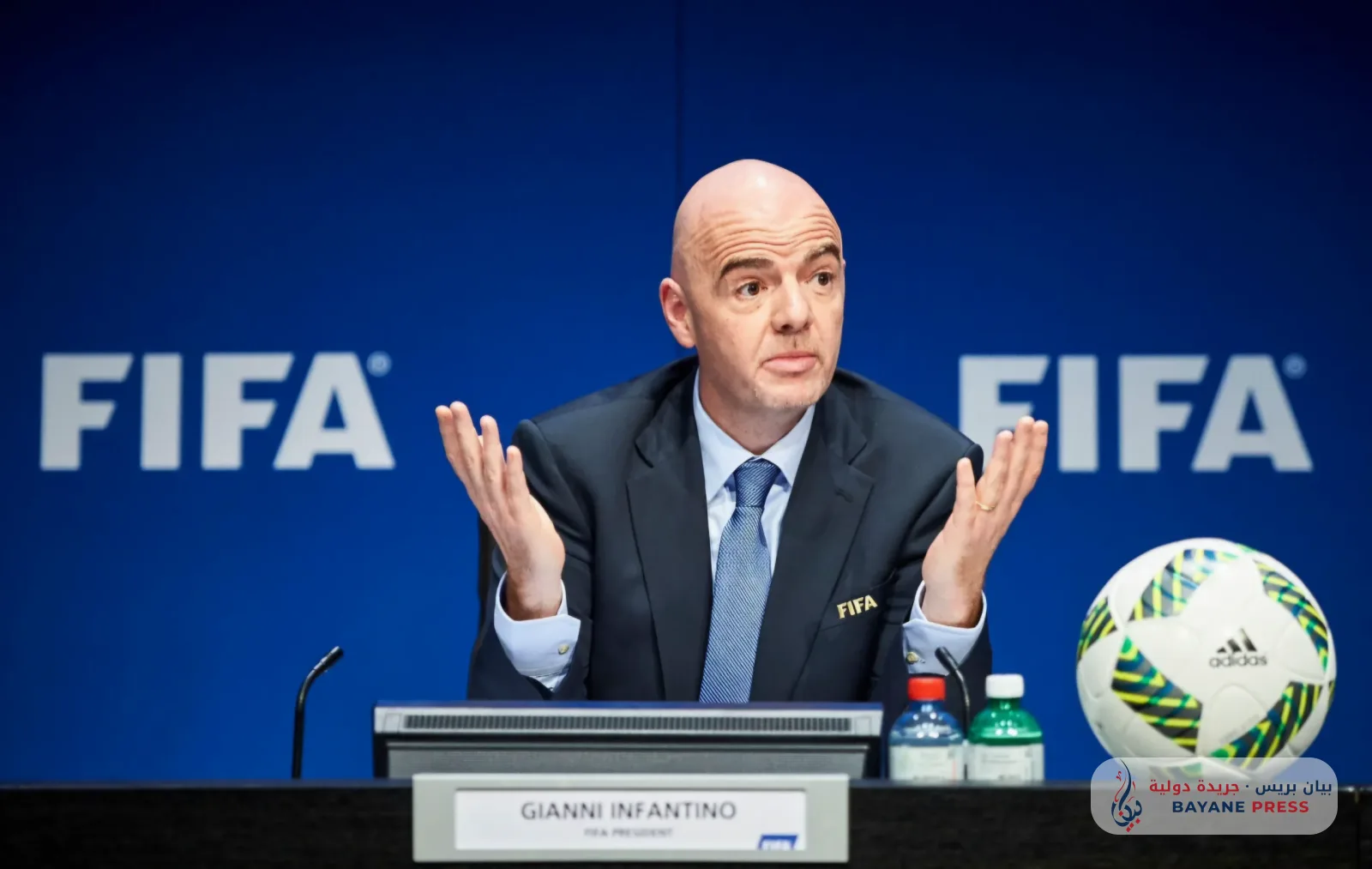
The crisis that shook the International Federation of Association Football (FIFA) in recent months was not merely a financial dispute over a twenty billion dollar investment project. Rather, it revealed a deeper conflict regarding who holds economic decision-making power in the world's largest football institution, who determines the value of World Cup rights, and whether the future profits of international tournaments are open to being shared with investors from outside the sports ecosystem.
The story began far from the pitch, specifically inside the Waldorf Astoria hotel in Manhattan, New York, on July 18, 2026, one day before the World Cup final. According to an investigation published by The New York Times, which was later cited by the Union of European Football Associations (UEFA) in its legal proceedings, five senior FIFA officials were asked to urgently consider a highly sensitive investment project, which ended with three of them supporting it while two objected. The circumstances of the meeting and the speed of the decision-making raised questions about the extent to which the relevant bodies were informed about the project—a narrative that remains a point of contention between the parties involved.
After ten days, the project emerged publicly under the name "FIFA Forward Enterprise." It was a commercial entity designed to consolidate broadcasting, sponsorship, advertising, ticketing, and commercial rights associated with FIFA competitions, while opening its capital to external investors for approximately twenty percent, in exchange for funding reaching 4.2 billion dollars, based on a total valuation of nearly twenty billion dollars.
Here, the first points requiring scrutiny appear; the circulated amount was not money that had disappeared from the federation's coffers, but rather an estimated value for a company that was ultimately never created. The proposed deal would have granted investors an economic stake in an activity primarily based on tournaments whose rights are owned by a non-profit organization representing 211 national associations.
According to reports from Reuters and the Associated Press, the American bank JPMorgan Chase became involved in the project's preparation and financial arrangements, while the name of the "Thrive Eternal" fund, linked to American investor Joshua Kushner, emerged as a potential lead investor. Kushner is the brother of Jared Kushner, son-in-law of former US President Donald Trump—a connection that piqued the interest of the international press given the close relationship between Trump and FIFA President Gianni Infantino, though it does not in itself constitute evidence of favoritism or legal wrongdoing.
Even more intriguing is that the financial aspect of the project was linked to an unprecedented offer for national associations. The plan would have allowed each association to receive an extraordinary payment of up to twenty million dollars, in addition to development funding of twenty million dollars during the 2027-2030 cycle, according to the formula explained by FIFA, subject to the required approvals and the participation of the concerned associations.
With a simple calculation, granting 211 associations twenty million dollars each means distributing 4.22 billion dollars, which is roughly equivalent to the entire amount the project aimed to raise from external investors. This comparison does not prove financial misconduct, but it raises a legitimate question: what is the true economic cost of granting investors a share of future commercial revenues in exchange for extraordinary funding that theoretically consumes most of the initial investment proceeds?
This question becomes even more significant when returning to the 25-page presentation seen by The Guardian. It included visions for revenue growth through the expansion of commercial activities and tournaments, increased ticket revenues, the use of external financing and loans, and improved exploitation of broadcasting rights. It also pointed to the possibility of increasing the number of global sporting events, which raised concerns about mounting pressure on players, clubs, and the international calendar.
One of the most concerning points was the lack of sufficient detail in the documents revealed by the media regarding the methodology used to reach the twenty billion dollar valuation, the existence of open competition among investors, and the terms for returns and exit strategies. Therefore, the question arose regarding the fair value of the rights: would FIFA have received the appropriate price for the offered stake, or would investors have benefited from future economic growth exceeding what the proposed valuation reflected?
It cannot be definitively stated that the World Cup rights would have been sold for less than their true value without reviewing the financial models, contractual obligations, and independent valuation studies. Furthermore, comparing the proposed company's value to FIFA's total revenue is not enough to prove an undervaluation, because revenue is not net profit, and the value of any project also depends on costs, risks, and the duration of the rights.
In contrast, Infantino defended the project as a means to boost football funding in countries that benefit less from global revenues. The international federation emphasized that it would retain control over the proposed company and all its regulatory and sporting powers, and that investors would not have decision-making authority over the laws of the game or the scheduling of competitions.
However, these assurances did not convince UEFA, which believed that introducing private capital into the World Cup's commercial activity could create constant pressure to increase profits, even at the expense of the balance between sporting interests and commercial considerations. Other football bodies joined the objections, including CONCACAF and the Asian Football Confederation, which criticized the lack of prior consultation, alongside the international players' union, FIFPRO.
After European associations threatened to boycott FIFA competitions, Infantino announced on July 31 the withdrawal of the project. However, the cancellation did not end the dispute; it shifted it to a more sensitive level, involving demands to disclose the deal's documents and the decision-making process.
On August 27 and 28, UEFA filed requests in US federal courts to obtain documents and testimony related to the project from American companies linked to FIFA and from financial and investment entities involved in the deal. These requests were based on the potential use of evidence in a possible criminal complaint in Switzerland regarding financial mismanagement.
According to available court records that have been reviewed, the matter involves four legal requests in three US judicial districts. However, these proceedings are aimed at obtaining evidence and do not mean that a crime has been proven or that Infantino has been convicted, nor has a final judicial ruling been issued on the merits of the accusations or a Swiss criminal investigation opened regarding them. For its part, FIFA rejected the accusations of mismanagement and considered the legal actions part of a campaign targeting its leadership.
But the most significant development revealed by tracking the file came on October 15, when FIFA announced a new plan to increase development funding during the 2027-2030 cycle to 6.35 billion dollars, including national associations and other football entities, with proposed allocations of 25 million dollars for each national association.
Notably, the new plan relies on utilizing the financial surplus and the international federation's reserves, after preliminary unaudited estimates indicated a surplus ranging between 5.2 and 5.6 billion dollars for the 2023-2026 cycle, while maintaining a proposed precautionary reserve of 1.7 billion dollars. The details of the plan are still subject to review and institutional approvals.
Here, the most important angle of the investigation takes shape: if it has become possible to propose extensive funding from internal resources, why was opening the commercial activity to external investors proposed in the first place? And did the expected increase in revenues justify giving up a share of future profits?
It is fair to note that the new plan does not match the previous investment offer in terms of value, funding sources, or continuity, and that FIFA believes external investment would have generated additional resources beyond what could be distributed from reserves. Nevertheless, the difference between the two visions remains in need of an independent financial audit that clarifies the cost and long-term benefits of each option.
On November 2, Reuters revealed that FIFA Secretary General Mattias Grafström invited interested Council members to view key documents related to the project at the organization's headquarters in Zurich, under specific conditions. This came after European demands for answers to dozens of questions regarding the federation's management and the transparency of its decisions.
However, making documents available to Council members under conditions does not necessarily equate to an independent external review, especially if the valuation methodology, the parties involved in the negotiations, and the associated institutional responsibilities are not published. At the same time, imposing confidentiality on commercial documents does not by itself prove wrongdoing, as it may be related to legitimate contractual and legal obligations.
As the FIFA presidential election scheduled for March 2027 in Morocco approaches, financial questions are becoming intertwined with power dynamics within the football institution. The cancelled project has become a test of confidence in Infantino's leadership, while the demand for institutional reform has turned into a central axis in the confrontation between the international federation and several football bodies.
The most important truth remains that the failure to complete the deal does not eliminate the need to know how it was prepared, who chose the potential investors, how the market value was determined, and what guarantees would have protected the future of the tournaments from conflicts of interest.
The issue is no longer just about twenty billion dollars, but about the model of global football management: will commercial rights remain a means to fund and develop the game under the supervision of its institutions, or will they gradually turn into investment assets whose future is determined by the logic of profitability?
Answering this question does not require pre-emptive accusations, but rather complete documentation, an independent financial assessment, and transparent institutional accountability. Until that happens, the incomplete FIFA deal will remain one of the most prominent open issues regarding the future of the international football economy.
Comments (0)
No comments yet. Be the first to react!