


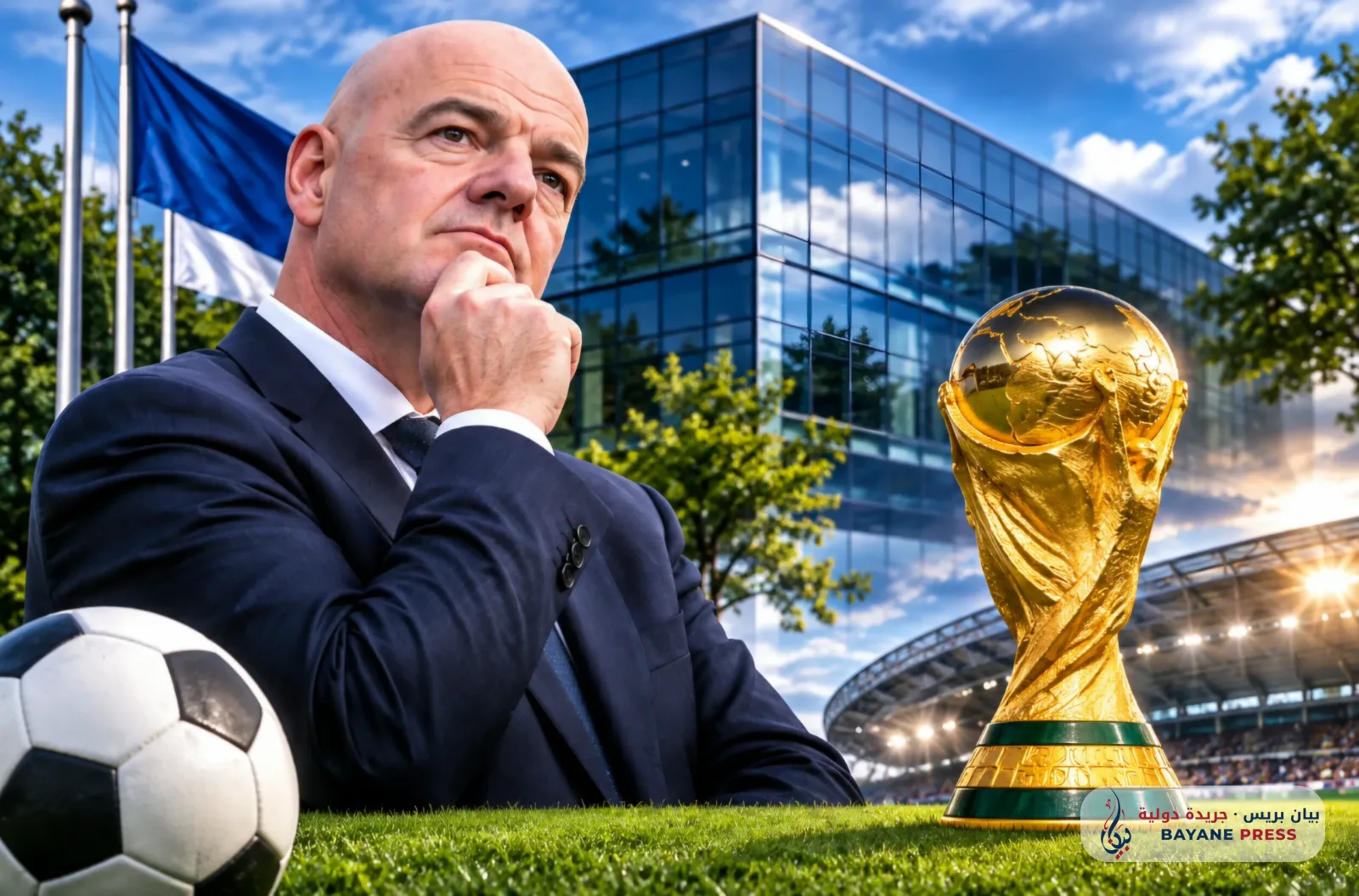
The most dangerous aspect of the "FIFA Forward Enterprise" project, which caused an earthquake within the international football governing body during the summer of 2026, was not the twenty billion dollar figure being circulated, but rather the financial questions the project left without clear answers: How was the commercial rights value of the world's largest football organization determined? What return would investors have received for their money? And did the national associations know the long-term economic price of the funding offered to them?
These questions gain new importance after reviewing the content of a 25-page commercial proposal dated July 2026, titled "FIFA Forward Enterprise – Member Materials," and marked as confidential and not for distribution. A version published on the "Scribd" platform contains core details that match the proposal the British newspaper "The Guardian" stated it had reviewed on July 30, although the authenticity of the published version remains independently unverified.
The pages of the proposal reveal an economic vision that would have changed the way FIFA manages its commercial assets by creating a company to handle most revenue-generating activities, including broadcasting rights, sponsorship, advertising, ticketing, commercial hospitality, and tournament organization, in exchange for opening a minority stake to external investors, while the international federation would retain control over sporting and regulatory decisions.
However, the first point that catches the eye in the financial analysis is the valuation method of the new company; reports from "Reuters" and "Associated Press" revealed that "JPMorgan" bank valued it at approximately twenty billion dollars, while the target funding from investors reached 4.2 billion dollars for a stake of nearly twenty percent.
These figures mean that the implied valuation derived from dividing 4.2 billion by twenty percent is 21 billion dollars, which is one billion dollars higher than the valuation circulated in the media. This discrepancy is not evidence of manipulation or inflation; it could be due to rounding or differences in the definition of the company's value before and after the investment, but it highlights the need to know the accounting basis used to determine the price.
More importantly, the published pages of the proposal do not include a detailed financial model showing net profit projections, discounted cash flows, the expected internal rate of return for investors, or the mechanism for valuing the stake in future sales. It also does not clearly present the exit conditions from the investment or whether there would be special guarantees to protect the rights of minority shareholders.
The absence of these elements from the proposal addressed to the associations does not necessarily mean they were not present in other negotiation documents, but it makes assessing the fairness of the deal impossible based on the proposal alone.
Another highly sensitive point appears on page nine, where the document compares the funding of the "FIFA Forward" program during the 2023-2026 cycle, amounting to about 1.7 billion dollars, with potential funding reaching 8.4 billion dollars during the 2027-2030 cycle, by combining the "FIFA Forward" and "FIFA Fast Forward" programs.
However, page twenty-three goes further, speaking of raising the total commitment to football development to more than ten billion dollars. The difference between the two figures, which is at least 1.6 billion dollars, requires clarification, especially since the proposal does not provide a detailed financial reconciliation in its published pages linking the various programs to the final total figure. The larger amount might include other development programs, but determining that accurately requires additional financial tables.
The most important detail lies in the distribution of funding; the proposal stipulated twenty million dollars from "FIFA Forward" funding for each of the 211 national associations, in addition to an optional extraordinary amount of up to twenty million dollars for the association under the "Fast Forward" program.
By calculating the optional payment alone for all associations, we reach 4.22 billion dollars, an amount that almost matches the funding the project aimed to raise from external investors. As for the regular program, it would have reached nearly the same volume, but its funding, according to FIFA's official interpretation, would have come from improving future commercial revenues.
Here, a fundamental equation emerges: investors would pay a large sum once, while receiving in return an ownership stake in a commercial company theoretically capable of generating recurring revenues. The published version did not clarify how profits would be distributed or how long it would take for investors to recover their capital or achieve additional profits.
Therefore, the comparison between the funds that the associations would receive immediately and the future value of the investment stake cannot be settled without knowing the terms of the deal. The operation might be financially viable, or it might be costly in the long run, but the available evidence does not allow for a definitive choice between the two possibilities.
The pages on commercial growth reveal a different perception of how to exploit football economically. On page seven, the proposal presents a comparison between FIFA's average annual revenue of about 3.6 billion dollars and the revenues of major American competitions, including the National Football League (NFL), whose revenues according to the table are 21.2 billion dollars.
The problem here is that FIFA is an international organization that organizes competitions and manages development and governance programs, while the NFL represents a different business model linked to clubs, franchises, and domestic rights. Therefore, a direct comparison between revenues might be useful for marketing, but it is not enough to prove that FIFA is generating less commercial return than it should, unless the differences between business models, costs, and obligations are taken into account.
On page fifteen, the proposal suggests increasing commercial partners, expanding the exploitation of broadcasting rights, optimizing operational costs, and attracting talent with wages linked to financial incentives. These arrangements are not exceptional in the corporate world, but they raise a question about how to reconcile generating profits for investors with maintaining the non-profit nature and developmental mission of the international federation.
Page nine includes a goal to increase the number of competitions from about 200 to 450, a figure that sparked media controversy regarding the possibility of doubling the global football calendar. However, examining the context of the page shows that the figure appeared alongside development indicators including an increase in the number of beneficiary players from about 300,000 to 650,000, new stadiums from about 570 to 1,200, and projects from 1,600 to 3,500.
The proposal does not clearly specify whether these competitions are local or regional supported by development programs, or additional international tournaments. Therefore, it is not correct to conclude, based on this page alone, that FIFA intended to organize 250 new international tournaments, although the general commercial formula of the project was based on expanding activities and increasing the exploitation of rights.
The document also raises the issue of the balance between men's and women's football; "The Guardian" noted that the Women's World Cup was mentioned only once in the commercial proposal, while Infantino confirmed in his official statements that the project would have enhanced investment in women's football and youth talent. The number of mentions alone does not prove the actual volume of funding, but it reveals the need for the proposal to have separate and measurable financial goals for different categories of the game.
As for the aspect that requires the greatest institutional scrutiny, it relates to the timeline for completing the deal; page twenty-two presents a path starting with the announcement in July, granting selected investors preliminary documents and terms during August, then receiving expressions of interest and binding commitments, leading to the transfer of funds by the end of October.
Interestingly, this schedule preceded the completion of consultations and the final vote by member associations, according to the mechanism officially confirmed by FIFA. Starting negotiations before approval might not be inherently contrary to rules, but it raises a question about the progress made in investment arrangements, and whether potential commitments would remain explicitly conditional on the approval of the relevant institutions.
Outside the pages of the proposal, international coverage revealed the role of American investor Joshua Kushner and "Thrive Capital" as among the most prominent potential investment parties. Last September, Kushner confirmed in a statement reported by "Reuters" that he would not have entered the project had he realized the scale of the conflict it would provoke, while defending the economic idea based on distributing greater resources to the least benefited associations.
However, the connection of potential investors to centers of financial or political influence does not, in itself, represent evidence of wrongdoing. The decisive issues remain the investor selection procedures, the independence of the valuation, the terms of competition, and any potential conflict of interest.
The controversy later turned into a legal confrontation after the Union of European Football Associations (UEFA) filed requests before American federal courts to obtain documents and correspondence related to the project, including materials concerning "JPMorgan" and other investors and entities. UEFA confirmed that such evidence might help it in assessing the filing of a potential criminal complaint in Switzerland, while FIFA denied any wrongdoing and considered the measures part of a campaign targeting its leadership.
Requests for evidence do not constitute a judicial ruling of a crime or a conviction of any person. Even procedural decisions issued in some American files cannot be converted into proof of the validity of the accusations related to the project.
However, the development that gives this investigation a new economic dimension occurred on October 15, when FIFA announced an alternative plan to fund football development worth 6.35 billion dollars during the 2027-2030 cycle, relying on part of its own surpluses and reserves, without the need to sell a stake in a new commercial company.
The proposed plan included allocating 25 million dollars to each national association, while maintaining a contingency reserve of 1.7 billion dollars. However, this plan is not identical to the cancelled project in terms of funding volume or sources, and it is still linked to final approval procedures.
Nevertheless, the emergence of the alternative raises a question that cannot be ignored: If FIFA's own resources allow for proposing development funding of this size, was the need for external investors a real financial necessity, or a strategic choice to expand commercial business and accelerate its growth?
On November 2, the issue returned to the forefront after "Reuters" revealed that FIFA Secretary General Mattias Grafström invited members of the FIFA Council to review key documents related to the project at the organization's headquarters in Zurich, under specific conditions, following rising European demands for transparency.
Thus, the cancellation of the project did not end the questions related to the way it was prepared, the selection of investors, or its valuation methodology, especially since the detailed contractual and financial documents are still not available for comprehensive public review.
It can be said that reviewing the commercial proposal revealed three fundamental gaps: the absence of a sufficient published explanation for the company's valuation and investor rights, the lack of detail on the difference between various development promises, and the failure to define the exact nature of some growth indicators used to market the project.
But these gaps are not evidence of embezzlement, corruption, or a confirmed attempt to sell football for less than its value. These are issues that require institutional and financial scrutiny, and a comparison between the promotional proposal and the legal and financial documents that have not been fully published.
In the end, the battle was not just about twenty billion dollars, but about a more important question: Who has the right to turn future World Cup revenues into an investment asset, and what are the guarantees that protect the interests of national associations, clubs, players, and fans?
The deal that never saw the light of day may have ended commercially, but the transparency test it imposed on the international federation has not yet ended, and will only be resolved by revealing the foundations of the valuation and the proposed commitments and subjecting them to an independent review that distinguishes between the legitimacy of investment and the requirements of good governance.


Comments (0)
No comments yet. Be the first to react!