


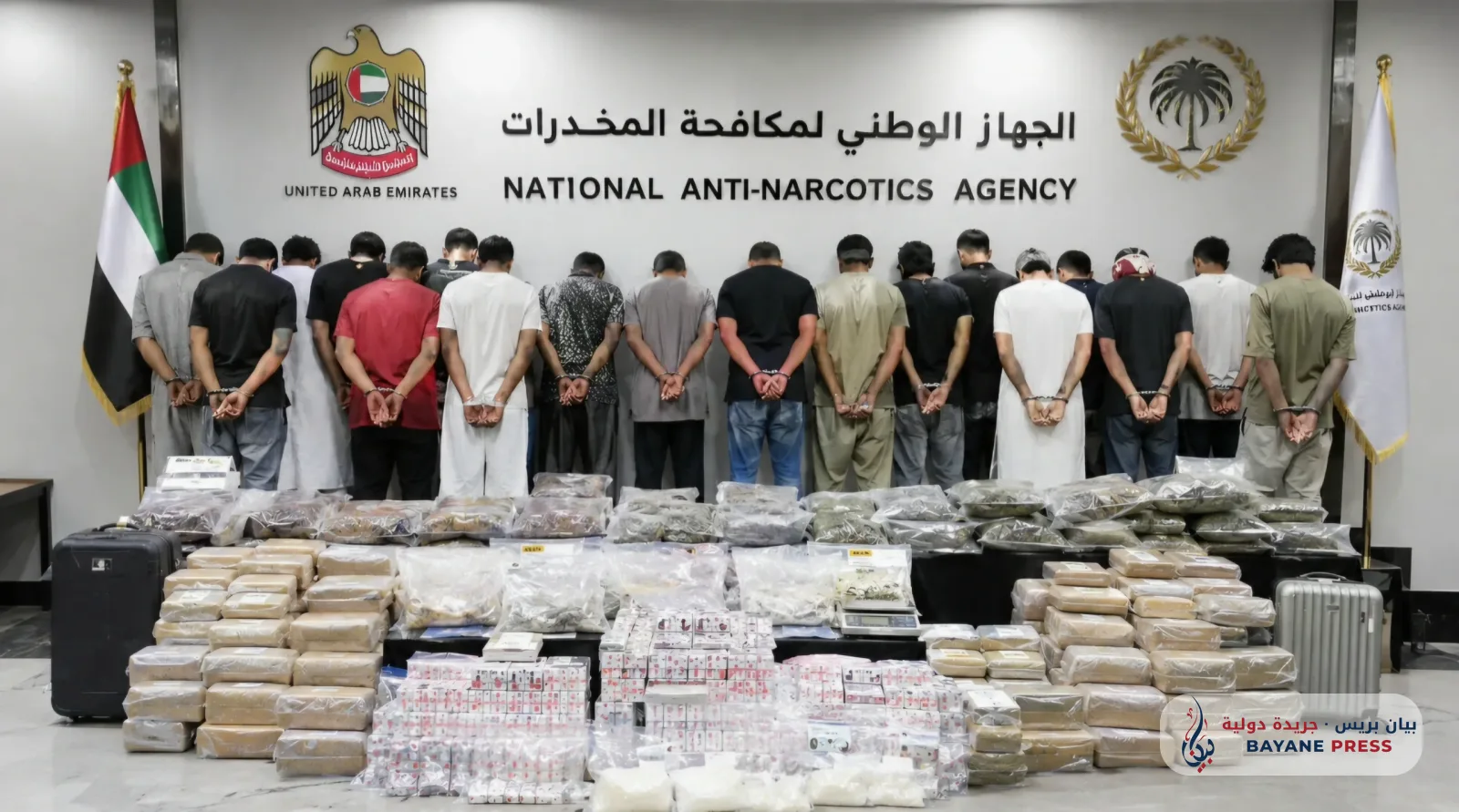
In a security operation that highlights the scale of challenges posed by transnational organized crime networks, UAE security services have dealt a new blow to international drug trafficking. They successfully thwarted an attempt to smuggle a massive shipment of prohibited substances and dismantled a criminal network comprising 20 suspects of various nationalities, in an operation that reflected the importance of intelligence coordination and regional security cooperation.
The National Anti-Narcotics Agency announced on Friday, November 6, 2026, the interception of 200,000 Captagon pills and over 30 kilograms of narcotics, including cocaine, crystal meth, marijuana, hashish, and spice. The network had planned to smuggle these substances through a border area in the Emirate of Ras Al Khaimah, in preparation for distribution within the country.
The operation was not merely a conventional security intervention; it was the result of intelligence cooperation between the UAE and Iraq. Exchanged information enabled the detection of the plot before its execution, leading to a field operation involving specialized units, as well as the police forces of Ras Al Khaimah, Dubai, Sharjah, and Ajman, in judicial coordination with the Federal Public Prosecution.
The security maneuvers resulted in the arrest of several suspects caught red-handed in possession of the narcotics while attempting to smuggle them. Specialized teams subsequently apprehended the remaining members of the network through security ambushes across the UAE, bringing the total number of suspects to twenty individuals of Gulf, Arab, African, and Asian nationalities.
The significance of this operation extends beyond the volume of seizures and the number of detainees; it reveals the nature of the challenge facing security agencies in light of the growing international character of smuggling networks, which exploit borders, trade routes, and multi-nationality to conceal their activities and expand their operations.
The operation also highlights the importance of moving beyond merely seizing shipments to targeting the networks behind them through information exchange, tracking involved elements, and coordination between security and judicial institutions.
As drug trafficking networks continue to seek new entry points, this operation confirms that proactive security cooperation is one of the essential tools for confronting organized crime, and that protecting societies from the dangers of drugs is no longer the responsibility of a single state, but a shared battle that transcends geographical borders.



Comments (0)
No comments yet. Be the first to react!