


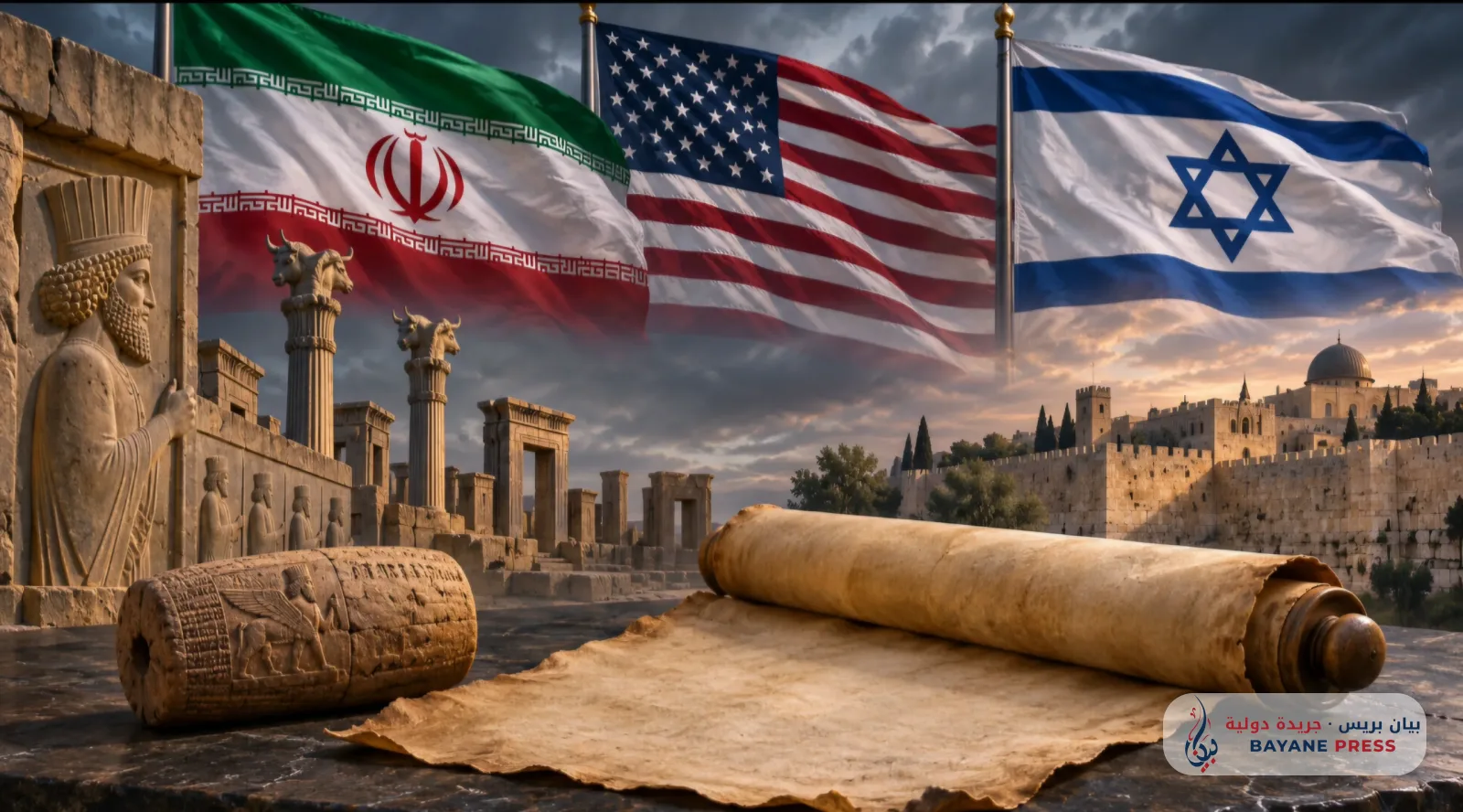
Amidst the confrontation between Israel, the United States, and Iran, a question arises that transcends military calculations: Do Jewish texts speak of this war, or are contemporary events being read through ancient religious narratives? A review of texts and historical references reveals references to Persia and wars associated with the time of redemption, but it also reveals a history of coexistence, alliances, arms deals, and shifting interests. Between these two paths, there is no explicit textual evidence defining the current war by its modern parties and timeline, nor anything that makes the hostility between Iranians and Jews a fixed fate throughout the ages.
The examination begins with three distinctions. The first is between rituals, with their associated holidays and rites, and religious scriptures and rabbinic interpretations.
The second is between the Children of Israel and ancient Jewish groups on one hand, and the State of Israel, founded in 1948, on the other. The third is between the Persian empires and the contemporary Islamic Republic. The persistence of names and symbols in memory does not imply the continuity of the same political entities or the stability of their interests.
In the Book of Ezekiel, specifically chapters 38 and 39, there is a description of an attack led by "Gog" on the land of Israel, and Persia appears among the peoples participating in his army, alongside Cush, Put, and others. This is an explicit mention of Persia in a religious narrative about a future confrontation, but it does not include the name of the United States or the Islamic Republic, nor does it specify the year the battle will take place. Equating this narrative with the current war is an interpretation, not a conclusion imposed by the text.
Another narrative appears in the "Yalkut Shimoni," a collection of rabbinic commentaries compiled in the Middle Ages from older sources. In section 499, related to the Book of Isaiah, a conflict between kings appears just before the appearance of the expected Messiah in Judaism, a confrontation between the King of Persia and the King of the Arabs, followed by turmoil and fear among nations, followed by a promise of redemption for the Children of Israel. However, this text is not part of the Hebrew Bible, but a late Midrashic interpretation, and it does not name today's rulers. Projecting its roles onto contemporary states is a reading that adds to the words of the narrative what is not there.
The Talmud does not offer a unified conception of the path of conflict between major powers. In "Yoma 10a," conflicting opinions appear, one expecting the fall of Rome at the hands of Persia, and another expecting the fall of Persia at the hands of Rome. The irony is that one of the inferences invokes the role of the Persians in building the Second Temple versus the Romans' destruction of it, which gives Persia a positive position in the argument. Extracting only the statement about Persia's defeat hides the diversity of opinions within the text. Furthermore, "Rome" in rabbinic tradition is an ancient symbol for "Edom" and later for the Christian world; turning it into a pseudonym for America is a modern interpretation built upon an old one.
Maimonides, one of the most prominent Jewish scholars, places a constraint on being certain about these readings. In the "Mishneh Torah," Laws of Kings and Wars 12:2, he explains that the details of these matters are not known with certainty before they occur, and that the disagreement among the sages regarding them is linked to their interpretation of the texts, while warning against being preoccupied with calculating the date of the end. Thus, from within the Jewish tradition itself, there is a ground that calls for caution against turning every war into a confirmed announcement of the approaching redemption.
The direct connection to rituals appears in the holiday of Purim, which celebrates survival according to the story of Esther. The story recounts that Haman plotted to exterminate the Jews in the Persian Empire, before Queen Esther intervened with the support of Mordechai to thwart the plan.
Among the rituals of the holiday is the reading of the Book of Esther, alongside celebration and the exchange of gifts. However, it is a religious commemoration of survival, not a prophecy about an American-Iranian war. Likewise, not all events in the book are proven by independent historical sources; researchers discuss its literary nature and the limits of its value as a historical record.
Returning to ancient history reveals a different picture from the idea of eternal enmity. Those who destroyed the First Temple and took many of the inhabitants of the Kingdom of Judah captive were the Babylonians. When Cyrus the Great, also known as Kurush, captured Babylon in 539 BC, the exiled Jews came under Persian rule. Biblical books attribute to him the permission for their return and the rebuilding of the Temple in Jerusalem, which was completed during the reign of Darius I around 516 BC. Thus, the rise of Persia in Jewish memory became linked to the possibility of restoring religious life after the exile.
The status of Cyrus in this memory reaches a remarkable extent, as Isaiah 45:1 describes him as his "anointed one," meaning the one anointed or chosen for a divine mission. This does not mean he is the expected Messiah in the later sense, but it reflects the exceptional status the text granted to a non-Jewish Persian king. Hence, reducing the image of Persia to the enemy that must be defeated ignores a king whom the scriptures themselves made an instrument for salvation and reconstruction.
However, this narrative also requires archaeological verification. The Cyrus Cylinder, which is often cited in this context, does not explicitly mention the Jews, Jerusalem, or the Temple, but speaks of returning groups and deities to their homelands. As for the specific narrative about the return of the Jews and the rebuilding, its source is the biblical books. The cylinder provides a historical context consistent with that narrative, but it is not considered an independent document that proves its details.
Not all Jews returned to Jerusalem; large groups remained in Babylon and areas that later fell under Parthian and Sassanid rule. Their long presence witnessed periods of stability and interaction, and others of restriction and persecution, depending on the authority and local circumstances. It is not accurate to describe this history as continuous tolerance, nor as a series of constant enmity between two peoples.
Among the less discussed details is that the Babylonian Talmud was formed in Mesopotamia under Sassanid rule, between the third and sixth centuries AD. Its rabbis lived within an Iranian political and cultural environment and interacted with its laws, society, and religious debates. Researchers, including Shay Secunda in his book "The Iranian Talmud," have observed connections between rabbinic culture and Middle Persian culture. However, similarity alone does not prove the transfer of a specific doctrine from one religion to another; determining the direction and extent of influence requires independent evidence. What these studies reveal is that one of the most important references of Judaism was formed in an Iranian space of friction, dialogue, and difference, not under the shadow of an eternal conflict.
The event in Jerusalem in 614 AD provides an example of how wars are linked to the expectation of redemption. The Sassanid army captured the city from the Byzantines in one of the most prominent episodes of the war between the two empires. The advance of the Persians raised hopes among some Jews who had suffered under Byzantine restrictions, and these aspirations appeared in religious poems associated with synagogue worship and in apocalyptic texts such as the "Book of Zerubbabel," which dealt with the restoration of religious life in Jerusalem and the emergence of Jewish leadership with redemptive connotations. In this reading, Persia was not a power threatening redemption, but a power hoped to open the way to it.
But those hopes did not withstand the shifts in politics. The Persian authorities later moved toward rapprochement with Christians and withdrew privileges granted to Jews, especially before the expansion toward Egypt in 618–619, so the aspirations turned into disappointment that appeared in the religious memory of that period. The details of the occupation, the roles of the groups, and the extent of the violence remain a subject of debate among researchers, but the event reveals how military victories are given redemptive significance, only for hopes to dissipate when the calculations of the victorious state change.
In the Iranian city of Hamadan, there is a shrine that Persian Jewish traditions attribute to Esther and Mordechai, which has been associated with visits and prayers for centuries. Although the identity of those buried there is not a settled archaeological fact, its significance is clear: the land of Iran itself hosted a sacred place in the memory of its Jews, and their relationship with Persia included local belonging and religious visitation, not just narratives of survival from danger.
In the modern era, Iran granted Israel de facto recognition in March 1950. The relationship developed during the reign of Shah Mohammad Reza Pahlavi, especially since the 1960s, into an informal strategic cooperation that included security, military, and economic fields. The interests of both parties intersected in confronting regional powers such as Nasserist Egypt and Ba'athist Iraq, and in the rapprochement with the United States, as it also aligned with an Israeli trend to build ties with countries located outside the immediate Arab sphere.
Iran was an important source of oil for Israel, and relations extended to trade and technical cooperation. But the 1979 revolution ended the official rapprochement, and the Islamic Republic adopted a hostile stance toward Israel, then the conflict deepened with Tehran's support for Hezbollah and Palestinian movements, competition for regional influence, and the dispute over the Iranian nuclear and missile programs. These are modern political and military shifts, not an automatic extension of wars mentioned in ancient texts.
However, the revolution did not immediately end all channels of interaction. Weapons and equipment reached Iran through Israeli channels during its war with Iraq, despite the declared hostility. Tehran's need for supplies for an army that relied heavily on Western equipment met with Israeli calculations that saw Iraq as a threat, and with the hopes of some officials to maintain an entry point into Iran. These were deals that were secret and then revealed, but they do not prove the existence of a permanent hidden alliance, nor do they negate the reality of the current conflict.
This path was manifested in the "Iran-Contra" affair during 1985 and 1986, when Israel participated in arrangements to transfer American weapons to Iran, against the backdrop of efforts to release American hostages in Lebanon and open channels with elements inside Iran. The Brown University project documenting the affair states that the first shipment, consisting of 96 TOW anti-tank missiles, was sent from Israel to Iran on August 20, 1985, and then the American role in the transport operations expanded.
The investigations add a detail that clarifies the breadth of the network of interests: part of the proceeds from arms sales was diverted to support the "Contra" rebels in Nicaragua. Thus, an arms deal with Iran, an Israeli mediation, a hostage file in Lebanon, and a conflict in Central America all converged in one operation. These are facts that deserve the description of "open secrets," because they are documented by investigations and records, not speculation based on the similarity of symbols or slogans.
To understand the intensification of the hostility, returning to 1979 alone is not enough; 1991 also represented an influential milestone. According to the analysis provided by the "Encyclopaedia Iranica," the collapse of the Soviet Union and the weakening of the Iraqi army in the Gulf War led to the decline of two threats that were part of the ground for common interests between the two countries. With the shifting balance of power, competition for regional position expanded, and a previous ideological hostility deepened when the motives for cooperation weakened.
The situation of Iranian Jews remains a necessary side to understand the scene. The Iranian constitution recognizes them in Article 13 among the recognized religious minorities, and acknowledges the practice of their rituals, the organization of their personal status, and their religious education according to their traditions, within the limits of the law. Article 64 also provides for the election of one representative for them in parliament. These texts impose a distinction between Iranian Jews as citizens and a religious minority, and Israel as a state with which Tehran is in conflict.
However, constitutional recognition and parliamentary representation alone do not prove full equality or the absence of discrimination. The constitution itself stipulates in Article 115 that the President of the Republic must be a follower of the official Shiite sect, and reports on religious freedom issued by the US Department of State and human rights organizations document restrictions that prevent non-Shiites from reaching other high positions, including the Supreme Leadership and the Assembly of Experts. Therefore, describing the situation of Jews in Iran requires combining legal recognition and its limits with the practices of the authority, without reducing them to the position of the Iranian state or assuming that they represent the policies of Israel.
As for the current confrontation, the Associated Press reported on November 7, 2026, the announcement by US President Donald Trump, on Friday, November 6, of carrying out new limited strikes against Iranian air defenses on Qeshm Island, described as the first since the US midterm elections. This coincided with Trump's confirmation that talks with Iran are ongoing and have achieved "significant progress." This correlation between military force and negotiation provides a direct political context for understanding events, while saying that decision-makers are implementing a religious prophecy requires evidence from their statements, documents, and decisions.
The question that this history allows for journalistic investigation is how the narratives that peoples use to explain their wars are chosen, and what is excluded from memory when mobilizing for conflict. Invoking Persia in the Gog narrative while ignoring Cyrus and the hopes of Jerusalem in 614 presents a different picture than reading the facts together; and invoking hostility since the revolution while dropping arms deals and the shifts of 1991 hides a documented side of state calculations. Reading texts in their contexts and examining decisions by their sources remain necessary to understand a war created by human choices and interests that are subject to change, without turning religious interpretation into confirmed news about the future.




Comments (0)
No comments yet. Be the first to react!