


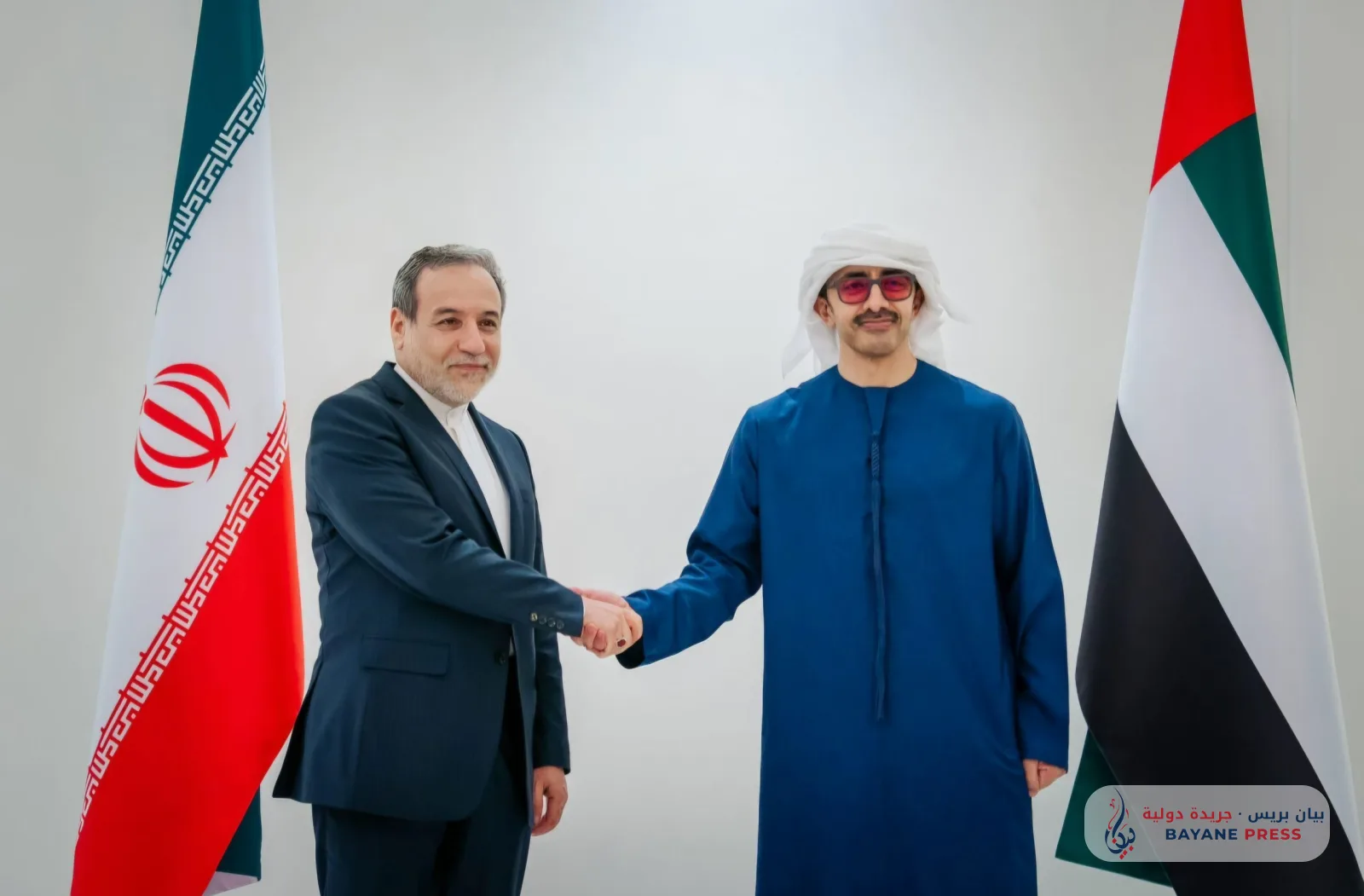
The phone call received by Sheikh Abdullah bin Zayed Al Nahyan, Deputy Prime Minister and Minister of Foreign Affairs of the UAE, from his Iranian counterpart Abbas Araghchi on the evening of November 5, 2026, did not occur in a fleeting protocol context, but rather crystallized at a highly complex geopolitical moment.
In this turbulent regional landscape, the possibilities of renewed direct military confrontation between Washington and Tehran are intertwined with rising risks to navigation in the Strait of Hormuz and growing Gulf concerns over the repercussions of an expanding conflict.
In this context, the Emirati Minister's emphasis on the importance of de-escalation and prioritizing the diplomatic path went beyond mere formal phrasing, establishing a pragmatic approach that seeks to contain crises.
The first paradox emerges in the timing of this dialogue, which follows months of unprecedented tension between the two capitals, reaching its peak on March 1, 2026, when Abu Dhabi closed its embassy and withdrew its diplomatic mission from Tehran in protest against Iranian missiles landing on its territory during the US-Israeli war on Iran, as well as its condemnation of a drone attack in late August. Based on this crisis-ridden background, the recent call represents a delicate attempt to keep political communication lines alive as an imperative necessity for crisis management and avoiding chaos, rather than a declaration of restored trust or turning the page on disputes.
Abu Dhabi realizes with deep strategic awareness that its national security is organically intertwined with the stability of its maritime neighborhood, where energy, investment, port, and airport sectors form vital arteries for its economy. The Strait of Hormuz stands at the heart of this security equation; with about twenty-one million barrels of oil passing through daily, any threat to navigation becomes a harbinger of rising insurance costs and global supply disruptions, especially after documented incidents of tanker targeting and reports of naval mines near the strait. Hence, the Emirati call for calm emerges as a direct response to the necessities of protecting an economic model based on openness and stability. Here, the second paradox manifests in the equation of international balances managed by Emirati diplomacy with great precision; while Abu Dhabi maintains close security and defense partnerships with the United States, it realistically engages with the weight of geography that necessitates dealing with Iran as a neighboring regional power.
This vision establishes a diplomacy of strategic interest, based on fortifying international alliances without necessarily slipping into a comprehensive and costly rupture with neighbors, with the aim of reducing areas of miscalculation.
This approach means maintaining active communication channels in parallel with upholding the requirements of national sovereignty, foremost among them the issue of the three islands: Abu Musa, Greater Tunb, and Lesser Tunb, which the UAE demands be resolved peacefully. This diplomatic path gains double importance in light of the intensive movement Tehran is conducting with several regional capitals, and the growing mediation efforts led by Doha to formulate potential settlements. Despite differing visions and deep-rooted disputes, countries in the region share an explicit conviction that the cost of absolute rupture far exceeds the cost of cautious dialogue. As reflected in the position announced by Diplomatic Advisor Anwar Gargash in early November, the pursuit of avoiding involvement in a new military confrontation is coupled with the readiness of deterrence to protect national assets. The most important conclusion remains that this Emirati-Iranian communication embodies an advanced practice of preventive diplomacy seeking to avert the worst within a turbulent environment, pending the translation of field and military behavior on the ground into the extent of these contacts' ability to curb disputes and prevent them from sliding back toward a direct threat to the stability of the Middle East.

Comments (0)
No comments yet. Be the first to react!