


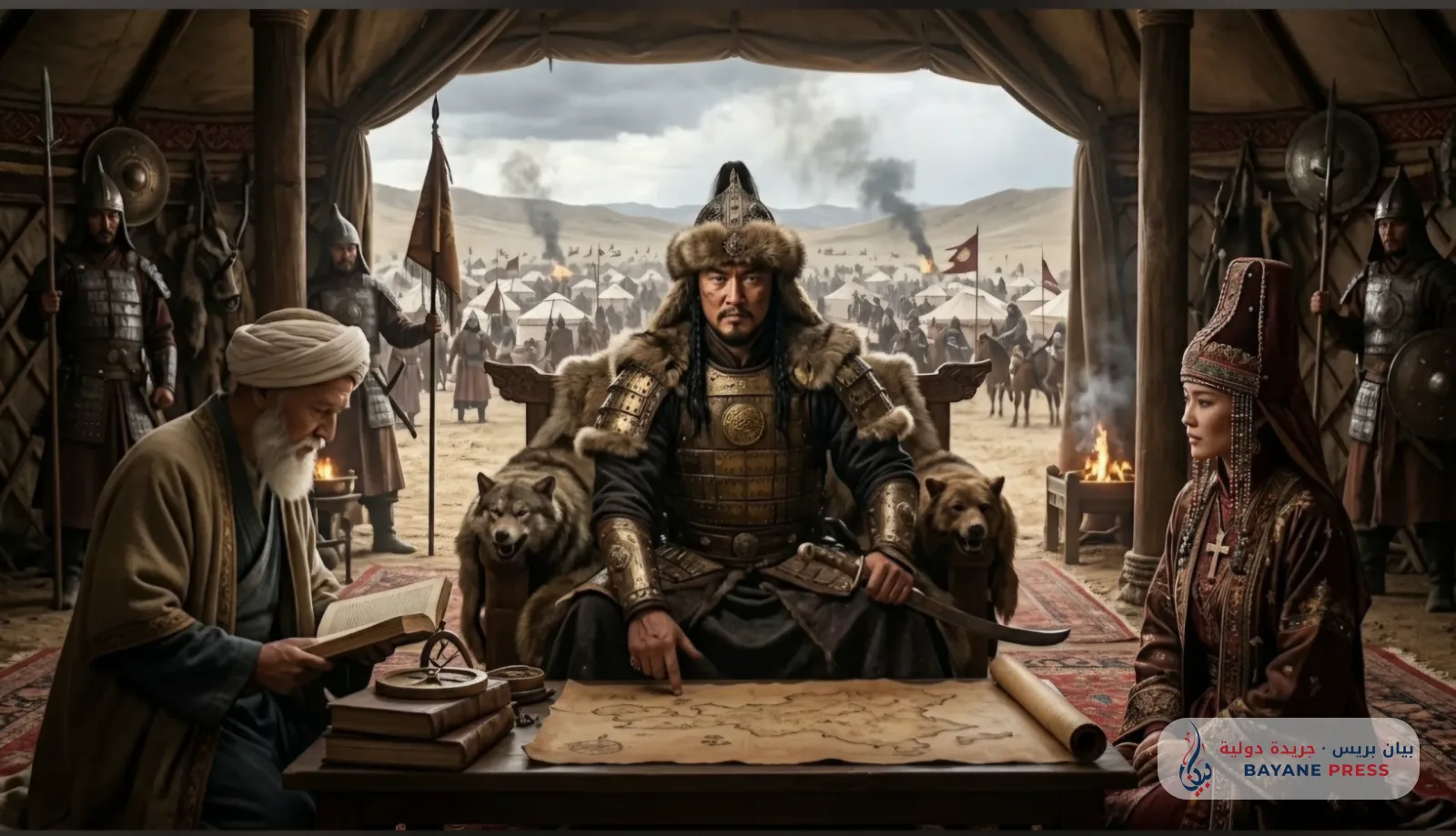
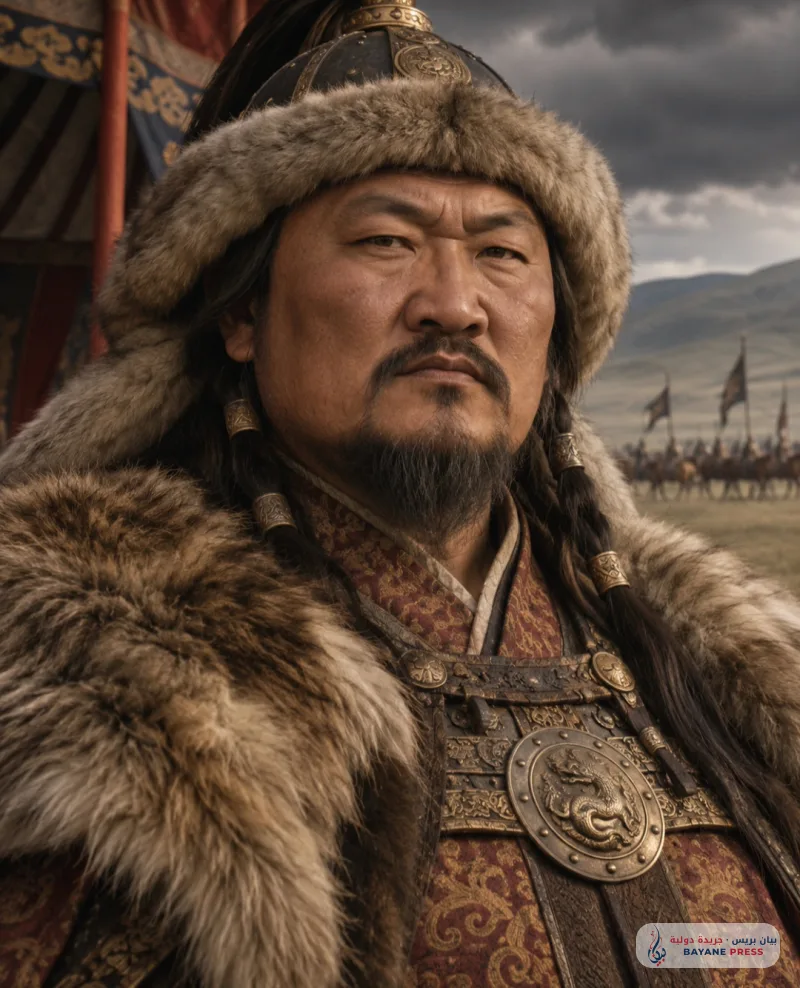
Hulagu Khan was born around 1217 AD, corresponding to the year 614 AH, in the heart of the Mongol steppes, into a family that forged the largest continental empire in human history with the sword. He was the son of Tolui Khan, the youngest and most formidable of Genghis Khan's sons in warfare. His mother was the Keraite princess Sorghaghtani Beki, who practiced Nestorian Christianity and is considered in historical sources, such as Rashid al-Din Hamadani's "Jami' al-Tawarikh" (Compendium of Chronicles), to be one of the most astute and influential women in Mongol history. She raised her four sons—Möngke, Kublai, Hulagu, and Ariq Böke—with military rigor combined with political cunning. Hulagu grew up imbued with the strict Genghisid "Yassa" code, while simultaneously being influenced by the religious pluralism within his court, particularly through his senior wife, the Nestorian Doquz Khatun, who accompanied him on his major campaigns and had a profound impact on his political and military decisions. Primary historical sources, especially Persian and Syriac chronicles, biographical dictionaries, and diplomatic documents, contain rare tales and secrets about Hulagu that transcend his stereotypical image as a bloodthirsty military commander, revealing his psychological anxieties, intellectual contradictions, and the secret workings of his court. Among the first of these secrets is Genghis Khan's prophecy during the "First Hunt Ritual" (1224 AD). The historian Ata-Malik Juvayni in "Tarikh-i Jahangushay" (History of the World Conqueror) and Rashid al-Din Hamadani in "Jami' al-Tawarikh" recount an early incident that occurred when Hulagu was seven years old and his brother Kublai was nine. Their grandfather, Genghis Khan, had returned from his campaign against the Khwarazmian Empire, and the two children met him at the Ili River after Kublai had hunted a wild rabbit and Hulagu had hunted a mountain goat. According to Mongol tradition, Genghis Khan stepped forward to perform the "Yaghlamishi" ritual (anointing the child's middle finger with the fat of their first kill). Kublai extended his hand politely and calmly, while the child Hulagu grabbed his grandfather's hand and squeezed it with such intensity and violence that it astonished the old conqueror. Genghis Khan laughed and said to Kublai: "Hulagu gripped my hand with great strength; this boy will possess immense power and an irresistible authority."
Hulagu's decisive historical role emerged following the Mongol supreme council, the "Kurultai," in 1251 AD (649 AH), when his elder brother Möngke Khan ascended the throne of the Great Khanate in the city of Karakorum. Möngke decided to complete his grandfather Genghis Khan's project of subjugating the known world. He assigned the Southern China front to his brother Kublai and entrusted Hulagu with the task of marching west to subdue the Islamic East, from the banks of the Amu Darya to the borders of Egypt. He set clear strategic objectives: to eradicate the Nizari Ismaili sect, known in historical sources as the Assassins; to subjugate the Abbasid Caliphate in Baghdad; and then to penetrate the Levant and Egypt. He provided him with a massive army, the likes of which the Mongols had never assembled for a single campaign. The Persian historian Ata-Malik Juvayni mentions in his book "Tarikh-i Jahangushay" that Möngke Khan ordered two men to be selected from every ten fighters across the Mongol Empire to join Hulagu's army, in addition to bringing a thousand families of Chinese engineers specialized in manufacturing catapults, incendiary oil, and siege machinery. This military deluge moved from Mongolia in the autumn of 1253 AD (651 AH) in a slow and organized march, for which roads were carved and bridges were built across Central Asia and Persia.
The first major milestone in Hulagu's military march was the destruction of the towering Ismaili Nizari fortresses in the Alborz Mountains and the Rudbar region of northern Iran in 1256 AD (654 AH), strongholds that had resisted the Seljuks and Khwarazmians for decades. Hulagu laid a tight siege to the "Maymun-Diz" fortress and forced the sect's last leader, Rukn al-Din Khurshah, to surrender in November of that same year. He then took the famous "Alamut" fortress and destroyed nearly fifty Ismaili strongholds before ordering the execution of Khurshah and his family, effectively closing the chapter on the Nizari state in Persia. However, this campaign led to a remarkable shift in Hulagu's entourage: the recruitment of the philosopher and astronomer Nasir al-Din al-Tusi, who had been residing in Alamut. He became his close scientific and political advisor after Hulagu permitted him to save thousands of precious manuscripts and astronomical instruments from the Alamut library before it was burned.
After finishing with the Ismaili strongholds, Hulagu turned his attention toward the Abbasid Caliphate's capital, Baghdad, exploiting the political weakness, administrative disintegration, and demobilization of most of the regular army that the city suffered under its thirty-seventh and final Caliph, Al-Musta'sim bi-llah. This was compounded by deep sectarian division and conflicting interests among state officials, as detailed in Islamic sources such as Ibn Kathir's "Al-Bidaya wa'l-Nihaya," Al-Dhahabi's "Tarikh al-Islam," the "Al-Hawadith al-Jami'a" attributed to Ibn al-Fuwati, and the works of Ibn Khaldun. These sources point to the role of the vizier Mu'ayyad al-Din ibn al-Alqami and his correspondence with the Mongols, in contrast to the intransigence of the Dawidar al-Saghir, Mujahid al-Din Aybak. After exchanges of letters containing severe threats from Hulagu and hesitation from the Caliph, the Mongol army closed in on Baghdad from both its eastern and western sides in Muharram 656 AH (January 1258 AD), led by Hulagu and his commander Baiju Noyan. They broke the dams to flood the Abbasid army camps and then battered the walls with catapults until Al-Musta'sim bi-llah was forced to leave his palace on the 4th of Safar 656 AH (10 February 1258 AD) in surrender. Hulagu's soldiers pillaged the city for forty days in a horrific massacre that historians estimate claimed hundreds of thousands of lives. Mosques, schools, and palaces were destroyed, and precious manuscripts from the "House of Wisdom" and libraries were thrown into the Tigris River until its water turned black with ink and red with blood. In this context, the "Gold Platters" debate with Caliph Al-Musta'sim bi-llah stands out. The contemporary historian Minhaj-i Siraj Juzjani in "Tabaqat-i Nasiri," Bar Hebraeus in "Chronography," and the Venetian traveler Marco Polo recount a story that took place during the ten days between the Abbasid Caliph's surrender and his death. Hulagu forced him to reveal a secret basin in the palace courtyard filled with gold and silver ingots. Hulagu then ordered the Caliph to be imprisoned and denied food. When Al-Musta'sim complained of hunger, Hulagu ordered that platters filled with gold and jewels be served to him instead of bread, saying: "Eat what you have collected!" When the Caliph replied that gold cannot be eaten, Hulagu said with cruel sarcasm: "Then why did you hoard it in the earth and not spend it on your soldiers to defend you and your ancestors' kingdom and cross the Euphrates to fight me?" On the 14th of Safar (20 February 1258 AD), Hulagu ordered the execution of Caliph Al-Musta'sim bi-llah in the village of Waqf by trampling, wrapped in a rug to avoid spilling royal blood on the ground, in accordance with Mongol beliefs and the advice of Nasir al-Din al-Tusi, who reassured Hulagu against the warnings of the astrologer Husam al-Din regarding cosmic disasters if the Caliph were killed. During this time, the "Mustansiriya School" fatwa also occurred, which saved the scholars of Baghdad. The historian Ibn al-Tiqtaqa recounts in his famous book "Al-Fakhri" an incident that took place immediately after the fall of Baghdad: Hulagu ordered the survivors among the city's jurists and scholars to be gathered in the Mustansiriya School and posed a cunning political question to legitimize his rule or justify their execution, saying: "Give us a fatwa; which is better: a just infidel sultan or an unjust Muslim sultan?" All the scholars refrained from answering out of fear and embarrassment, until the Shi'a scholar Radi al-Din Ali ibn Tawus stepped forward, took the paper, and wrote his preference for "a just infidel over an unjust Muslim." The other scholars followed his signature one by one, and thus the sword was lifted from their necks by Hulagu's order. Furthermore, his military partner "Baiju Noyan" was liquidated in the shadows. Among the secrets rarely mentioned in general narratives is that after the conquest of Baghdad, Hulagu turned against the most prominent and senior Mongol army commander in the region, "Baiju Noyan" (the commander who had subdued the Seljuks of Rum at the Battle of Köse Dağ and besieged Baghdad from its western side). Rashid al-Din Hamadani mentions that Hulagu harbored suspicion and envy toward him due to his growing influence and suspicion of his secret inclination toward the rival "Golden Horde" princes. He orchestrated a swift military trial in which Baiju Noyan was secretly executed, and his wealth and armies were confiscated. He also executed his first Mongol vizier, "Saif al-Din Bitikchi," in the same manner, fearing that anyone might challenge his sovereign authority.
"Hulagu gripped my hand with great strength; this boy will possess immense power and an irresistible authority."
Hulagu's ambition did not stop at the walls of Baghdad; he formed a close military alliance with King Hethum I of Lesser Armenia and the Crusader Prince Bohemond VI of Antioch, and crossed the Euphrates toward the Jazira and the Levant. He closed in on the city of Mayyafariqin until it fell after a bitter siege, and he killed its Ayyubid emir, Al-Kamil Muhammad ibn al-Muzaffar Ghazi. He then stormed the city of Aleppo in Safar 658 AH (January 1260 AD) and subjected it to sword and plunder for days, which prompted Damascus to surrender without a fight in Rabi' al-Awwal of the same year after the flight of its Ayyubid sultan, An-Nasir Yusuf. Hulagu sent a famous threatening letter to the Mamluk Sultan in Egypt, Saif al-Din Qutuz, calling on him to surrender. However, fate intervened to change the course of history. While in the Levant, Hulagu received news of the death of his brother, the Great Khan Möngke, in China while besieging a fortress. This forced him to retreat eastward toward Azerbaijan with most of his forces in anticipation of the struggle for the Mongol throne between his brothers Kublai and Ariq Böke. He left behind in the Levant a garrison of about ten to twenty thousand fighters led by his Nestorian deputy, Kitbuqa Noyan. Sultan Qutuz and the commander Rukn al-Din Baibars seized this historic opportunity and marched with the Mamluk army to meet Kitbuqa on the 25th of Ramadan 658 AH (3 September 1260 AD) at the decisive Battle of "Ain Jalut" in Palestine. Hulagu's army suffered a crushing defeat in which Kitbuqa was killed, the legend of the invincible Mongol army was shattered, and the Levant slipped from Hulagu's grasp forever, despite the limited retaliatory raids he attempted later.
Following the retreat of his influence from west of the Euphrates and the disintegration of the unified Mongol Empire, Hulagu devoted his final years to consolidating the foundations of his own state, which became known historically as the "Ilkhanate." He took the title "Ilkhan," meaning the Khan subordinate to the Great Khan Kublai in Beijing, and extended his authority over Iran, Iraq, Azerbaijan, and parts of Anatolia, using the cities of Maragheh and Tabriz as bases for his kingdom. However, this phase was consumed by a fierce civil war that broke out between him and his cousin Berke Khan ibn Jochi, leader of the "Golden Horde" in the Kipchak steppes, who had converted to Islam and was enraged by Hulagu's destruction of Baghdad and his killing of the Abbasid Caliph without consulting the princes of the Genghisid house. He allied with the Mamluk Sultan Al-Zahir Baibars to place Hulagu between the jaws of a pincer. Battles erupted between the two sides in the Caucasus region, reaching their peak in late 1262 and early 1263 AD (661 AH) at the Terek River, when the commander Nogai ibn Tatar surprised Hulagu's army and inflicted a heavy defeat, during which thousands of Ilkhanid soldiers drowned after the ice broke under their feet. This drained Hulagu's military strength and prevented him from repeating his campaign against the Levant and Egypt. Behind the scenes of these conflicts, the secret Latin letter to Louis IX, King of France (1262 AD), stands out. A rare historical document in Latin was found in the National Archives in Vienna, dictated by Hulagu in his camp in Maragheh on April 10, 1262 AD, through his European translator "Richard," and sent secretly with his ambassador "John the Hungarian" to King Louis IX of France. In it, Hulagu claims that the heavenly god "Tengri" inspired his grandfather Genghis Khan through the shaman priest "Teb Tengri" to grant the Mongols sovereignty over the earth. He proposes a secret military alliance to the King of France, whereby the French fleet would blockade the coasts of Egypt and the Levant, while Hulagu would march by land to avenge the defeat at "Ain Jalut," recover Jerusalem, and hand it over to the Crusaders. However, Hulagu's preoccupation with his civil war with his Muslim cousin Berke Khan aborted this plan before it saw the light of day.
Historians' judgments and what was said about Hulagu in historical sources varied, reflecting the perspective between the victim and the sultan's entourage. In Arabic and Islamic sources, Hulagu was portrayed as a symbol of oppression and annihilation. The scholar Ibn Kathir described him in "Al-Bidaya wa'l-Nihaya" by saying: "He was a stubborn tyrant, a shedder of blood, draped in the cloak of awe and tyranny," and considered his entry into Baghdad the greatest catastrophe to befall the Islamic world. Meanwhile, the historian Shams al-Din al-Dhahabi described him in "Siyar A'lam al-Nubala" and "Tarikh al-Islam" with traits of strength and cunning combined with excessive cruelty, saying: "He was a brave, firm, and awe-inspiring hero, possessing cunning and guile, a shedder of blood, of great stature." Taqi al-Din al-Maqrizi reported in "Al-Suluk" the words of his Muslim cousin Berke Khan when he stood over the corpses of the slain, moved: "Hulagu has taken the lives of all Muslims, destroyed the lands of Islam, and killed the Caliph without consulting his family." Conversely, Persian historians who worked in the Ilkhanate court, such as Rashid al-Din Hamadani in "Jami' al-Tawarikh" and Ata-Malik Juvayni in "Tarikh-i Jahangushay," along with the Syriac historian Bar Hebraeus in "Chronography," painted another picture of Hulagu inside his council, highlighting his passion for the sciences of wisdom, astronomy, and chemistry, and his association with scholars and sages. Here, the deception of the alchemists and the obsession with the "Elixir of Immortality" become clear. Rashid al-Din Hamadani reveals in "Jami' al-Tawarikh" that Hulagu, in his final years, became obsessed with "ancient chemistry" (alchemy) in search of turning base metals into gold and reaching the "Elixir of Life" that prevents death. A group of charlatans and pretenders who flocked to his court exploited this obsession, and Hulagu spent vast sums from his treasury on them to no avail, until his advisor Nasir al-Din al-Tusi intervened and exposed their tricks through demonstrative experimentation, convincing him that true chemistry is the cultivation of the earth and the observation of the planets. This led Hulagu to expel the alchemists and redirect those funds toward astronomy and mathematics. This was accompanied by the "Copper Basin" trick that convinced Hulagu to build the Maragheh Observatory. Persian sources, including the book "Habib al-Siyar" by the historian Khwandamir, mention that Hulagu initially hesitated when Nasir al-Din al-Tusi asked him for huge sums to build the "Maragheh Observatory," and asked him disapprovingly: "What is the use of the science of the stars if what is to happen is predestined and cannot be prevented?" Al-Tusi asked Hulagu for permission to conduct a practical experiment and secretly ordered a soldier to climb to a height above the camp at night and throw a huge "copper basin" downward. When the terrifying sound of the basin crashing echoed in the silence, Hulagu and all his guards and emirs were startled and jumped for their weapons, while Al-Tusi remained sitting in complete calm. He then turned to Hulagu and said: "This is the benefit of the science of the stars, my lord; he who knows of an event before it happens is not startled when it occurs." Hulagu was impressed by his quick wit and immediately ordered the treasuries to be opened to build the observatory. They noted his order in 1259 AD to build the famous "Maragheh Observatory" under the supervision of Nasir al-Din al-Tusi, equipping it with a library that contained about four hundred thousand volumes collected from the cities of Iraq, the Levant, and Persia. Furthermore, he showed wide tolerance toward Christians thanks to the intercession of his wife Doquz Khatun, whom Armenian and Syriac chronicles called "the new Helena," while Hulagu himself remained attached to Mongol Shamanism mixed with a clear inclination toward Tibetan Buddhism and its "Bakhshi" monks in his later years.
Hulagu's chapter closed in the winter of 663 AH (early 1265 AD), after he was troubled by the appearance of the Great Comet in the sky in 1264 AD and feared evil from it. He was struck by seizures and a severe fever after bathing in his winter camp on the banks of the "Jaghatu" (Zarrineh Rud) river south of Lake Urmia in Azerbaijan. His Chinese and Persian court physicians were unable to treat his ailment, and he breathed his last on the 19th of Rabi' al-Thani 663 AH, corresponding to February 8, 1265 AD, at the age of forty-eight. He was buried according to ancient Mongol traditions in the rocky "Shahi Island" fortress in the middle of Lake Urmia, where he kept his treasures and spoils. The historian Shihab al-Din Wassaf al-Hadra mentions in his book "Tajziyat al-Amsar" that Hulagu's tomb was the last tomb of a Genghisid prince in which treasures were thrown and beautiful slave girls were buried with him in their clothes and jewelry according to the old pagan custom. His life companion, Doquz Khatun, followed him four months later, and his eldest son, Abaqa Khan, inherited the throne of the Ilkhanate.


Comments (0)
No comments yet. Be the first to react!