


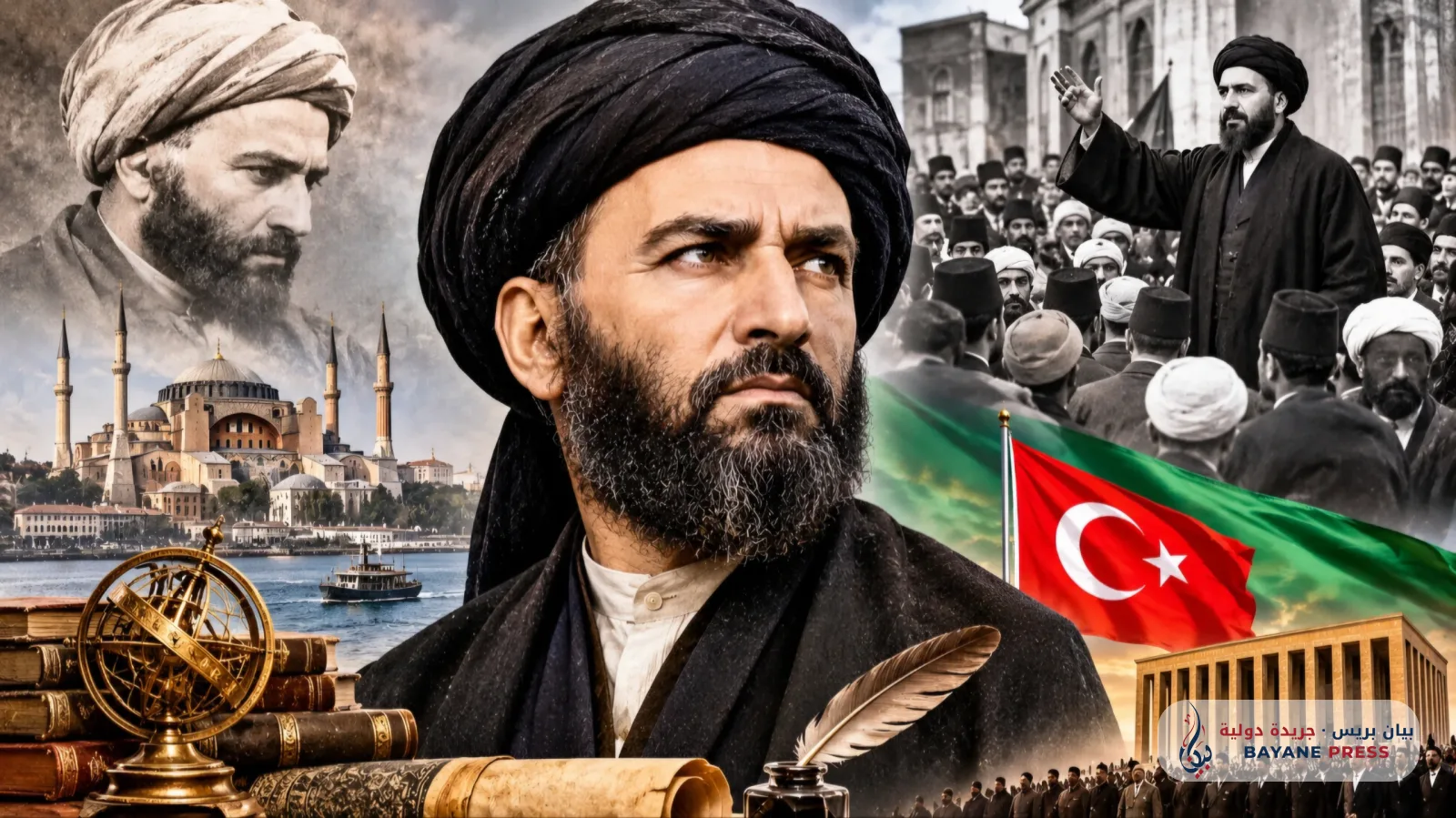
In Sha'ban of the year 1254 AH, corresponding to November 1838 AD, Muhammad Jamal al-Din ibn al-Sayyid Safdar al-Husseini was born in an environment shrouded by one of the greatest documentary enigmas in modern Islamic history. While he announced throughout his life that he was born in the village of 'Asadabad' in the Kunar province of eastern Afghanistan—attributing his lineage to it with the epithet 'Al-Afghani' to gain wide acceptance in major Sunni metropolises and evade the consular and political pursuit of the Qajar Shah of Iran—documents preserved in his family's archives, the memoirs of his nephew and close disciple Mirza Lutf Allah Khan, and British and Ottoman intelligence reports reveal that he was born in the town of 'Asadabad' near the city of Hamadan in northwestern Iran, to a Twelver Twelver Mousavi Husseini family. From his early childhood, signs of sharp intelligence and intellectual rebellion were evident in him. Thus, his father took him at the age of ten in 1848 to the Qazvin school, from where he moved in 1850 during the outbreak of the cholera epidemic to study under the jurist Agha Sayyid Sadiq al-Tehrani, before heading in the same year toward the holy shrines in Najaf and Karbala in Iraq, where he stayed for four full years studying jurisprudence under the renowned jurist Sheikh Morteza Ansari and Mullah Hussein Quli Hamadani. Among the hidden intellectual secrets of that period was his secret immersion in the study of Illuminationist philosophy (Hikmat al-Ishraq), theoretical mysticism, the school of Sheikh Ahmad al-Ahsại, and the emerging Babist movement. He kept in his private box of papers philosophical and esoteric texts that accompanied him on his long travels and later explained his bold rationalist inclination.
In 1855, Jamal al-Din left Iraq via the port of Bushire to India, where he stayed for about two years, during which he studied modern mathematical sciences and the principles of European physics. He witnessed with his own eyes the horrors of the Indian Rebellion of 1857 and the bloody British colonial oppression of Muslims that followed—an early shock that planted in his soul an eternal hostility toward the British Empire. After performing the Hajj pilgrimage in 1857 and wandering through the Hijaz, the Levant, and Iraq, he appeared in Afghanistan in the early 1860s, where he joined the court of Amir Dost Muhammad Khan, witnessing with him the siege of the city of Herat and his death in 1863. He then became the primary political advisor and hidden minister to Amir Muhammad Azam Khan in Kabul between 1866 and 1868. Secret dispatches from the Indian representative in Kabul, preserved in the India Office archives in London, reveal that Jamal al-Din was known there as 'Sayyid Jamal al-Din al-Rumi,' spoke Persian with a Tehran accent, and incited the Amir to ally with Tsarist Russia to expel the British from the Indian subcontinent—until Muhammad Azam Khan was defeated by his British-backed brother Sher Ali Khan. Al-Afghani was thus expelled from Kabul in November 1868 after his request to head to Russian Bukhara was rejected. He exited via Kandahar to India, from where he sailed toward Suez.
Al-Afghani landed in Cairo for forty days in the summer of 1869, frequenting Al-Azhar and meeting the young Muhammad Abduh for the first time, before continuing his journey to Istanbul, the capital of the Ottoman Caliphate, in the autumn of the same year. There, he was received with great warmth by Grand Vizier Muhammad Amin Ali Pasha and appointed as a member of the Supreme Council of Education in 1870. However, his stay in Istanbul ended with a resounding intellectual earthquake in Ramadan of the year 1287 AH, corresponding to December 1870, when he delivered a lecture at the Ottoman 'Dar al-Funun' in which he compared human society to a living body, placing prophecy and philosophy within the context of supreme industries necessary for human life. Sheikh al-Islam Hasan Fehmi Efendi, who harbored deep jealousy toward him, exploited this philosophical expression to accuse him of heresy and disbelief, inciting mosque preachers against him. This forced the Ottoman government to issue a deportation decree to preserve public order, leading him to leave Istanbul for Egypt, arriving there on March 22, 1871.
Al-Afghani settled in Egypt for eight consecutive years at the invitation of Minister Riyad Pasha, who assigned him a monthly salary of a thousand piasters. He took a modest residence in Khan el-Khalili and later in Haret el-Yahud, turning 'Matatia Café,' facing the Azbakeya Garden, into a nightly intellectual parliament surrounded by an elite group of brilliant young men who would later shape the history of Egypt and the East—foremost among them Muhammad Abduh, Saad Zaghloul, Ibrahim al-Helbawi, Abdullah al-Nadim, Adib Ishaq, and Yaqub Sannu'. He taught them at his home the books of Ibn Khaldun, Ibn Sina, logic, and politics, and pushed them to found free newspapers such as 'Masr,' 'Al-Tijara,' and 'Mirat al-Sharq.' Among the deepest historical secrets of his Egyptian years was his involvement in Masonic lodges in 1875 with the aim of utilizing their foreign immunity and organizational secrecy for political work against European intervention and the tyranny of Khedive Ismail. He first joined the 'Kawkouk al-Sharq' (Star of the East) lodge No. '1355', affiliated with the English Grand Lodge, and was elected its president in early 1878. When the British objected to his transforming the lodge into a political revolutionary cell, he broke away and founded the Egyptian National Lodge affiliated with the Grand Orient of France, attracting over three hundred Egyptian notables and army officers, and even inducting Crown Prince Muhammad Tawfiq himself, who swore an oath before him to establish a constitutional government based on consultation (Shura) once he ascended the throne. However, as soon as Tawfiq assumed power in June 1879 following the deposition of his father Ismail, he reneged on his pledge under the instigation of British Consul 'Frank Lascelles,' issuing a secret order on the night of August 24, 1879, to arrest Al-Afghani at dawn as he returned home. He was immediately deported under heavy guard in a closed carriage to the port of Suez without even being allowed to take his clothes or books, and placed aboard a steamship heading to India.
Al-Afghani resided in the city of Hyderabad, Deccan, in India for about two years under strict British surveillance. There, he authored his famous Persian-language book 'Refutation of the Materialists' in 1881, attacking materialist philosophy and the pro-British school of Sir Syed Ahmad Khan. When the Urabi Revolution erupted in Egypt in 1882, the British authorities forcibly transferred him to the city of Calcutta and placed him under house arrest until the war ended with the defeat of Ahmed Urabi and the occupation of Egypt, after which they allowed him to leave in late 1882. Al-Afghani headed toward Europe, visiting London for a few days before landing in Paris in January 1883. There, in May of that year, he engaged in his historic philosophical debate on the pages of the French newspaper 'Le Débats' with the philosopher and orientalist Ernest Renan in defense of the rationality of Islamic civilization. He then summoned his exiled disciple in Beirut, Muhammad Abduh, to Paris, and together they founded—in a small room above the roof of a building on 'Monsieur-le-Prince' street—the secret society and newspaper 'Al-Urwah al-Wuthqa' (The Firmest Bond). Its first issue was published on March 13, 1884, with covert funding from the pro-Eastern British Lord Wilfrid Blunt, some disgruntled members of the Muhammad Ali royal family, and dignitaries from India and Tunisia. Its eighteen issues were smuggled inside cargo boxes and book covers to Egypt, India, and the Islamic world, until British intelligence clamped a financial and postal siege on it, causing it to cease publication in October 1884.
Among the rare emotional and personal secrets in the life of this revolutionary—who never married and constantly repeated that the world was too narrow to accommodate both his family and his mission—is what French police records and memoirs of his contemporaries revealed about his relationship during his Parisian stay with a young German-origin woman named 'Kathy,' who loved him sincerely, accompanied him in his European travels, and kept his secrets and letters in his modest apartment before he left France. In 1885, he was summoned to London to negotiate with Sir Henry Drummond Wolff and Lord Salisbury regarding the Egyptian and Sudanese questions. He then accepted the invitation of Naser al-Din Shah Qajar, arriving at the Iranian port of Bushire in May 1886, and from there to Isfahan and Tehran, where he stayed at the palace of the wealthy merchant Hajj Mohammad Hasan Amin al-Zarb. However, his outspokenness in criticizing tyranny alarmed the Shah, who prompted him to leave the country for Tsarist Russia in the spring of 1887.
Al-Afghani spent two full years in Moscow and St. Petersburg, weaving the threads of a secret alliance with the leader of the Slavic nationalist party, Mikhail Katkov, to persuade Tsar Alexander III to wage war against Britain in Central Asia and India. He also persuaded the Tsar to allow the printing of the Holy Quran and Islamic books for the Muslims of Kazan and Russia. He then met Shah Naser al-Din again in the German city of Munich in 1889 and returned with him to Tehran on the promise of reforming laws. However, the Shah soon reneged on his promise, and Al-Afghani sought refuge in the sanctuary of the shrine of 'Shah Abdul Azim al-Hassani' in the city of Rey, south of Tehran, fortifying himself inside. From there, he managed a vast secret opposition movement, prompting the Shah in January 1891 to violate the sanctity of the shrine and send five hundred soldiers who stormed the place, dragging Al-Afghani from his sickbed in the bitter winter cold, barefoot and semi-naked. They chained him to the back of a mule and marched him under guard through the snow via Kermanshah until they dumped him at the Khanaqin border in Ottoman Iraq.
From his new exile in Basra in 1891, Al-Afghani dealt his most powerful political blow against the Shah of Iran and England. He wrote his eloquent historical letter to the Grand Ayatollah Mirza Hasan Shirazi in Samarra, warning against selling Iran to the British through the tobacco monopoly concession. This resulted in the famous fatwa prohibiting tobacco, which paralyzed Iranian markets and forced the Shah to cancel the British concession. Meanwhile, Al-Afghani secretly left Basra for London in late 1891, where he published the magazine 'Dia al-Khafiqin' (The Light of the Two Horizons) in Arabic and English, launching a fierce campaign from its platform demanding the deposition of Naser al-Din Shah. Faced with the danger of this movement, Ottoman Sultan Abdul Hamid II intervened through his advisor Abu al-Huda al-Sayyadi, issuing an urgent official invitation to Al-Afghani to come to Istanbul and work with him on the Pan-Islamic unity project. Al-Afghani accepted the invitation after hesitation and arrived in Istanbul in the summer of 1892, entering what historians called the 'Golden Cage' from which he never emerged alive.
In Istanbul, Sultan Abdul Hamid allocated a luxurious palace for him in the upscale 'Nişantaşı' district, arranged a monthly allowance of seventy-five Ottoman liras, and offered him marriage to one of the palace concubines. Al-Afghani proudly refused, saying he did not wish to sever his connection to the world of detachment. The Sultan tasked him with forming a committee of Shia and Sunni scholars in Istanbul to correspond with the scholars of Iraq and Iran and unite their voices under the banner of the Caliphate. However, intrigues within Yıldız Palace—led by Abu al-Huda al-Sayyadi after he feared Al-Afghani's growing influence with the Sultan—soon poisoned Abdul Hamid's heart against him. Suspicion reached its peak in the summer of 1895 when Al-Afghani met—either by coincidence or secret arrangement—in the 'Kağıthane' gardens of Istanbul with the young Khedive of Egypt, Abbas Hilmi II. Spies accused Al-Afghani of conspiring with the Khedive to transfer the Islamic Caliphate from the House of Osman to the Muhammad Ali family in Egypt. The Ottoman authorities imposed a tight police blockade on him and barred him from travel after the British Embassy refused to issue him a passport on the grounds that he was an Afghan subject.
The pivotal dramatic event that accelerated Al-Afghani's end occurred on May 1, 1896, when Mirza Reza Kermani—a loyal servant and student of Al-Afghani who had visited him in Istanbul and received his revolutionary instructions—shot Naser al-Din Shah Qajar in the chest with a rusted pistol inside the shrine of Shah Abdul Azim in Tehran, the very place where his master's dignity had been violated five years earlier, crying out at the moment of assassination:
"Take it from the hand of Jamal al-Din!"
The Iranian government demanded that Sultan Abdul Hamid immediately hand over Al-Afghani as the primary instigator of the Shah's murder. The Sultan refused to extradite him, fearing the erosion of his standing as Caliph of the Muslims before a Shia state, but he tightened Al-Afghani's isolation completely within his Nişantaşı palace. A few months later, specifically in the autumn of 1896, a painful boil appeared on his lower jaw. It was diagnosed by the Sultan's private dentist, 'Arif Bey,' and then by the Greek-Ottoman surgeon 'Alexander Kampouroglou Pasha' as jaw cancer. Three successive surgeries were performed on him in which a large part of his lower jawbone was excised, causing him to lose the ability to speak and swallow. This occurred amidst strong historical suspicions recorded by his contemporaries—including Prince Muhammad Ali Tawfiq and Shakib Arslan—that the surgery involved deliberate poisoning or intentional contamination of surgical instruments by secret orders from Yıldız Palace circles to be rid of his political burden.
On the morning of Tuesday, March 9, 1897, corresponding to the 5th of Shawwal in the year 1314 AH, the soul of Jamal al-Din al-Afghani departed at the age of fifty-eight. There was no one by his side in his final hours except his faithful servant 'Abu Turab,' who kept wiping the pus and blood from his speechless mouth. The Ottoman secret police confiscated all his papers and manuscripts immediately upon his death, ordering him to be buried hurriedly and without any official ceremonies in the 'Sheikhs Cemetery' in the Nişantaşı district in the presence of only a handful of people—no more than the fingers of one hand. His grave remained unmarked for nearly thirty years until the American pro-Eastern philanthropist 'Charles Crane' visited Istanbul in 1926 and built a marble mausoleum over his grave, before the Afghan government officially requested the repatriation of his remains in December 1944. The grave was opened, and the coffin was transported via Iraq and India in a majestic procession to be buried in a towering shrine in the heart of Kabul University, following a stormy life that ignited the spark of political and intellectual awakening throughout the Islamic East.


Comments (0)
No comments yet. Be the first to react!