


Gaza Strip - Sunday November 8, 2026
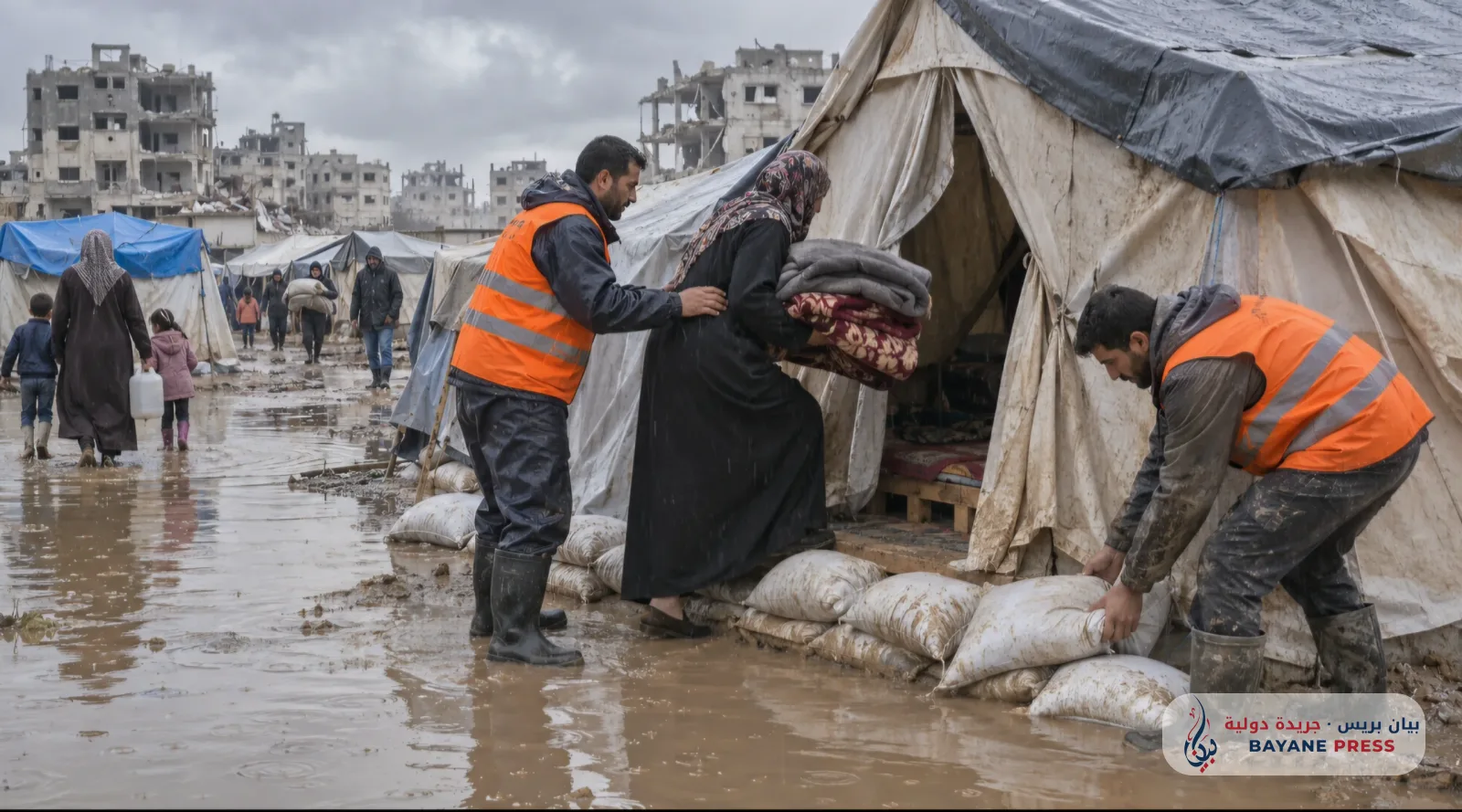
The Supreme Winter Emergency Committee extends its sincere gratitude and appreciation to the heads and members of emergency committees in governorates and municipalities, as well as the teams from Social Development, Civil Defense, Public Works and Housing, the Ministry of Local Government, and all field teams. It commends the immense effort exerted during this current period to address hotspots, take preventive measures, and replace worn-out tents in preparation for the winter season.
The Committee confirms that following the deep weather depression passing through the Gaza Strip, accompanied by heavy rainfall ranging from 45 to 55 mm over 6 continuous hours, initial observations of the depression might lead some toward a "negative outlook." In contrast, it emphasizes the necessity of adhering to a "realistic and positive outlook," which is summarized as follows:
* First: The impact of preventive measures: Were it not for early interventions, the disaster would have been many times worse than what is witnessed on the ground today.
* Second: The scale of field challenges and military control: The rainfall of these quantities in record time usually causes flooding in streets and stable countries with complete infrastructure; how much more so in the Gaza Strip, which has emerged from and is still living the repercussions of a war of extermination, in light of the occupation's continued control by fire, incursions, and forced displacement over more than 70% of the Strip's area, in addition to the deliberate obstruction and hindrance of the entry of rescue vehicles, equipment, tents, and fuel.
The Committee praises the efficiency and dedication of all field teams despite the scarcity of resources, reiterating that "Gaza needs an international response and urgent relief intervention that exceeds the capacity of its local capabilities and institutions under the current circumstances."
The Reality of Displaced Persons and Tents: A Worsening Disaster Affecting Millions
The Committee highlights the tragic humanitarian scene experienced by the population, clarifying the following data:
* Scale of displacement and camps: More than 1.5 million displaced persons in the Gaza Strip face tragic conditions, distributed across 2,100 shelter and displacement camps in various governorates.
* Reality of tents and facing the depression: The Strip's camps contain about 270,000 tents, of which more than 162,000 are completely worn out and dilapidated, leading to the flooding of 70,000 tents due to rainwater and floods.
* Human toll of the damage: The depression caused direct damage to 350,000 people, in addition to recording a number of difficult humanitarian injuries arriving at hospitals in critical condition due to the collapse of walls and parts of houses and buildings damaged by shelling, caused by wind and rain.
* Disruption of public life: The repercussions of the depression and scattered floods lead to the complete disruption of the educational process in various areas of the Strip.
Infrastructure and Local Government: Systematic Destruction and Dilapidated Networks
The Committee confirms that the infrastructure in the Gaza Strip is reaching a state of complete collapse after the Israeli occupation destroyed more than 90% of it, and reviews the field data for the damaged sectors:
* Sewage and rainwater drainage networks: The occupation army has destroyed more than 700,000 linear meters of sewage networks, causing about 190 sites to experience severe sewage overflow during the depression, which warns of imminent environmental and health disasters.
* Roads and streets: The occupation has caused the destruction of more than 3,000,000 linear meters of road and street networks, leading during this depression to the flooding and impact of more than 750 roads and the complete cessation of movement on them.
* Buildings at risk of collapse: Reports from the Ministry of Public Works and Housing indicate the existence of 4,500 buildings classified as dangerous and at risk of falling and collapsing due to previous targeting and current rains, including nearly 90 buildings that must be removed immediately and urgently to protect the lives of citizens and displaced persons adjacent to them.
In facing this difficult reality, emergency teams in the Ministry of Local Government and municipalities are coordinating with partner entities to respond according to available capabilities; interventions include providing barriers, quantities of sand, and sandbags to fortify camps and displacement centers, and protecting tents from flooding. The Committee confirms that these treatments exceed the capabilities of municipalities in light of the severe shortage of heavy equipment and vehicles, which requires urgent support for maintenance work and emergency interventions.
Social Development: Damage Assessment and Relief for 1000 Families in Cooperation with Partners
Within the framework of field monitoring of the depression's repercussions and providing relief to affected families, the emergency teams of the Social Development Directorates in the governorates announce the results of the damage assessment for the sites and camps affected in the field:
* Central Governorate: 75 damaged camps | 2,355 affected families.
* Gaza Governorate: 51 damaged camps | 1,996 affected families.
* North Gaza Governorate: 40 damaged camps | 1,621 affected families.
* Rafah Governorate: 5 damaged camps | 149 affected families.
* Khan Yunis Governorate: 3 damaged camps | 80 affected families.
* Grand Total: 174 camps severely damaged and 6,201 families directly affected.
Social Development clarifies that this comprehensive assessment is being provided to the UN Office for the Coordination of Humanitarian Affairs (OCHA), where partners are initiating assessment and immediate distribution operations for 1,000 affected families, including the provision of tents and emergency relief supplies.
Civil Defense: 2,166 Distress Calls and Field Center Disruptions
For its part, the General Directorate of Civil Defense clarifies that all areas of the Strip are facing a renewed humanitarian crisis during the depression, with rainwater levels rising in some areas to more than 1.5 meters, leading to the flooding of large parts of camps and shelter centers.
Civil Defense field reports indicate:
* Distress calls: Receipt of 2,166 distress calls from citizens, camp administrations, and families whose homes were damaged by shelling.
* Response limits: Teams, in cooperation with municipalities, were able to respond to only 218 calls due to limited capabilities, while the rest of the calls were handled by providing preventive instructions and guidance in the field.
* Closure of centers and cessation of vehicles: The Directorate reveals the closure of entire Civil Defense centers in some areas and their cessation of service as a result of the breakdown of their vehicles and equipment, and the occupation's direct denial of oils, spare parts, and necessary maintenance for these vehicles.
Urgent Demands and Positions
Faced with these catastrophic data and meteorological warnings of a winter season that may witness upcoming heavy depressions, the Supreme Winter Emergency Committee and the competent authorities call for:
* Immediate international pressure: Forcing the occupation to lift the ban and allow the entry of rescue equipment and vehicles, tents, plastic tarpaulins, and mobile homes ("caravans"), and allowing the entry of spare parts and oils for Civil Defense and municipal vehicles.
* Supporting infrastructure and municipalities: Providing urgent international and relief support for the maintenance chain of rainwater and sewage drainage networks (more than 700 thousand meters damaged), and securing heavy machinery to address more than 3 million linear meters of damaged and destroyed roads.
* Securing fuel and equipment: Providing Civil Defense and municipal teams with the necessary fuel to ensure the continuation of the humanitarian response and the reactivation of closed centers.
* Addressing dangerous buildings: Urgent humanitarian and engineering intervention to deal with the 4,500 buildings at risk of collapse, and the immediate removal of 90 buildings that threaten the lives of citizens and displaced persons.
* Assuming responsibilities: Demanding that the countries guaranteeing the ceasefire and the National Committee for Managing the Gaza Strip take urgent action to save more than 1.5 million displaced persons and provide the basic necessities for protection from upcoming depressions.
* Urgent convening: Directing all winter emergency committees in the governorates and municipalities to meet immediately to assess the situation, strengthen points of strength, and address field gaps.
Supreme Winter Emergency Committee
Gaza Strip - November 8, 2026


Comments (0)
No comments yet. Be the first to react!