


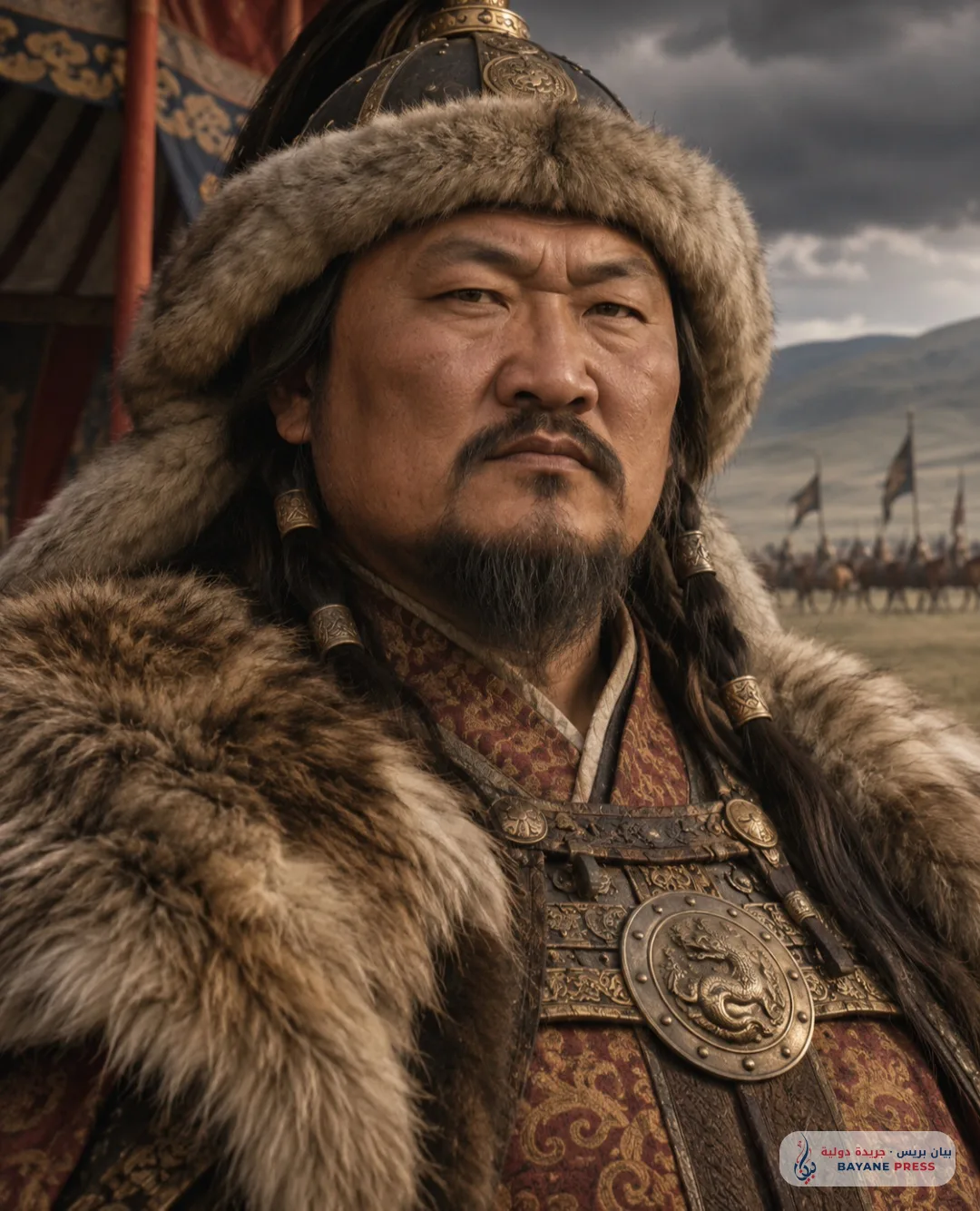
When the Arab historian Izz al-Din ibn al-Athir recorded the events of the Mongol invasion of Muslim lands in the thirteenth century, he did not begin by recounting battles, victories, or defeats, but rather expressed the magnitude of the catastrophe by stating:
"For several years, I refrained from mentioning this incident, overwhelmed by its gravity."
These words were a testament to one of the most violent transformations in the history of the Islamic world, yet they represented only one facet of a more complex story; the story of a man who emerged from the steppes of Mongolia to establish a military state that shifted the balance of power in Asia, opened paths for cross-civilizational exchange, and left behind destroyed cities and societies that paid a heavy human price.
That man was Temujin, historically known as Genghis Khan, whose character and motivations remain a subject of debate among historians. While the Mongolian national memory celebrates him as the founder of the state and the unifier of the tribes, Arab and Persian historical accounts recall him as a leader whose name is synonymous with conquest, slaughter, and ruin. Between these two images, it is necessary to return to historical documents, far from the myths created by imperial propaganda or amplified by the memory of wars.
Temujin was born in Mongolia during the twelfth century; some historians suggest the year 1162, while others propose a later date. The oldest Mongolian accounts, most notably the "Secret History of the Mongols," reveal that he grew up in a turbulent tribal environment, lost his father early, and his family lived through years of isolation and struggle for survival. However, this source, despite its exceptional importance, is not without mythical elements and narratives that glorify the leader's upbringing, making a critical approach essential.
After years of wars, alliances, and defections, Temujin succeeded in subduing rival tribal forces and building a military loyalty that transcended many traditional clan ties. In 1206, a grand council of leaders recognized his supreme authority, and he assumed the title of Genghis Khan, thus giving birth to the nucleus of the Mongol Empire.
Genghis Khan's military genius was not linked to cruelty alone, as some popular narratives suggest. He succeeded in building an army based on discipline, speed of movement, and unit coordination, benefiting from the decimal organization of fighters and the ability of cavalry to cover long distances and maneuver on the battlefield. He integrated elements from defeated groups into his forces and recruited those with military and administrative expertise, which allowed for the transformation of a volatile tribal alliance into an organized expansionist force.
But the question that still faces researchers is: Why did Genghis Khan move from unifying the tribes to an imperial conquest project?
The sources do not provide a single definitive answer. Some link the expansion to the need for resources and trade, others point to the necessity of maintaining tribal unity by directing its power outward, while other researchers focus on the development of a political vision that granted the Mongol ruler the right to sovereignty over other peoples and territories. Historically, it is most likely that these factors interacted, rather than reducing the conquests to a mere personal desire for bloodshed.
Major campaigns began against the ruling powers in northern China, particularly the Jin dynasty in 1211, before expansion turned toward Central Asia. The incident in the city of Otrar in 1218 was one of the most important turning points, after its governor killed a group of merchants coming from Mongol lands and confiscated their goods, and a diplomatic mission sent by Genghis Khan to protest was subsequently killed and insulted.
The Encyclopedia Iranica documents this incident based on Persian historical accounts, including the book "History of the World Conqueror" by Ata-Malik Juvayni. However, considering it the sole cause of the war remains a simplification; the region was already experiencing political and commercial competition between two rising powers.
In 1219, Mongol armies surged into the lands of the Khwarazmian Empire, ruled by Sultan Ala ad-Din Muhammad, beginning a series of campaigns that toppled important urban and commercial centers, most notably Bukhara and Samarkand, with their destructive effects extending to the cities of Khorasan.
Here, the great difference between historical accounts emerges. Ibn al-Athir recorded in "The Complete History" the horrors of the invasion, portraying what happened as an exceptional catastrophe that befell the Muslim lands. As for Juvayni, who lived later under Mongol rule, he combined in his writings the documentation of destruction with praise for some Mongol administrative systems. At the beginning of the fourteenth century, Rashid al-Din Hamadani provided in "Jami' al-Tawarikh" (Compendium of Chronicles) a vast account of Mongol history, benefiting from information linked to the imperial court and its narratives.
The disagreement among these historians does not mean that historical truth is absent, but rather reveals the impact of each author's political and social position on how events were recorded. Ibn al-Athir wrote from within an Islamic world under attack, Juvayni was a Persian official who served the Mongol authority, and Rashid al-Din was linked to the institutions of the Ilkhanate state.
Modern studies, especially the research of historian Peter Jackson published by Yale University, indicate that the massacres that accompanied some Mongol campaigns are a proven historical fact, but the fate of the cities was not uniform. Some were subjected to destruction and mass killing, others survived after surrendering or accepting vassalage, while artisans and professionals were moved from their regions to other centers within the empire.
The death tolls remain one of the most contentious issues. Some medieval sources included massive figures that cannot be statistically verified according to modern standards, especially in the absence of accurate population records. Therefore, it is not correct to treat all circulated numbers as final facts, although this does not negate the occurrence of human catastrophes and widespread destruction.
On the other side of Mongol rule, policies characterized by political pragmatism emerged, including the utilization of experts from different peoples, the protection of some trade networks, and granting religious groups space to practice their rituals. However, these policies were not an expression of modern equality among the population, but were also linked to the state's interest in managing vast territories containing multiple religions and cultures.
Genghis Khan died in 1227 during his campaign against the Western Xia kingdom, before the empire reached its maximum extent. He was not directly responsible for all the disasters that were later associated with the name of the Mongols in the Arab memory.
The fall of Baghdad in 1258 occurred under the leadership of his grandson, Hulagu Khan, more than thirty years after Genghis Khan's death. The invasion led to the end of the Abbasid Caliphate in Baghdad and the killing of Caliph Al-Musta'sim, in addition to widespread acts of killing and sabotage. However, the precise details of some events, especially the figures circulated regarding the victims, remain subject to historical debate.
Two years later, in 1260, the Mamluks, led by Sultan Saif ad-Din Qutuz and with the prominent participation of Emir Baibars, managed to defeat a Mongol force led by Kitbuqa at the Battle of Ain Jalut in Palestine. The victory was decisive in limiting the Mongol advance toward Egypt and restoring Mamluk control over the Levant, without it meaning the fall of the Mongol Empire or the end of its influence in Asia.
The historical irony is that the Mongol forces that swept through large parts of the Islamic world later witnessed profound religious transformations, as a number of their rulers embraced Islam, and some Mongol states became centers for the patronage of Islamic culture, arts, and sciences.
The expansion of Mongol rule also contributed to the revitalization of some land trade routes and facilitated the movement of goods, information, and people between China, Central Asia, the Islamic world, and Europe. However, what is historically known as the "Pax Mongolica" was not a comprehensive peace; wars continued between the Mongol entities themselves, and merchants and cities were subjected to violence and instability at times.
The most important thing revealed by comparing Arab, Persian, and Mongol references with contemporary academic research is that Genghis Khan was not a figure who could be understood by a single moral judgment that cancels out his other dimensions. He possessed an exceptional ability for organization and building military power, but he used this ability in an expansionist project linked to massacres that cannot be justified under the title of civilizational achievements.
The trade that flourished in some stages of Mongol rule was not compensation for the lives lost, just as the atrocities of the invasion do not negate the reality of the political and cultural transformations the empire brought to the history of the Eurasian continent.
After nearly eight centuries, the most important question remains not whether Genghis Khan was a hero or a tyrant, but how a leader belonging to a tribal society with limited resources was able to build a force that subdued ancient nations, and why wealthy and fortified empires failed to confront it?
Studying the Mongol experience offers an answer that goes beyond the person of Genghis Khan himself: power is not always measured by the size of wealth or population, but by the leadership's ability to organize, adapt, and exploit the divisions of opponents. But it also reveals that establishing a great empire through conquests does not guarantee the permanence of its unity, and that history preserves, alongside the news of the victors, the testimonies of those who paid the price for their victories.
Comments (0)
No comments yet. Be the first to react!