

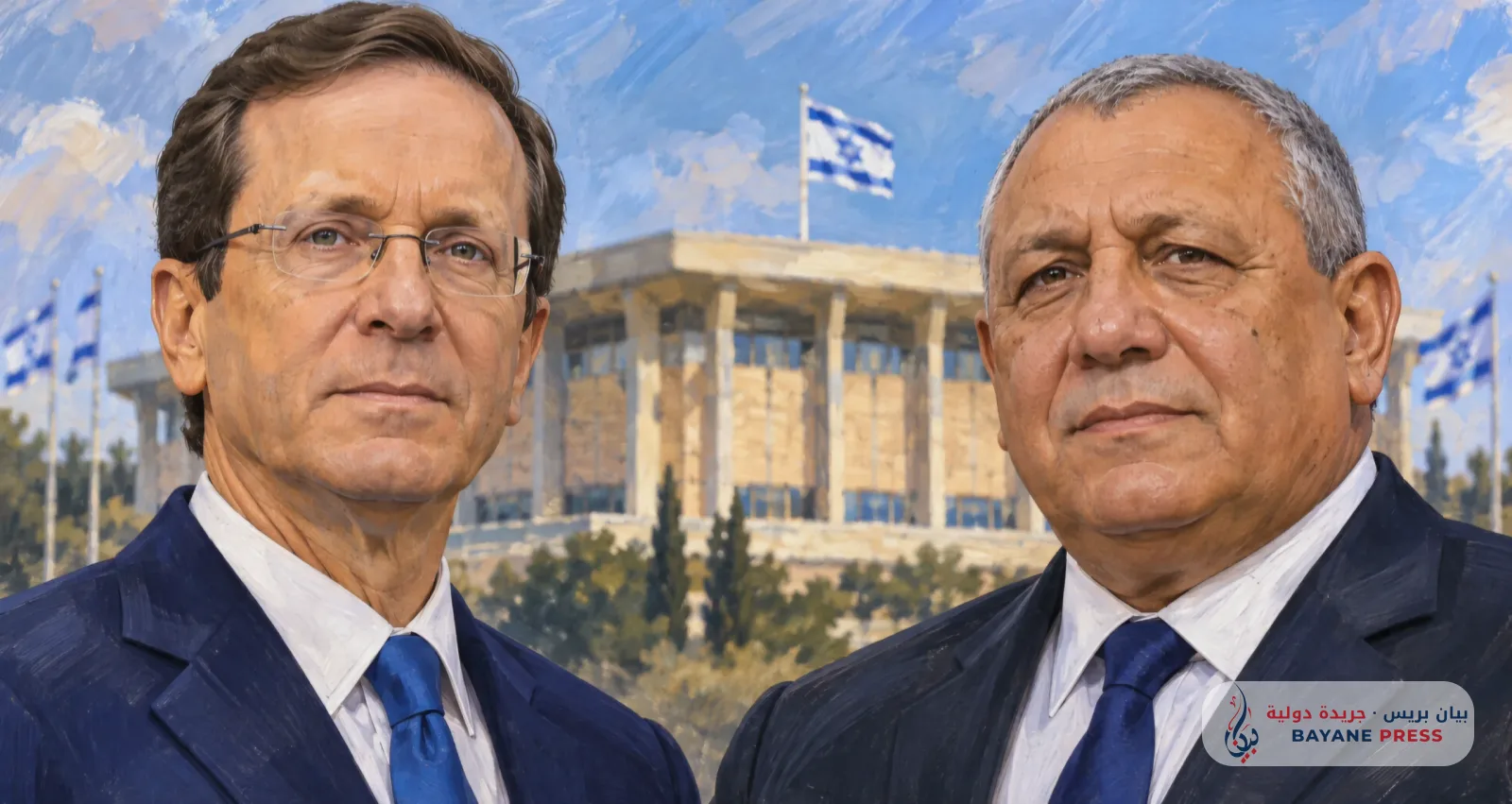
Israeli President Isaac Herzog announced on Saturday evening that he will task 'Yashar' party leader Gadi Eisenkot with forming the new Israeli government, with the official mandate ceremony to be held at the President's residence in Jerusalem tomorrow, Sunday, at 5:00 PM. From the moment he receives the mandate, Eisenkot will have a legal deadline of 28 days to finalize a government coalition, with the President having the authority to extend it by up to 14 additional days.
The decision follows two days of consultations held by Herzog with the factions elected to the 26th Knesset. Eisenkot received recommendations from blocs totaling 67 members, compared to 46 members who recommended Likud leader and Prime Minister Benjamin Netanyahu, while the 'United Torah Judaism' bloc, with its seven members, refrained from recommending either candidate, marking a notable departure from its traditional support for Netanyahu during previous election cycles.
Herzog had postponed the announcement of his decision following the conclusion of consultations on Thursday, preferring to hold private meetings with several party leaders over the weekend, including two meetings with Netanyahu and Eisenkot, in an attempt to push the parties toward rapprochement and the formation of a stable government.
However, the numerical majority gathered by Eisenkot does not necessarily mean a smooth path to the premiership; this figure was reached thanks to the inclusion of recommendations from the Joint List and the United Arab List (Ra'am), which together hold 19 seats, added to the 48 seats of the opposition bloc, without the two Arab parties committing to participate in the upcoming coalition. Indeed, Herzog himself cautioned that Eisenkot's ability to form a government remains uncertain in light of the mutual vetoes between the parties.
The issue of Arab parties represents the most significant hurdle within Eisenkot's camp, as Avigdor Lieberman, leader of the 'Yisrael Beiteinu' party, rejects any partnership with them, while Yair Golan, leader of the 'Democrats' party, has called for an alliance with them. Eisenkot had set principles for any party wishing to participate in his government, including recognizing Israel as a Jewish state and considering Hamas a terrorist organization—conditions that could lead to the exclusion of some Arab members.
The 27 October elections produced a divided landscape in which neither camp secured the necessary majority of 61 seats out of 120. Netanyahu's camp won 53 seats, including 27 for the Likud party, compared to 48 for Eisenkot's camp and 19 for the Arab parties. The new Knesset is scheduled to be sworn in next Tuesday, regardless of the progress of coalition negotiations.
If Eisenkot fails in his mission within the maximum deadline of 42 days, the President has the right to task another member of the Knesset for a non-extendable period of 28 days. Then, a final opportunity remains for 61 members to recommend a third candidate who would be granted a maximum of 14 days, before Israel heads to new elections. Amid these scenarios, the idea of a national unity government—which Herzog has been pushing for since before the vote—or a minority government is also being discussed, noting that Eisenkot has announced his refusal to join any government headed by Netanyahu.



Comments (0)
No comments yet. Be the first to react!