


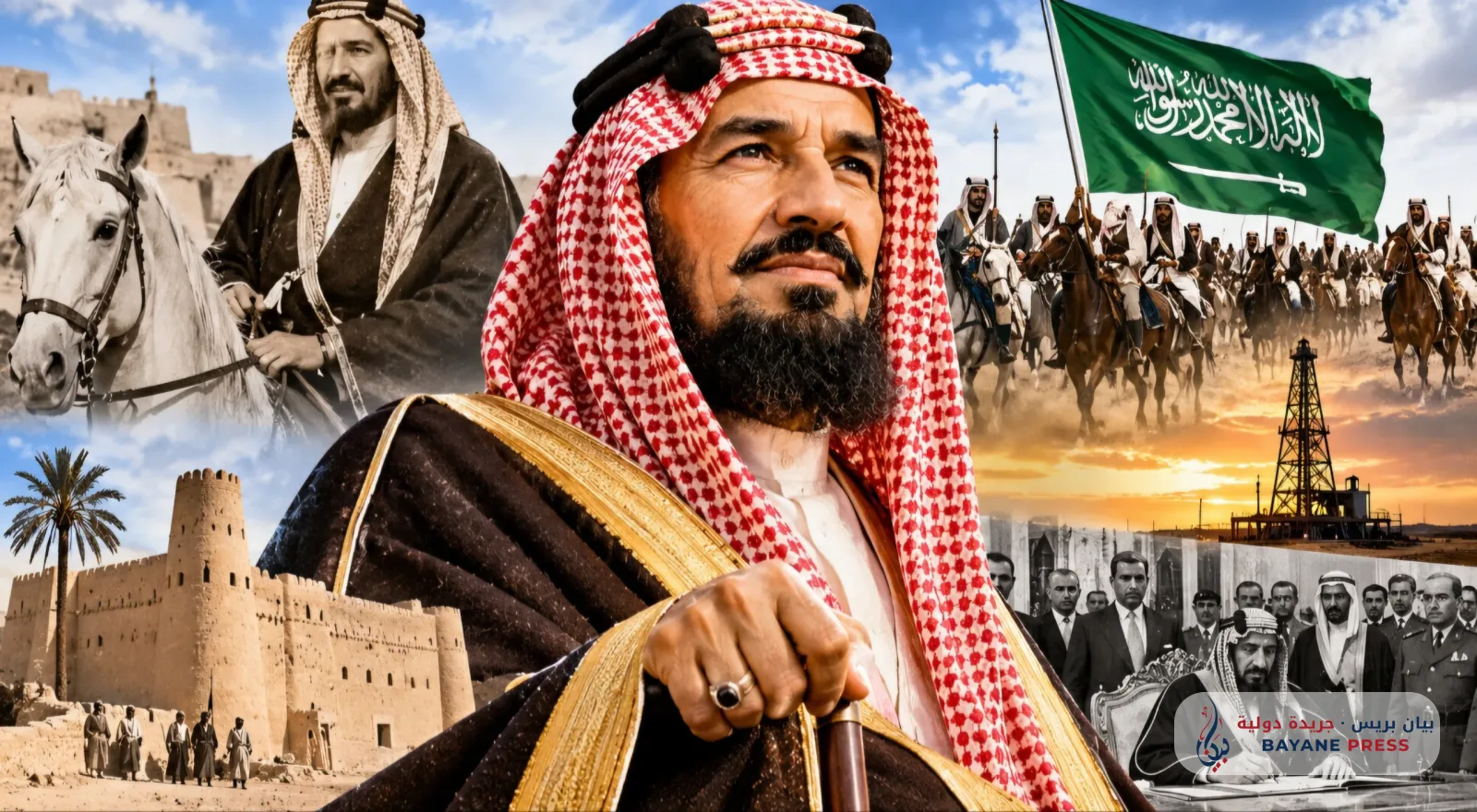
On the 19th of Dhu al-Hijjah in the year 1292 AH, corresponding to January 15, 1876 AD, inside the mud-brick "Al-Bulaida" or "Al-Badi'ah" Palace in the heart of Riyadh, Abdulaziz bin Abdulrahman bin Faisal bin Turki Al Saud was born at a critical historical moment when the pillars of the Second Saudi State were collapsing due to the bloody conflict among his uncles, the sons of Imam Faisal bin Turki. His mother, Sarah bint Ahmed Al-Kabeer Al-Sudairi, was a tall, strong-willed woman from whom Abdulaziz inherited his imposing stature, which later exceeded one hundred and ninety-eight centimeters. His father sent him at the age of seven to learning circles in Riyadh, where he memorized the Holy Quran under the guidance of Judge Sheikh Abdullah bin Abdulatif Al Al-Sheikh and Sheikh Mohammed bin Musibih. In his early youth, he trained in horseback riding, marksmanship, and sword fighting in the riverbed of Wadi Hanifa. One of the early pivotal events that left a mark on his memory was witnessing, at the age of fourteen in 1890, the entry of the powerful Emir of Hail, Mohammed bin Abdullah bin Rashid, into Riyadh. Young Abdulaziz was appointed to the negotiation delegation sent to meet Ibn Rashid. The Shammar emir, recognizing the sharpness of the young boy's gaze, told his companions his famous statement that this boy would achieve great things.
Following the defeat at Al-Mulayda in January 1891 and the fall of the Second Saudi State, Imam Abdulrahman bin Faisal was forced to leave Riyadh at night with his family, fleeing the tyranny of Ibn Rashid. Among the harsh hidden details of that journey was that young Abdulaziz, along with his younger sister Noura, was carried in two saddlebags on the back of a single camel in the darkness of the night. The former ruling family wandered in the unknown wastes of the barren "Rub' al Khali" (Empty Quarter) desert for nearly two full years in the vicinity of the Al-Murrah tribe. There, the boy lived a harsh Bedouin life in all its details, sleeping on the sand, drinking camel milk, and enduring hunger. Indeed, he fell severely ill in the remote desert oasis of "Yabrin" with a fever that almost cost him his life, were it not for the care of his mother and sister Noura, who treated him with cauterization and wild herbs. Afterward, he moved with his father to Bahrain and Qatar, finally settling in Kuwait in late 1892 with the approval of the Ottoman Empire, which allocated a modest monthly stipend of sixty Ottoman liras to Imam Abdulrahman.
In Kuwait, the Saudi family lived in a modest mud-brick house known as "Bayt Al-Amir" in the Al-Wust neighborhood, consisting of no more than three narrow rooms with an open courtyard. There, the young Abdulaziz lived nine years of financial poverty and political wealth. He frequented the councils of Kuwait's astute ruler, Sheikh Mubarak Al-Sabah, nicknamed "Mubarak the Great," sitting in the corner of the council listening in deep silence to the complex secret negotiations Mubarak conducted with British, Russian, and German consuls and Ottoman governors regarding the Berlin-Baghdad railway line and influence in the Gulf. Thus, he emerged from the school of Kuwait with an early diplomatic awareness, understanding the balances of great power. In early 1901, when Sheikh Mubarak Al-Sabah marched his army to fight Abdulaziz bin Mitab Al-Rashid in Qassim, young Abdulaziz bin Saud set out at the head of a small force toward Riyadh, besieging the Al-Masmak Palace. His men began digging a secret tunnel under its walls to blow it up with gunpowder. However, the catastrophic defeat suffered by Sheikh Mubarak Al-Sabah's army at the "Battle of Al-Sarif" in March 1901 forced Abdulaziz to lift the siege immediately and make a rapid retreat to Kuwait.
The 25-year-old youth did not despair. He set out from Kuwait again in the autumn of 1901 at the head of only forty men riding lean mounts and carrying old Martini-Henry rifles, a number that grew along the way to sixty-three men. One of the rarest military secrets of that adventure was that when Ibn Rashid pressured the Ottoman Empire to cut off his father's financial allowances and tribes dispersed out of fear of the Emir of Hail's wrath, Abdulaziz made a bold military decision to completely vanish from sight. He and his men entered the deadly wastes of the "Al-Jafura" sands on the fringes of the Empty Quarter, hiding there for fifty full days during which they fasted the month of Ramadan in 1319 AH, subsisting on dates and wild game meat, until Ibn Rashid's scouts and spies believed they had perished of thirst or returned to Kuwait. On the night of the 5th of Shawwal in the year 1319 AH, corresponding to January 15, 1902, Abdulaziz reached the outskirts of Riyadh by night. He left twenty men with the camels at "Dila' Al-Shuqaiq" with strict instructions to save themselves if his messenger did not arrive by dawn the next day, and advanced with forty-three men to the palm groves in "Al-Shandagha," where he kept his brother Mohammed with thirty-third men. He, along with just seven men, infiltrated the heart of Riyadh, scaling the wall using a palm trunk into the house of a woman named "Juwaiza," which was adjacent to the house of Riyadh's governor, Ajlan bin Mohammed. They stormed Ajlan's house, finding his wife in bed, who informed them that he slept inside the fortified "Al-Masmak" fortress and did not leave it until after sunrise. Abdulaziz summoned his brother Mohammed and the rest of the men inside the house. They sat in the dark drinking coffee, eating dates, and reading the Quran to calm their nerves until the dawn of the 5th of Shawwal broke. The small side gate of the fortress, called the "Khoukha," opened, and Ajlan emerged with his guards to inspect his horses. Abdulaziz and his men pounced on him, shooting him in the leg, and his cousin Abdullah bin Jiluwi followed up by killing him inside the fortress gate in a swift battle that restored the rule of Al Saud.
Following the recovery of Riyadh, Abdulaziz fought a continuous war lasting thirty full years to unify the warring regions of the Arabian Peninsula. In 1904, he clashed with eight regular Ottoman battalions supported by German Krupp artillery sent by Sultan Abdul Hamid to rescue Ibn Rashid in the battles of "Al-Bukayriyya" and "Al-Shinana" in Qassim, where Abdulaziz was wounded by an artillery shrapnel in his left palm and another in his knee. Yet, he held firm until he defeated the joint forces, then eliminated his arch-nemesis Abdulaziz bin Mitab Al-Rashid at the "Battle of Rawdat Muhanna" in April 1906. In May 1913, he carried out a surprise night operation that expelled the Ottoman garrison from the coastal region of Al-Ahsa without notable bloodshed. With the outbreak of World War I, he managed a delicate balancing act. At the "Battle of Jirab" in January 1915 against Ibn Rashid, the English Captain William Shakespear was killed while operating an artillery piece in the ranks of Abdulaziz's forces. In June of the same year, during the nocturnal "Battle of Kanzan" against the Ajman tribe in Al-Ahsa, his beloved brother Saad bin Abdulrahman was killed beside him, and Abdulaziz himself was seriously wounded by a bullet that pierced his abdomen and lower chest. Among the astonishing secrets of his political cunning was that when his enemies spread news of his death from his wounds to destabilize tribal loyalty, he ordered a girl from the notables of Al-Ahsa to be brought forward, married her, and consummated the marriage that very week while bleeding under his medical bandages to cut off rumors and prove to the Bedouins that he was in full health. Then, in December 1915, he signed the "Darin Treaty" with British High Commissioner Sir Percy Cox, securing British recognition of his rule and financial assistance without entangling his army in the major war fronts.
After decisively overthrowing the Al Rashid Emirate in Hail in November 1921, Abdulaziz set an unusual precedent in tribal warfare by refraining from taking revenge against the family of his historical adversaries. He relocated the Al Rashid princes and their children to Riyadh, housing them honorably in his palaces and marrying his children to their daughters. He then turned his attention westward toward the Hijaz, conquering Taif, Makkah, Medina, and Jeddah between 1924 and 1925, thereby ending the rule of the Hashemite Sharifs. However, the most dangerous crisis that nearly shattered his realm from within erupted between 1927 and 1929 when hardline leaders of the "Ikhwan" (Brotherhood) movement rebelled against him, led by Faisal Al-Duwaish, Sultan bin Bujad, and Dhaidan bin Hithlain. They opposed the demarcation of borders with British-ruled Iraq and Jordan, and forbade the introduction of the telegraph, wireless telephone, automobiles, and bicycles, considering them the work of Satan and sorcery. Among the documented historical anecdotes is that to convince the scholars and Ikhwan leaders that the wireless device was not inhabited by demons, King Abdulaziz ordered engineers to read Quranic verses via the microphone in Makkah so the sheikhs could hear them through the receiver in Riyadh, arguing against them with the Quranic verse that denies demons descending with the Quran. When the rebel leaders insisted on armed disobedience, he marched against them personally and settled the matter militarily at the decisive "Battle of Sibila" in March 1929, paving the way to officially declare the unification of the country under the name "Kingdom of Saudi Arabia" on September 23, 1932.
Among the rare hidden events rarely mentioned with precise details is the horrifying assassination attempt faced by King Abdulaziz inside the Grand Mosque in Makkah on the Day of Sacrifice (Eid al-Adha), the 10th of Dhu al-Hijjah in the year 1353 AH, corresponding to March 15, 1935, known as the "Haram Incident." While the King was circumambulating the Holy Kaaba on his fifth circuit, wearing the two white, unstitched garments of Ihram and unarmed, accompanied by his crown prince Prince Saud, three Yemeni men armed with sharp daggers rushed from behind Ismail's Stone and the Black Stone. The first, Ali bin Hazam, lunged directly toward the King's chest. Prince Saud leaped like lightning, throwing his body in front of his father to take the deep dagger thrust in his left shoulder, while the King's personal guard, led_by Abdullah bin Khunizan, engaged the three attackers and shot them dead in the Mataf courtyard within seconds. The King continued his Tawaf with composure after the blood was washed from the Mataf.
On the economic front, the nascent state faced the specter of total bankruptcy in the early 1930s due to the Great Depression and the decline in pilgrim numbers from one hundred thousand to fewer than twenty thousand, to the point where the treasury could not pay employee salaries and borrowed from local merchants. Here, the former British advisor who converted to Islam under the name "Abdullah Philby" played a decisive secret role. He advised King Abdulaziz to open the door to American companies to break the British monopoly. Thus, Minister of Finance Abdullah Al-Sulaiman signed on May 29, 1933, at Khuzam Palace in Jeddah, an oil exploration concession agreement with the American company "Standard Oil of California" in exchange for thirty-five thousand English gold sovereigns delivered in cash in wooden boxes to the port of Jeddah. After five lean years of failed drilling in the Dhahran desert that almost led the American company to pack up its equipment and leave in despair, oil gushed in massive commercial quantities on March 4, 1938, from "Dammam Well No. 7" at a depth of one thousand four hundred and forty-one meters—a well the King later named "Prosperity Well"—shifting the country from a desert subsistence economy to the heart of the global energy equation.
In February 1945, in an unprecedented historical move, King Abdulaziz left the territory of the Arabian Peninsula aboard the American destroyer USS *Murphy*, whose steel deck was covered with oriental rugs, Bedouin tents were erected upon it, and eighty sheep were brought aboard to be slaughtered fresh for the meals of the King and his entourage. He headed to the "Bitter Lakes" in the Suez Canal to meet US President Franklin D. Roosevelt aboard the cruiser USS *Quincy* on February 14, 1945. Among the documented hidden details of that meeting is that Roosevelt, who was paralyzed, gifted King Abdulaziz his personal spare wheelchair upon learning that the King suffered from painful stiffness in his knee joint due to old war injuries. During the discussions, Abdulaziz firmly and decisively rejected Roosevelt's financial temptations in exchange for accepting the resettlement of European Jews in Palestine, stating his famous phrase that the aggressor Germany should pay territorial compensation to the Jews, not Arabs paying the price for a crime they did not commit. He extracted from Roosevelt a written promise signed on April 5, 1945, just one week before the American president's death, that Washington would take no action in Palestine without consulting the Arabs. Just three days after the Bitter Lakes summit, the King met British Prime Minister Winston Churchill at the Auberge du Fayoum hotel in Egypt. During the long hours of the meeting, Churchill was forced to refrain from smoking his Cuban cigar and consuming alcohol out of respect for the strict traditions imposed by the King in his council, even though Churchill had previously extracted from him symbolic approval to declare war on Germany and Japan to secure a seat for the Kingdom of Saudi Arabia as a founding member of the United Nations.
In his private life, King Abdulaziz wove a wide-ranging network of tribal intermarriages that included most major tribes and families in the Arabian Peninsula to cement national unity through the bond of blood. He fathered thirty-six surviving sons and twenty-seven daughters. However, the deepest emotional wound that never healed in his heart throughout his life occurred in 1919—the year Najdis called the "Year of Mercy" due to the outbreak of the lethal Spanish flu pandemic—when death snatched away in a single week his eldest son and right-hand military arm, Prince "Turki the First," and his most beloved wife, Princess "Al-Jowhara bint Musaed bin Jiluwi." The King ordered Al-Jowhara's room in the Al-Dira Palace in Riyadh to be locked with her belongings and perfumes left untouched for decades. He would enter it alone at night to weep there in secret. He was also deeply attached to his sister, Princess "Noura bint Abdulrahman," whom he cherished, shouting in decisive moments: "I am the brother of Noura!" His daily routine was strict and unchanging; he slept no more than four fragmented hours at night and during the day, spent the early dawn hours reading the Quran and supplications, and was fond of French perfumes blended with Indian oud oil and Taif rose water.
Since the beginning of 1953, King Abdulaziz's health deteriorated rapidly due to coronary atherosclerosis and angina pectoris. In the summer of that year, he moved to the city of Taif, hoping the moderate mountain air would alleviate his shortness of breath. He stayed in a modest palace belonging to his son Prince Mansour bin Abdulaziz in the "Al-Hawiya" neighborhood, rejecting the advice of his American and Arab doctors to travel abroad for treatment, preferring to die on the soil of his country. On October 9, 1953, he issued the last royal decree of his life establishing the "Council of Ministers" headed by his crown prince Prince Saud to institutionalize governance before his departure. At dawn on Monday, the 2nd of Rabi' al-Awwal in the year 1373 AH, corresponding to November 9, 1953, after praying Fajr and listening to the recitation of Surat Yaseen, he suffered a severe heart attack and breathed his last at exactly 4:30 AM at the age of seventy-seven. His body was transported after Dhuhr prayer on a special Dakota aircraft from Al-Hawiya Airport in Taif to Riyadh, and he was laid to rest before sunset that same day in a simple, unmarked grave inside the "Al-Oud Cemetery" in Riyadh, thus closing the biography of a man who redrew the geopolitical map of the Arabian Peninsula in the 20th century.

Comments (0)
No comments yet. Be the first to react!