


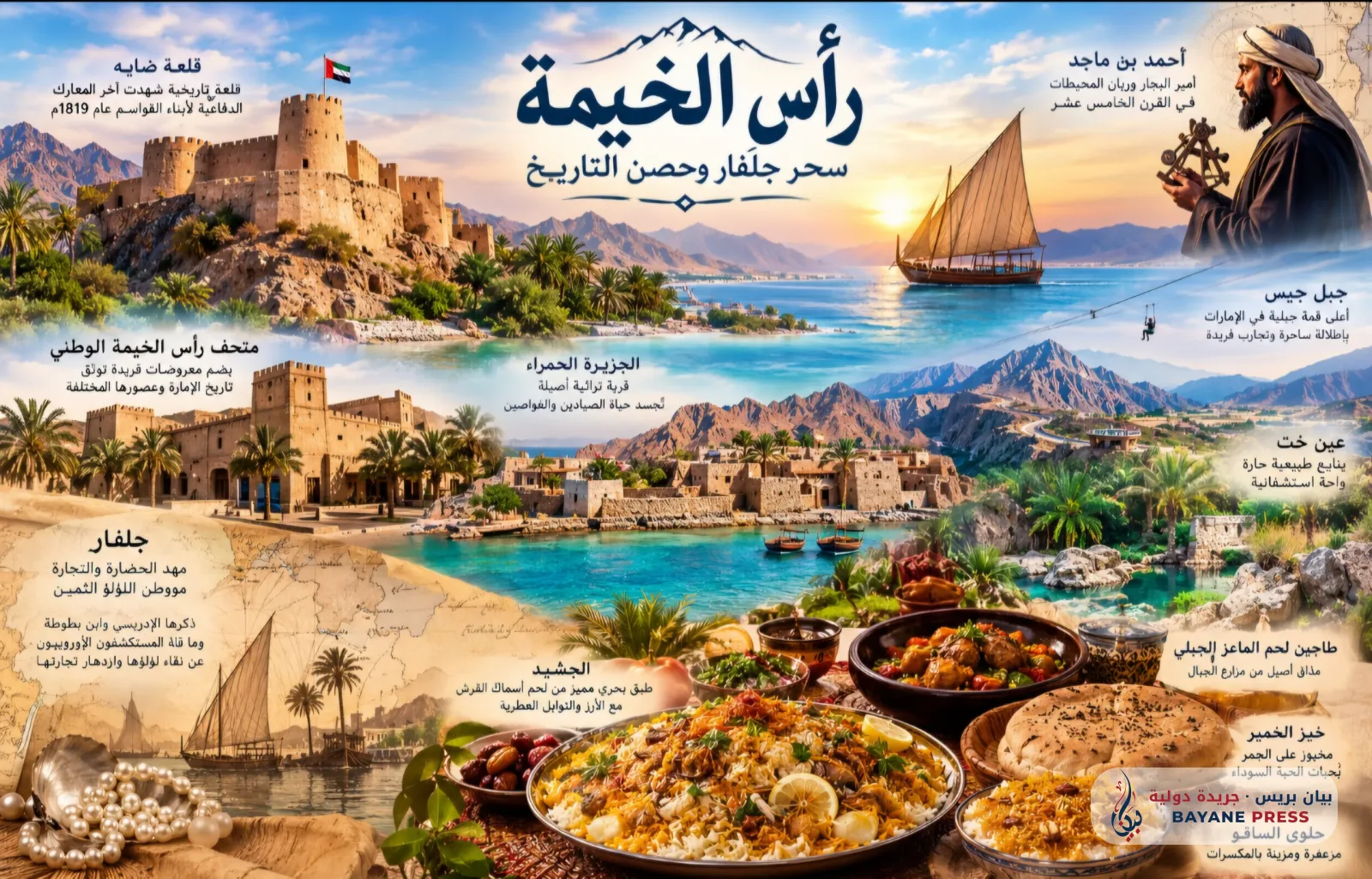
Ras Al Khaimah rests upon a glorious and deeply rooted historical throne under its immortal name of "Julfar", that great metropolis documented by archaeological excavations at the sites of Sham, Ghalilah, and Al-Hulaila Island. Since the third millennium BC, this region has constituted the cradle of distinctive pottery industry and copper trade in the Wadi Suq culture, before becoming in the Islamic Middle Ages the premier commercial port of the southern Gulf for the export of porcelain and the trade of precious natural pearls to China, India, and the coasts of Africa. From the maritime routes of Julfar set sail the prince of the seas and celebrated ocean navigator Ahmad ibn Majid in the 15th century AD, leaving behind written nautical poems and treatises that guided ships through the turbulent waters of the Indian Ocean and the Arabian Sea. In modern centuries, the ancient Al Qasimi tribes settled in Ras Al Khaimah, turning it into a maritime capital and a fortified base for their war fleets, which grew to number hundreds of ships. They confronted Portuguese and British colonial ambitions, writing memorable epics in defense of the independence of their waters, until the emirate joined the auspicious union on February 10, 1972 under the leadership of the late Sheikh Saqr bin Muhammad Al Qasimi, thus combining the fragrance of maritime heritage with the majesty of its captivating mountainous nature.
Ras Al Khaimah is home to the most impressive archaeological castles and forts in the United Arab Emirates, crowned by the historic "Dhayah Fort", built in the 16th century with mud and coral stones on top of a rocky hill overlooking the palm groves and coastal waters. This fort was the scene of the Al Qasimi's last heroic defensive battles against British forces in 1819. In the heart of the city stands the "Ras Al Khaimah National Museum", located within the former royal palace of the ruling family, which houses an exceptional defensive tower and unique exhibitions documenting the Stone Age, the pearl trade, and historical weapons. On the southwestern coast rises "Al Jazirah Al Hamra", an integrated heritage village abandoned by its inhabitants in the middle of the last century, thus preserving its original character as the most authentic model of a fisherman and pearl diver village in the Arabian Gulf, with its narrow alleys, houses and towers built from coral stone, sea shells, and palm fronds, alongside its ancient mosques. In the east of the emirate looms the majestic peak of "Jebel Jais", the highest mountain peak in the United Arab Emirates with an altitude of nearly nineteen hundred meters above sea level, offering fascinating mountain routes and the world's longest zipline, combining with natural hot springs in the therapeutic oasis of "Ayn Khatt".
Julfar and Ras Al Khaimah have held a place of extreme importance in the chronicles of travelers and geographers over the centuries; the geographer Al-Idrisi mentioned them in "Nuzhat al-mushtaq", praising their pearl banks and the movement of their vessels, and Ibn Battuta immortalized them in his journey as he traversed the ports of the Gulf and the Sea of Oman. The Portuguese explorer and traveler Pedro Teixeira recounted in the early 17th century the purity of Julfar's pearls and their exceptionally high quality, making them the most valuable in the markets of Lisbon, Madrid, and Goa. The Portuguese writer and traveler Duarte Barbosa recorded in his works the details of Julfar's prosperity and the influx of Muslim captains and merchants to its markets to close transactions for horses, pearls, and spices. Likewise, British leaders and officers wrote in their 1819 military reports about the extraordinary valor of the defenders in Dhayah Fort and the walls of Ras Al Khaimah, praising the bravery of the tribesmen and their exceptional skill in combat across rugged terrain among towering summits and coastal paths.
Ras Al Khaimah's gastronomy possesses an exceptional singularity that fuses the riches of the fertile foothill farms with the sea's great variety of fish. The dish of "Al-Jashid" tops the list of its most famous popular foods; it is an exquisite seafood dish made from the meat of young sharks, known locally as "Awal" or "Yair", or with Lokh fish brought fresh from the Gulf. The fish is cleaned and boiled in salted water with lemon juice, turmeric, and pieces of desert dried limes (loomi) to remove fat and impurities. Next, it is drained, the white meat is separated from the skin and cartilage, and finely shredded by hand. Afterwards, chopped onion, garlic, and ginger are sautéed in a hot pot with traditional aromatic ghee, frying well before adding the shredded fish meat along with a rich mixture of fresh coriander, dill, cinnamon powder, cardamom, turmeric, black pepper, and Emirati fish spices. The mixture is stirred over low heat until completely dry, absorbing the aromas and releasing a delightful fragrance. Al-Jashid is served hot over a pyramid of white rice cooked with rose water and garnished with fried onions, pouring a few drops of melted clarified butter over it. The emirate's mountain tables are also famous for mountain goat stews cooked in underground earth ovens (tanoor), "Khamir" bread flavored with black anise seeds and baked over hot coals, and the saffron "Sago" dessert, translucent and sprinkled with toasted walnuts and almonds.
Comments (0)
No comments yet. Be the first to react!