


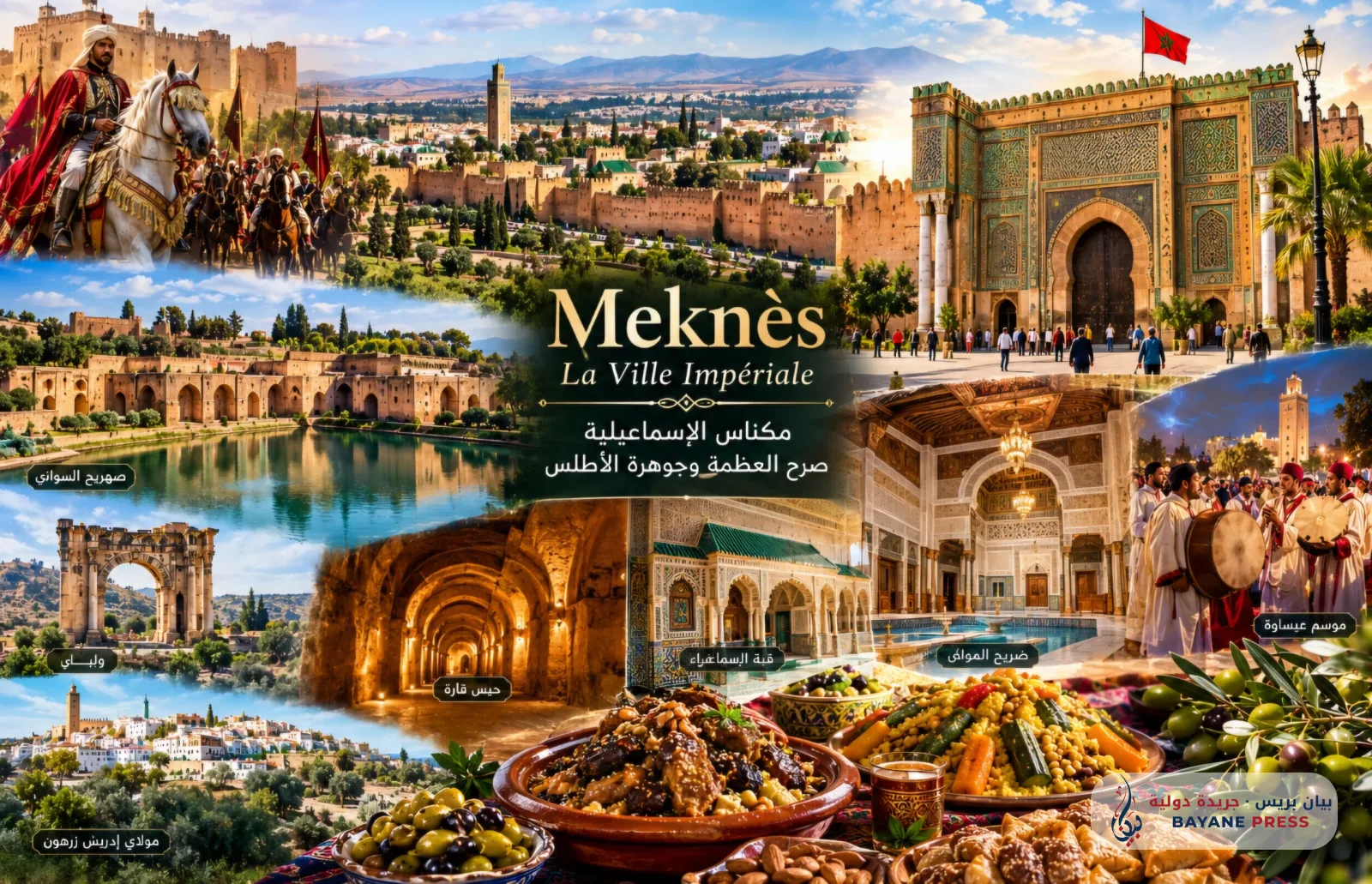
The early origins of Meknes date back to the 4th Hijri century when factions of the Zenata Amazigh tribe of "Meknasa" settled on the banks of Wadi Boufekrane in the fertile Saiss sedimentary basin. Benefiting from abundant water resources, high-quality agricultural land, and flourishing vineyards, it evolved from a rural settlement and scattered fortresses into a fortified town. It attracted the attention of the Almoravids, who built the "Takerart" kasbah and the Nejjarine Mosque there, followed by the Almohads, who expanded its Great Mosque and brought the waters of Wadi Rekrak via elaborate canals. However, the greatest historical turning point in the city's saga occurred in 1672 AD, when the powerful Sultan Moulay Ismail bin Sharif ascended the throne of the Alaouite State. He made Meknes the major military and political capital of his united kingdom, embarking on a colossal urban project unmatched in North Africa. Aspiring to build a imperial capital matching the majesty and vastness of the Palace of Versailles under his contemporary, King Louis XIV of France, he established within its walls the permanent camps for his famous regular army, the "Abid al-Bukhari army." This transformed the city into a towering strategic fortress surrounded by massive earthen and stone walls exceeding forty kilometers in length, punctuated by defensive towers and musketry loopholes.
Meknes's structures encapsulate Sultan Moulay Ismail's ambition for immortality, chief among them being "Bab Mansour al-Alej" overlooking El Hedim Square. This gate was completed by his son, Sultan Moulay Abdallah, in 1732 AD, crafted by an architect who converted to Islam and was thus nicknamed "Al-Alej" (the Renegade). It is truly the crown jewel of historical gates in the Islamic West, featuring intertwined broken arches and intricate green and yellow zellij mosaic decorations. Its majesty is completed by two colossal ancient Corinthian marble columns brought from the ruins of the nearby Roman city of Volubilis. El Hedim Square, planned as a spacious courtyard to accommodate military parades and imperial events, leads to the landmark of "Heri es-Souani" or the House of Water. These are massive grain storehouses characterized by thick walls and giant arched vaults carefully designed to keep crops cool and maintain a moderate temperature for years in anticipation of sieges and droughts. They connect directly to the "Souani Basin" (Agdal Basin), a vast artificial water reservoir covering an area of four hectares, excavated to supply the imperial stables which once housed twelve thousand horses of the Ismaili army through an advanced system of rotating water wheels powered by the horses themselves.
The secrets of Meknes continue within "Habs Qara," a vast complex of underground vaulted dungeons and corridors without windows, around which endless popular legends have been woven. It was built as a prison for warriors and captives and a strategic military warehouse for equipment and provisions. Nearby stands the "Dome of the Ambassadors" (Qebbat al-Sufara), the magnificent hall where Sultan Moulay Ismail received envoys, diplomats, and ambassadors of European kingdoms to negotiate ransoms and conclude trade treaties. The landmarks of the Ismaili city are completed by the "Mausoleum of Moulay Ismail," representing an oasis of serenity and architectural majesty with its marble-tiled hallways, softly murmuring fountains, and delicate plaster carvings crowned with gold-painted cedarwood capitals, alongside impregnable royal palaces such as the Mhencha Palace, Dar al-Makhzen, and the Mansour Palace, as well as other major defensive gates like Bab El Khemis and Bab Berdaien. Geographically and historically, Meknes is linked to its immediate hinterland: the ancient Roman city of Volubilis with its preserved mosaics and triumphal arch, and the white town of "Moulay Idriss Zerhoun," which cradles the tomb of the founder of the Idrisid dynasty amidst the mountain slopes.
The accounts of ambassadors and orientalists chronicled the details of the Ismaili court in Meknes, led by the English writer John Windus's book entitled "A Journey to Mequinez," published in 1725 AD. He accompanied the embassy of Captain Charles Stuart to ransom captives and recorded his overwhelming astonishment at the massive scale of the Ismaili walls, the agility of the horses in the stables, and the grandeur of the military parades involving thousands of soldiers and horsemen. The Moroccan historian Abd al-Rahman ibn Zaydan recorded in his seminal encyclopedia "Ithaf Alam al-Nas bi-Jamal Akhbar Hadirat Meknes" a towering historical documentation gathering details of military and urban organizations, as well as the city's figures and scholars. The French novelist Pierre Loti recorded his deep emotion upon seeing the sprawling walls of Meknes at dusk, describing them as built with enough solidity to defy the centuries and the vicissitudes of time. Furthermore, the testimonies of liberated European captives, such as the German Gregorius and the fatwas of Spanish redeemers, left images rich in information about daily life and the sophisticated urban organization of the city at the height of its power.
Meknes is an ancient cradle of Sufi orders, prominently featuring the "Zawiya al-Isawiyya," founded by Sheikh Muhammad bin Issa, known as "Al-Sheikh al-Kamil" (The Perfect Sheikh), whose order branched out across Morocco and the Islamic world. The annual Moussem of Aissaoua is held there coinciding with the anniversary of the Prophet's birthday (Mawlid), filling the city's alleys with the piercing tunes of the Isawiyya ghaita, large drumbeats, and the swaying of muridin (disciples) in the ecstatic Sufi "Hadra." Meknes was also a pioneering capital for the masters of "Malhoun" poetry, where its greatest poets lived and composed. Foremost among them were Sidi Kaddour al-Alami (Sidi Abd al-Qadir bin Muhammad al-Alami), author of renowned poems, along with the poet Ahmed al-Ghrabli and Al-Tohami al-Madghari, who immortalized the city's alleys and gardens in a unique popular poetic diwan.
Meknes cuisine reflects the fertility of the Saiss orchards and its prized olives, with "Tagine Mderbel" standing at the forefront of its ancient traditional dishes. This is an upscale imperial dish in which tender lamb is slow-cooked over charcoal with minced onions, garlic, pure saffron, ginger, and a cinnamon stick until the sauce reduces and turns a deep golden brown. Meanwhile, fresh black eggplants are sliced into rounds, salted, and fried in olive oil until browned. They are then dipped into a parallel pot containing the meat broth with the addition of sugar or honey and a generous dash of cinnamon and toasted sesame seeds. The caramelized eggplant rounds are arranged atop the pyramid of tender meat in a unique harmony blending saltiness and sweetness with a punch of authentic spices. Meknes is also famous for "Couscous with Seven Vegetables" topped with Tfaya (caramelized onions and raisins), as well as the high quality of its renowned oil and olives. In the Rahbat Bab Boudir market, shops selling marinated olives of all kinds—stuffed with almonds, seasoned with mountain thyme, harissa, and garlic cloves—line the streets, and the meal is completed with crunchy "Feqas Meknassi" pastries with almonds and anise, and "Mhancha" pastry filled with local almond paste.
Comments (0)
No comments yet. Be the first to react!