


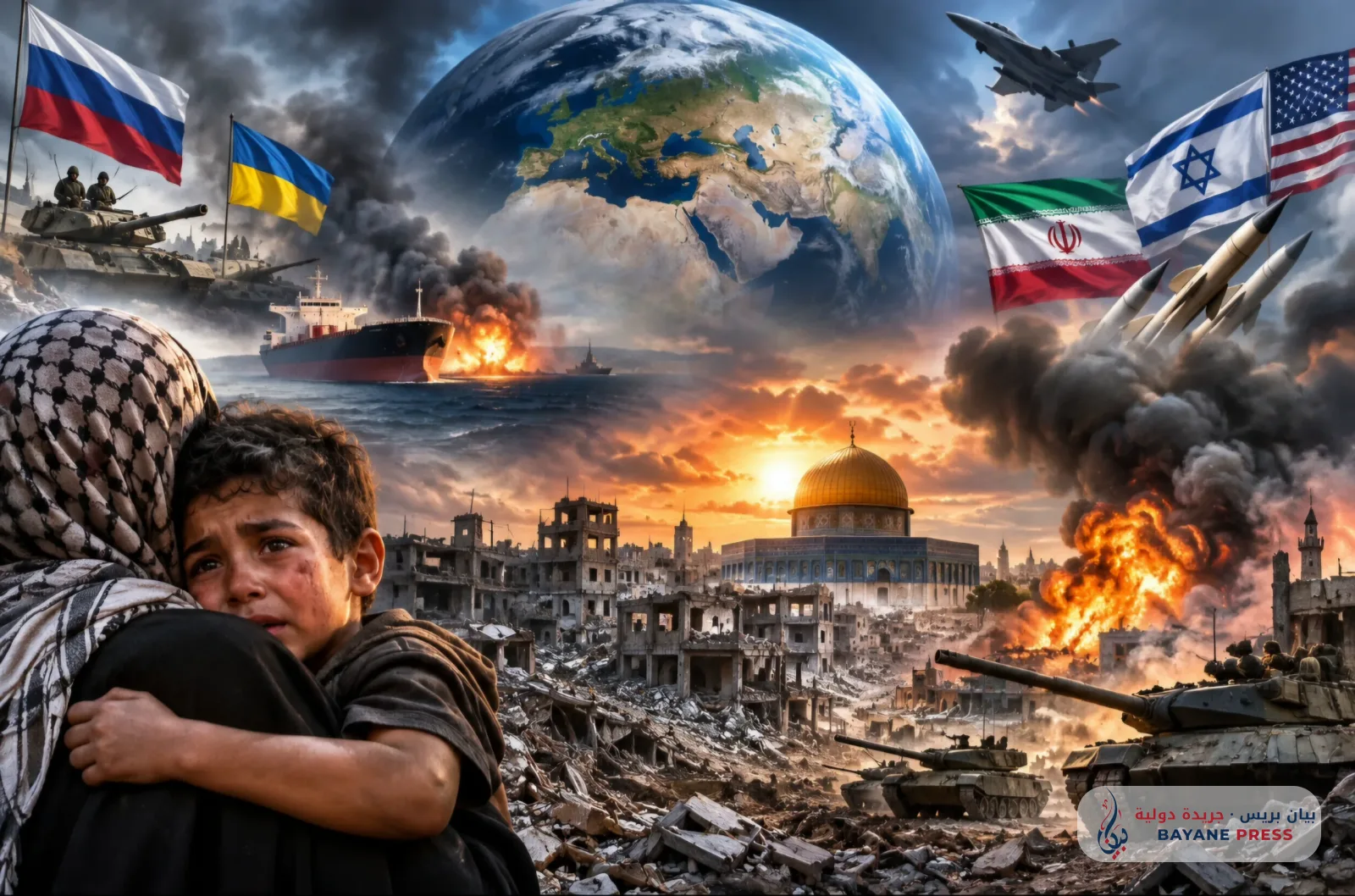
The world today stands before a highly dangerous international landscape, where raging wars intersect with power struggles and strategic interests, and where circles of fear regarding the future of humanity are widening. Meanwhile, voices are rising to link the ongoing destruction, killing, and displacement to the signs of the end times and the approach of the Great Finale. From the Russian-Ukrainian war to the Israeli-Iranian confrontations and American interventions in the Middle East, passing through the Palestinian tragedy and tensions in Lebanon and Yemen, to the devastating war tearing Sudan apart, humanity seems to be living through one of its most turbulent stages, in a world where the capacity of international institutions to contain conflicts is receding, and the language of force is advancing at the expense of law and justice.
However, more dangerous than the wars themselves is the growing fear that infiltrates the consciousness of societies, when military conflicts are turned into material for hasty religious interpretations, presenting contemporary disasters as inevitable signals of the world's imminent demise, and granting political and military events metaphysical dimensions that are not always based on a disciplined scientific reading of religious texts.
Here, the fundamental question arises: do current wars constitute definitive religious evidence of the approaching end of the world, or are some media, political, and religious discourses investing in human fears, invoking the signs of the Hour to explain conflicts that are, in reality, governed by considerations of power, wealth, and influence?
Returning to the Holy Quran and the authentic Prophetic Sunnah reveals a doctrinal truth that admits no ambiguity: the knowledge of the timing of the Hour is among the unseen matters that God Almighty has reserved for Himself. No human, regardless of their religious or political knowledge, can determine the time of the end or assert that a specific contemporary war is its direct prelude.
God Almighty says in Surah Al-A'raf: ﴿They ask you about the Hour, when is its arrival? Say, "Its knowledge is only with my Lord. None will reveal its time except Him."﴾, and He says in Surah Luqman: ﴿Indeed, Allah [alone] has knowledge of the Hour.﴾.
Prophet Muhammad (peace be upon him) settled this matter in the famous Hadith of Gabriel, narrated by Imam Muslim, when he was asked about the Hour and replied:
«The one questioned about it knows no more than the questioner.»
.
This prophetic answer establishes a precise epistemological rule: that belief in the Hour does not mean possessing the keys to its timing, and that knowing its signs does not grant anyone the authority to assert its proximity based on a political or military event, no matter how dangerous it may be.
The Holy Quran informed of the existence of signs preceding the Hour, as God Almighty said in Surah Muhammad: ﴿Then do they await except that the Hour should come upon them unexpectedly? But already there have come its indications.﴾. The authentic Prophetic Sunnah also contained Hadiths addressing the spread of tribulations (fitan), the abundance of killing, and disturbances in people's lives.
It was reported in the two Sahihs from Abu Hurairah (may God be pleased with him) that the Prophet (peace be upon him) told of the abundance of 'al-harj', and clarified that it meant killing. In Sahih Muslim, it is stated that the Prophet (peace be upon him) said:
«The killer will not know why he killed, and the killed will not know why he was killed.»
.
This is a highly significant prophetic depiction of the state of chaos in which tribulations intensify, and the motives for violence become confused, until killing becomes an act detached from insight and legitimate purpose.
However, using this Hadith to infer the horror of wars does not mean that all their victims fall under the warning mentioned in its remainder, or that every war occurring in our era represents a specific fulfillment of this text; Hadiths are understood in their contexts, and it is not correct to apply the rulings of fighting during tribulations to innocent civilians who are killed unjustly and aggressively.
In another Hadith narrated by Abu Dawood from Thawban (may God be pleased with him), and classified as Hasan or Sahih by a number of scholars, the Prophet (peace be upon him) warned against the nations gathering against the Muslims, comparing it to diners gathering around their dish, explaining that numerical superiority does not prevent weakness when 'wahn' (weakness/love of the world) takes hold of the souls.
One who contemplates the reality of international relations may find aspects of comparison between some of the general meanings of this Hadith and the manifestations of weakness, dependency, and scrambling for interests. However, turning it into a definitive interpretation for every military confrontation in Palestine, Lebanon, Sudan, or elsewhere, and identifying the countries and figures intended by it without explicit evidence, takes the inference out of the circle of legitimate understanding into the space of forced interpretation.
For religious texts were sent for guidance, warning, and reflection, not to be ready-made political maps that every generation projects onto the disputes of its era.
As for the major signs of the Hour, they were stated in the Hadith of Hudhayfah ibn Asid al-Ghifari (may God be pleased with him), narrated by Imam Muslim, in which the Prophet (peace be upon him) mentioned ten signs preceding the Hour: the Smoke (ad-Dukhan), the Antichrist (ad-Dajjal), the Beast (ad-Dabbah), the rising of the sun from the west, the descent of Jesus son of Mary (peace be upon him), Gog and Magog, three eclipses in the East, the West, and the Arabian Peninsula, and a fire emerging from Yemen driving people to their gathering place.
However, the importance of this Hadith does not lie in the enumeration of the signs alone, but in the necessity of understanding it according to the methodology of scholars; mentioning the ten signs does not mean the establishment of a detailed chronological order for all of them, even if other Hadiths have clarified the order of some events and their relationships to one another.
Hence, the claim that contemporary wars represent the beginning of a specific, irreversible sequence toward the Hour lacks the religious evidence that would allow for such certainty.
Prophetic Hadiths spoke of the appearance of the Mahdi at the end of time, including what was narrated by Abu Dawood from Abdullah ibn Mas'ud (may God be pleased with him) regarding the emergence of a man from the Prophet's household whose name matches his name, who will fill the earth with equity and justice. A number of scholars have classified this Hadith as Sahih or Hasan.
But the Mahdi was not mentioned among the ten signs in the Hadith of Hudhayfah ibn Asid, nor do the texts permit people to designate a specific contemporary figure as the Mahdi based on similarities in names or the circumstances of wars and disturbances.
Regarding the Smoke, God Almighty says in Surah Ad-Dukhan: ﴿Then watch for the Day when the sky will bring a visible smoke.﴾.
Interpreters have differed in interpreting the verse; Abdullah ibn Mas'ud (may God be pleased with him) and a group of the predecessors held that it refers to the severe hunger that afflicted the Quraish during the time of the Prophet (peace be upon him), while others saw it as relating to a future smoke among the signs of the Hour. The mention of smoke in the authentic Hadith remains established, with the necessity of distinguishing between the establishment of the sign and the disagreement in interpreting the verse.
This scholarly disagreement reveals the importance of humility before the texts, and confirms that matters of the unseen should not be subjected to impressions or images of bomb explosions, fires, and smoke clouds left by wars.
As for the Antichrist (ad-Dajjal), authentic Hadiths have come regarding him, describing him as one of the greatest tribulations facing humanity, and it is established in Sahih Muslim that Jesus son of Mary (peace be upon him) will descend at the end of time and kill the Dajjal, then the emergence of Gog and Magog will occur during his time.
The Holy Quran pointed to Gog and Magog in Surah Al-Anbiya with His saying: ﴿Until when [the dam of] Gog and Magog has been opened and they, from every elevation, descend.﴾.
The Quran also mentioned the emergence of the Beast in Surah An-Naml, and the authentic Sunnah spoke of the rising of the sun from the west, and what is associated with this sign regarding a great transformation in the acceptance of faith and repentance.
These are major metaphysical events with their own specific religious significance, and it is not correct to reduce them to the fluctuations of international politics, or to consider the emergence of a new military power or the invention of an advanced weapon as definitive evidence of the realization of one of them.
Perhaps history offers a very important lesson in this regard; humanity has witnessed great disasters that led entire generations to believe they were living the moments of the end.
When the Mongols invaded the Islamic East and Baghdad fell in 1258, the scale of killing and destruction seemed beyond the imagination of many contemporaries. The Crusades also witnessed long religious and military conflicts, then came the First and Second World Wars with the massacres, vast destruction, and use of chemical and nuclear weapons they brought.
In each of these stages, existential fears widened, and readings appeared linking major disasters to the approaching end of the world, while life continued, generations succeeded one another, and the balance of power shifted.
The purpose of this comparison is not to deny the signs of the Hour, but to emphasize that the magnitude of a disaster is not enough on its own to prove the occurrence of a specific metaphysical sign.
God Almighty says in Surah Al-Imran: ﴿And these days [of varying conditions] We alternate among the people.﴾, a verse that reminds us of the changing conditions of nations and the shifting balance of victory and weakness, far from the belief that every political or military collapse represents the end of history.
From here, the most complex problem is revealed, related to the way in which religious and existential fears can be turned into a means for political and media influence.
Wars are not fought with weapons alone, but also by the narratives presented by states, groups, and media outlets to explain their goals, justify their decisions, and mobilize supporters.
When a military confrontation is given the character of an inevitable holy battle, or is portrayed as part of an eschatological scenario that cannot be changed, this discourse may contribute to disabling critical thinking, reducing the space for debate regarding the responsibility of political and military leaders, and weakening the demand for accountability for violations.
This does not mean that all states or media institutions adopt a unified project to manufacture fear; such a claim requires independent evidence. But it is possible to observe the employment of religious discourse in some conflicts to mobilize the public or lend legitimacy to political and military goals, an employment that must be subjected to examination and criticism.
The danger of this practice doubles when verified news is mixed with metaphysical predictions, and fragmented clips of Hadiths are spread on digital platforms, accompanied by scenes of explosions and destruction, to present them as final evidence of the approaching Hour.
Here, fear turns from a legitimate human feeling in the face of disaster into a tool for producing helplessness, and the human becomes more preoccupied with the date of the end of the world than with the causes of wars, the responsibility of those who ignite them, and the ways to stop them.
The truth is that interpreting wars as divine destiny must not turn into a means to exempt humans from responsibility for their actions. Belief in destiny does not negate accountability, belief in the unseen does not drop the duty of justice, and certainty of the Hour does not justify surrendering to injustice or refraining from supporting the oppressed.
The Holy Quran commanded justice even when facing opponents, as He said in Surah Al-Ma'idah: ﴿And do not let the hatred of a people prevent you from being just. Be just; that is nearer to righteousness.﴾.
From this perspective, protecting civilians, rejecting aggression, aiding the afflicted, demanding an end to wars, and holding those responsible for crimes accountable are not positions that contradict belief in the signs of the Hour, but rather align with the moral principles established by Islamic Sharia.
Prophet Muhammad (peace be upon him) provided a highly significant guidance in establishing the value of work and not surrendering, when he said in the Hadith narrated by Al-Bukhari in 'Al-Adab Al-Mufrad' and Ahmad, from Anas ibn Malik (may God be pleased with him):
«If the Hour comes while one of you has a sapling in his hand, if he is able to ensure it does not come until he plants it, let him plant it.»
.
It is a prophetic image that summarizes a deep philosophy in dealing with the future; even when a person contemplates the end of the world, it does not turn into a justification to stop building, reforming, and doing useful work.
It is ironic that some contemporary discourses invoke the end of time to justify surrender, while this prophetic guidance calls for continuing work even in the most extreme moments of human existence.
What is happening in Palestine, Sudan, Ukraine, and other conflict zones is not just fleeting scenes in news bulletins, nor raw material for manufacturing hasty prophecies, but a painful human reality that has its victims and its political, legal, and moral responsibilities.
The duty toward these tragedies is not to search for the names of contemporary armies in the Hadiths of 'Al-Malahim' (great battles), nor to turn the suffering of peoples into mathematical indicators of the approaching end, but to understand the causes of conflicts, distinguish between the aggressor and the victim according to facts and evidence, and work to protect lives and achieve justice.
The world does not become closer to destruction just because fear has taken hold of souls, just as belief in the Hour does not grant politicians, media figures, or preachers the authority to claim knowledge of its timing.
And if death, resurrection, and reckoning are established truths in Islamic creed, determining their timing remains beyond human capacity, no matter how much technology advances, and no matter how violent wars become.
Here, the deepest conclusion becomes clear: the problem is not in people's belief in the signs of the end times, but in turning this belief into a market for fear, where tragedies are consumed and religious texts are exploited to fuel panic, justify helplessness, or lend sanctity to human decisions that are subject to criticism and accountability.
For wars are made by humans through their decisions, alliances, and interests, and they are responsible for their results. Political greed must not hide behind the veil of metaphysical inevitabilities, nor should faith be turned into a tool to silence the human conscience.
Perhaps the more worthy question occupying the world today is not when will the Hour come?, but when will humans stop manufacturing wars?, and when will they realize that protecting life and establishing justice is more profound than any discourse that sows terror in the name of the end?
For true belief in the end of time does not create a human who waits for annihilation in surrender, but creates a human who realizes that the future is in God's hands, and that their responsibility in the present is to resist injustice and cultivate the earth, until the last moment they are able to plant a sapling of hope.

Comments (0)
No comments yet. Be the first to react!