


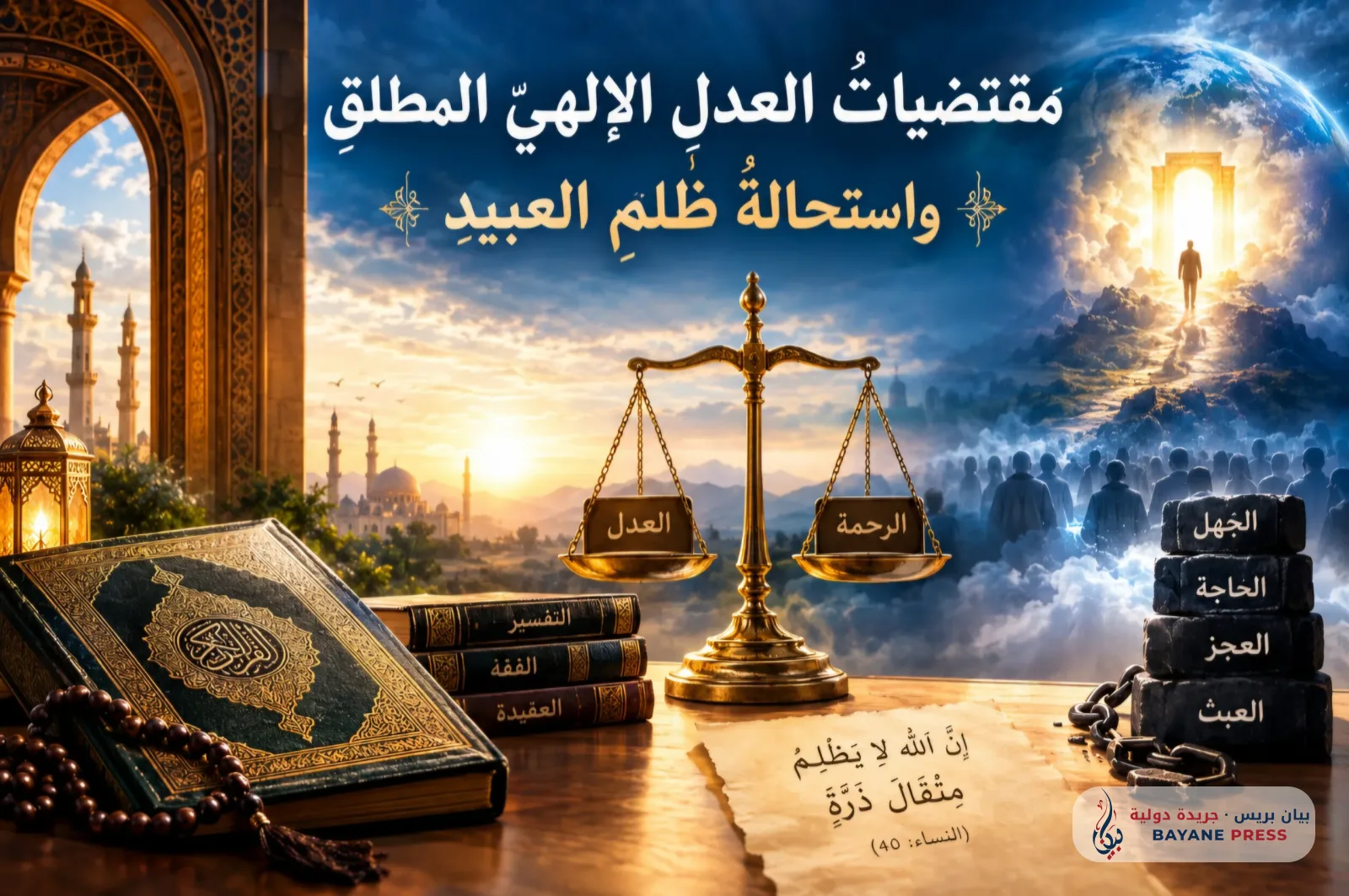
The theological and legislative framework in Islam is founded on the absolute proportion between divine perfection and human responsibility, as the Quranic text is not merely rhetorical preaching, but a rigorous demonstrative structure that places the intellect before the imperatives of existence and the laws of recompense. At the heart of this structure resonates a majestic Quranic refrain in five pivotal places throughout the Wise Revelation. It progresses in its discourse from absolute unseen information in His saying: ﴿And that Allah is not unjust to the worshippers﴾ in Surah Al-Imran, Al-Anfal, and Al-Hajj, to the discourse attributed to the tender station of Lordship in Surah Fussilat: ﴿And your Lord is not unjust to the worshippers﴾, leading to the pinnacle of direct self-manifestation in the scene of the afterlife judgment in Surah Qaf: ﴿The word will not be changed with Me, and I am not unjust to the worshippers﴾. This stylistic transition from the apparent Proper Name ﴿Allah﴾, encompassing all attributes of perfection, to the descriptor ﴿Your Lord﴾, which implies nurturing, care, and governance, and then to the singular first-person pronoun ﴿I﴾ in the supreme court of justice, reveals a rhetorical architecture establishing that the negation of injustice is not a transient ruling, but an intrinsic requirement of both Lordship and Divinity. It manifests in this world through governance and legislation, and in the hereafter through reckoning and recompense.
By examining the reasons for revelation and the contexts of discourse in these five instances, it becomes clear that the noble verse came to dismantle the two most dangerous fallacies known to human thought in its relationship with the heavens: the fallacy of "deterministic evasion" (whereby man casts the blame for his corruption on destiny), and the fallacy of "class entitlement" (whereby the affluent delude themselves that worldly provision is evidence of heavenly favor). In the Meccan context of the two verses in Surah Fussilat and Al-Hajj, the verses were revealed in confrontation with the leaders of Quraysh—such as Al-Walid ibn al-Mughirah, Al-Nadr ibn al-Harith, and Abu Jahl—who argued about Allah without knowledge, claiming that if they were resurrected, they would have the best with Allah just as they were given sovereignty in this world, or claiming that their polytheism and aggression were by Allah's will and thus they had no argument against them. The Quranic response came decisively in His saying: ﴿Whoever does righteous deeds does so for his own soul, and whoever does evil does so against it; and your Lord is not unjust to the worshippers﴾, and in His Exalted saying: ﴿That is for what your hands have put forth﴾, linking destiny to the earning of the hand and the choice of free will. In the Medinan context of Surah Al-Imran and Al-Anfal, the text was revealed in response to the Jewish rabbis—such as Finhas ibn Azura—who fabricated lies against Allah, saying: ﴿Indeed, Allah is poor and we are rich﴾, and killed the prophets without right. It was also revealed following the Battle of Badr regarding the fallen polytheists, establishing the divine ruling that what befalls them of worldly disgrace and torment in the hereafter is neither divine vindictiveness nor tyranny, but the inevitable and objective consequence of their actions recorded in the ledger of existence.
When we delve into the subtleties of exegesis and the secrets of rhetoric among verifying imams such as Al-Tabari, Al-Zamakhshari in (Al-Kashshaf), Fakhr al-Din al-Razi in (Mafatih al-Ghayb), Al-Baydawi, Abu al-Su'ud, and Ibn Ashur in (Al-Tahrir wa al-Tanwir), we encounter a precise linguistic dilemma that scholars have long pondered: Why did the negation come in the intensive form ﴿Bi-zallamin﴾ (greatly unjust) on the measure of (Fa'al) rather than (Zalim) (unjust), even though the negation of abundance might at first glance suggest the permissibility of a small amount, while Allah is exalted far above any injustice the weight of an atom? The verifiers have answered this through four integrated demonstrative paths. First, the path of "Quantitative Comparison": if Allah were to wrong every single one of His worshippers—whose number none can count except Him—by a single atom, He would, considering the sum of all creations (on the premise of the impossible), be deemed "Zallam" (greatly unjust) due to the sheer multitude of those upon whom the act falls. Therefore, when He wished to negate even the slightest injustice from the totality of worshippers across all eras, it was fitting to use the form ﴿Bi-zallamin﴾ in parallel with the plural form ﴿Lil-'abid﴾ (to the worshippers). Second, the path of "Allusion to Kings and Tyrants": it is the custom of earthly kings and masters that whoever possesses slaves tends to excessively subjugate them and withhold their rights until injustice becomes a permanent habit. Thus, the Quran expressed it using the word ﴿Al-'abid﴾ (the worshippers/slaves), which denotes the utmost state of servitude and weakness, and the word ﴿Rabbuka﴾ (your Lord), which denotes the Owner and Governor, telling the addressee: Do not measure the kingdom of the heavens by earthly kingdoms; earthly rule is prone to tyranny, whereas your Lord has nothing in His status or laws resembling the ways of unjust tyrants. Third, the path of "Qualitative Heinousness": injustice, even if small in itself, if committed by the Absolute, Capable, Wise Provider, would be considered immense and atrocious in the scale of the intellect. Thus, the intensive form was used in consideration of the greatness of the Agent rather than the frequency of the act. Fourth, the path of linguistic imams such as Al-Khalil and Sibawayh, who established that the measure (Fa'al) appears in the Arabic tongue to denote affiliation rather than intensity, as in their saying (Tammar) and (Labban) for one who acquires dates and milk (i.e., "possessor of dates and milk"). Thus, the meaning of ﴿Laysa bi-zallamin﴾ is that He is not one who possesses injustice whatsoever, and the redundant emphatic letter 'Ba' is introduced in the negated predicate to signify the total encompassing negation of the genus from its very origin.
This linguistic verification harmonizes with a comprehensive system of definitive transmitted evidence from the Book and the Sunnah. The Noble Quran explains itself, lifting any potential ambiguity with His saying: ﴿Indeed, Allah does not wrong [anyone] as much as an atom's weight﴾, and His saying: ﴿And they will not be wronged, [even as much as] a thread (fatila)﴾ nor ﴿a date stone speck (naqira)﴾. Rather, He details the reality of the negated injustice in the hereafter by restricting it to two matters, with no third, in His Exalted saying: ﴿He will not fear injustice or deprivation﴾. The majority of exegetes maintain that (injustice) means loading a person with the burden of a sin they did not commit, and (deprivation) means diminishing the reward of a good deed they performed. The purified Prophetic Sunnah arrives to provide the highest legislative explanation of this verse in the sublime Sacred Hadith (Hadith Qudsi) reported by Imam Muslim in his Sahih from Abu Dharr al-Ghifari, may Allah be pleased with him, from the Prophet (PBUH) narrating from his Lord, the Almighty and Majestic, that He said:
"O My worshippers, I have forbidden injustice for Myself and have made it forbidden among you, so do not oppress one another."
concluding with His saying:
"O My worshippers, these are only your deeds which I reckon for you, then I compensate you for them in full. So whoever finds good, let him praise Allah, and whoever finds other than that, let him blame no one but himself."
As Shaykh al-Islam Ibn Taymiyyah and his student Ibn al-Qayyim explained in their verification of this hadith, Allah's prohibition of injustice upon Himself is not a prohibition of obligation imposed by a commander above Him—Allah is exalted far above that—rather, it is a prohibition of transcendence and refusal demanded by His sacred Essence, and a truthful promise He bound Himself to out of grace and wisdom, just as He prescribed mercy for Himself. This prophetic exposition of divine justice extends to encompass cosmic retribution on the Day of Resurrection, as stated in Sahih Muslim:
"Rights will certainly be restored to their owners on the Day of Resurrection, even to the extent that a hornless sheep will be avenged against a horned sheep."r
If Allah's scale does not neglect the butt of a non-accountable beast in order to uphold the image of pure justice, how could the weight of an atom be lost for an accountable worshipper?
When we expose these transmitted truths to the test of philosophical and theological intellect, we find that the noble verse entails a rigorous rational proof wherein demonstrative reasoning meets explicit revelation. Scholars, in defining the reality of (injustice), split into two major schools of thought, both of which rationally lead to the impossibility of injustice on His part. The first school views injustice as (disposing of another's property without permission). By this definition, injustice is rendered existentially impossible for Allah because the entire universe, with all its atoms, galaxies, and worshippers, is His absolute property by creation and sustenance, and there is no other owner whose property He could trespass upon. However, the second school—which is deeper in method and closer to the implication of the verses—defines injustice as (placing a thing in other than its proper place befitting the system of wisdom, such as equating the righteous and the wicked, or punishing the innocent). Here, the definitive rational proof (the proof of elimination and division) arises to establish that the occurrence of evil or injustice from any agent in existence cannot rationally be devoid of four underlying causes: either (ignorance) of the evil of the act and the measures of entitlement; or (need) to bring about a benefit, repel a harm, or remedy a deficiency; or (inability) to achieve the goal except by wronging others; or (futility) devoid of purpose and wisdom. Since definitive rational proof has established that the Necessary of Existence, may He be glorified, is characterized by all-encompassing knowledge from which not even an atom's weight escapes, by absolute self-sufficiency which obedience does not benefit nor disobedience harm, by complete power which nothing incapacitates, and by consummate wisdom transcending futility, all motives necessitating injustice fall away. Thus, it is established by rational necessity that every act proceeding from Him, may He be glorified, is the very essence of justice and wisdom.
Furthermore, the intellect perceives that when Allah, may He be glorified, established the system of (religious obligation/taklif), sent messengers, and revealed scriptures, He granted man (the capacity for choice) and (the locus of earning), which remove his actions from the realm of deterministic inanimate movement into the realm of conscious moral action. If the afterlife reward were to occur haphazardly without a causal link to the deeds of worshippers, the wisdom of legislation would be nullified, the truthful and the lying would become equal, and the sending of messengers would be futility contradicting His saying: ﴿Then will We treat the Muslims like the criminals? What is [the matter] with you? How do you judge?﴾. Hence, the magnificence of the verse ﴿And your Lord is not unjust to the worshippers﴾ is unveiled as an existential covenant combining the unfettered nature of divine power with the inevitability of justice. It frees man from the illusions of deterministic oppression, placing him in the station of full responsibility for his choices, certain that he stands before a Lord who counts breaths and thoughts, multiplying a good deed tenfold up to seven hundred times by His sheer grace, and recompensing an evil deed with its like or pardoning it by His sheer justice and generosity. Thus, none perishes before Allah except one who doomed himself by persisting in injustice after the argument had been established and the clear path illuminated.



Comments (0)
No comments yet. Be the first to react!