


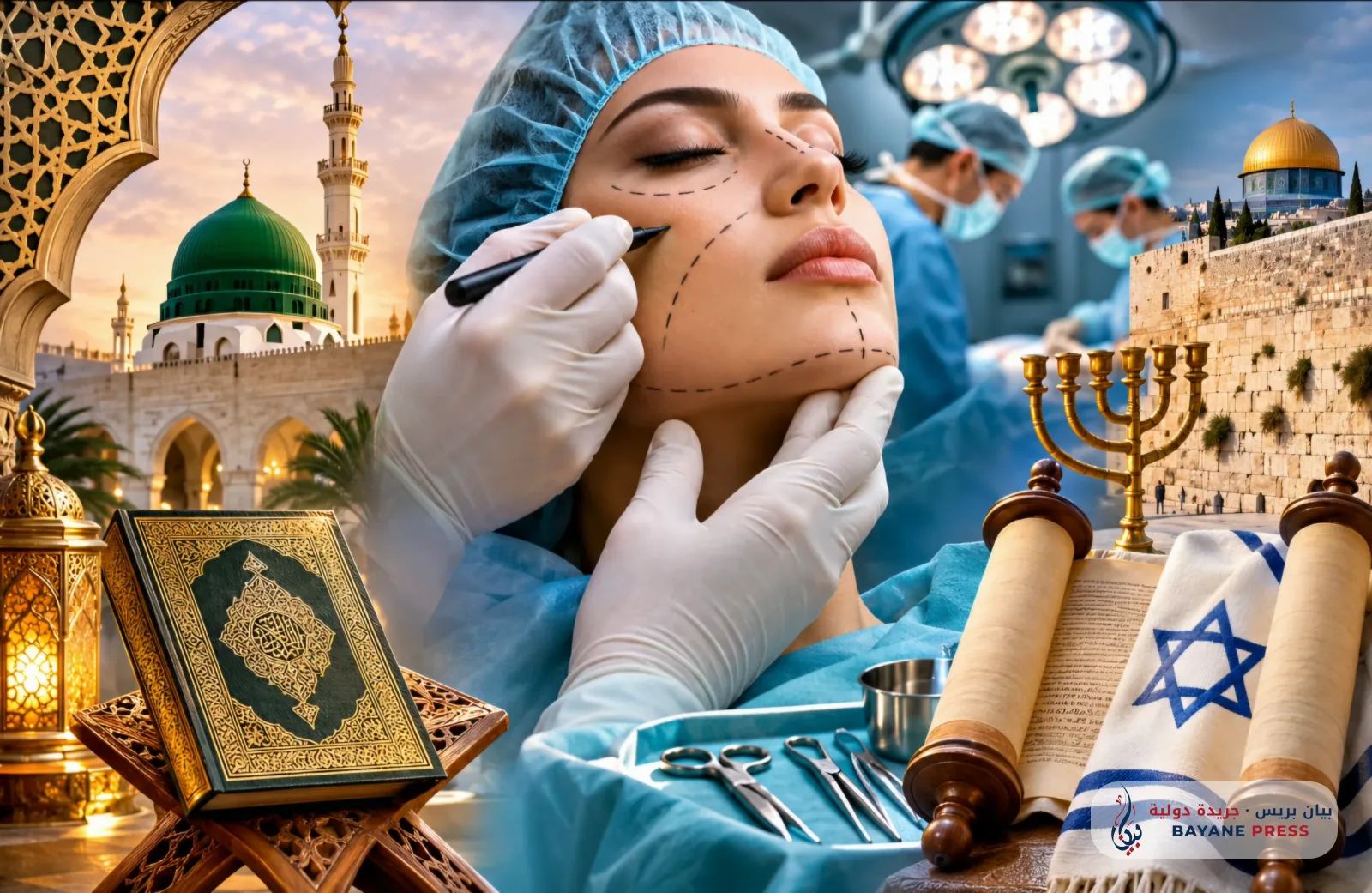
In the modern era, cosmetic surgery is no longer merely a means to repair deformities resulting from accidents and illnesses; it has transformed into a widespread phenomenon where the desire for beauty intertwines with medical advancement and the growing influence of social media. Between those who resort to surgery to restore lost features and those seeking to alter a natural appearance that no longer satisfies them, deep religious and ethical questions arise concerning the limits of intervening in the human body, the legitimacy of modifying its creation, and whether a human has the right to change their features according to personal desires. These are questions addressed by Islamic jurisprudence and Jewish legal scholars, each starting from their religious texts and legislative rules, revealing striking points of agreement as well as differences in interpreting and applying certain guidelines.
In Islamic law, beauty is not viewed as inherently blameworthy, nor is every medical intervention that alters a human appearance ruled as forbidden. Instead, the ruling is tied to the nature of the change, its purpose, and the potential harm it may entail. It is reported in Sahih Muslim, on the authority of Abdullah ibn Mas'ud, may Allah be pleased with him, that the Prophet, peace be upon him, said: "No one who has an atom's weight of arrogance in his heart will enter Paradise." A man asked: "A man likes his clothes to be nice and his shoes to be nice." The Prophet, peace be upon him, said: "Verily, Allah is beautiful and loves beauty. Arrogance is the rejection of truth and looking down on people." This hadith confirms that caring for one's appearance and loving beauty are not absolutely forbidden, even though it cannot be taken by itself as proof for the permissibility of all cosmetic means.
However, Islam sets limits on changes that go beyond permissible adornment to altering the normal creation merely for the sake of enhanced beauty. Among the prominent texts relied upon by jurists is the Almighty's saying, in the context of recounting Satan's threat to mislead the children of Adam: ﴿And I will surely command them and they will change the creation of Allah﴾ [Surah An-Nisa: 119]. Commentators have discussed the meaning of changing Allah's creation with various interpretations. It is incorrect to consider the verse a direct prohibition of every modification occurring to the human body; rather, it is read in light of the Prophetic Sunnah and legal rules that distinguish between permissible correction and prohibited alteration.
The most direct evidence regarding the issue of cosmetic surgery comes from the hadith narrated by the two Imams Al-Bukhari and Muslim from Abdullah ibn Mas'ud, may Allah be pleased with him, in which he said: "Allah has cursed the women who tattoo and those who have themselves tattooed, those who pluck facial hair and those who have it plucked, and those who create spaces between their teeth for beauty, altering Allah's creation." The phrase "for beauty" acquires special importance in understanding the ruling, as it points to the change intended for pure aesthetic improvement, not for treating a disease or removing an impactful defect. Commentators on the hadith, including Imam al-Nawawi in his commentary on Sahih Muslim, explained that prohibited tooth-gapping for beauty differs from medical necessity or correcting a dental defect.
The Prophetic Sunnah was not limited to explaining forms of prohibited alteration; it also included an important incident cited by jurists as evidence for the permissibility of repairing deformities. Abu Dawud narrated in his Sunan, in hadith number 4232, that Arfajah ibn As'ad, may Allah be pleased with him, had his nose cut off on the day of Al-Kulab, so he wore a silver nose, which caused a foul odor. The Prophet, peace be upon him, then ordered him to get a nose made of gold. This hadith was graded as Hasan (good) by a number of scholars, including Al-Albani. This incident reveals that restoring a damaged limb to a state closer to its natural condition is not necessarily among the prohibited changes to Allah's creation; rather, it may fall under the category of medical treatment and the removal of harm.
This jurisprudential distinction evolved with the emergence of modern surgeries, culminating in the International Islamic Fiqh Academy issuing its Resolution No. 173 (18/11) regarding plastic surgery and its rulings during its 18th session held in Malaysia in 2007. The Academy permitted necessary surgeries aimed at repairing congenital defects, such as a cleft lip and severe deformities, or treating acquired damages caused by burns, accidents, and diseases, including skin grafting, limb reconstruction, and restoring functional capacities.
The resolution also included among permissible cases the removal of deformities causing significant psychological or organic distress, provided that the therapeutic benefit is substantial, the surgical risks do not outweigh its benefits, and the procedure is performed by a qualified physician after informing the patient of the risks. Conversely, the resolution prohibited enhancement procedures that do not fall under medical treatment and whose purpose is to alter a normal physique based on personal desires or mimicking the appearance of others, such as certain nose, lip, and cheek surgeries performed merely to achieve a different look.
Nevertheless, practical details are not devoid of differing fatwas, especially with the emergence of non-surgical cosmetic means, such as Botox injections. Egypt's Dar al-Ifta, in its fatwa number 4215 issued on December 27, 2017, permitted the use of Botox for therapeutic and corrective purposes under specific guidelines, and also expanded the permissibility of some of its cosmetic uses for married women under conditions it specified. This shows that applying rulings to modern procedures is not uniform across all fatwas, and distinguishing between treatment, adornment, and pure enhancement may vary according to ijtihad (independent reasoning) and context.
As for Jewish law, known in its jurisprudential terminology as "Halakha," the issue of cosmetics is based on a set of principles related to the sanctity of the body, the preservation of life, and the avoidance of exposing oneself to harm without justifiable cause. The ancient books of the Torah do not contain detailed rulings addressing contemporary surgical cosmetic procedures in their modern medical form; therefore, rabbis relied on general rules found in religious texts and then applied them through ijtihad to modern surgeries.
Among the most prominent of these rules is what the Jewish jurist Moses Maimonides, known in Jewish tradition as "Rambam," established in his book "Mishneh Torah," under the laws of injury and damages, chapter five, paragraph one, where he ruled that a person is forbidden from harming themselves or others. This ruling is linked in his reasoning to a text from Deuteronomy, chapter twenty-five, verse three, concerning not exceeding the prescribed number of lashes in punishment, from which he deduced a broader rule prohibiting assault on the body.
This rule acquires importance when discussing cosmetic surgeries; surgery requires making incisions or changes in tissues and may involve pain or health complications. Here the jurisprudential question emerged: Is surgery chosen by an individual to improve their appearance considered a prohibited self-injury, or can the temporary harm occurring during the procedure be legitimate if it results in a substantial benefit?
Rabbi Moshe Feinstein, one of the most prominent Orthodox Jewish jurists of the 20th century, discussed this issue in his responsa collection "Igros Moshe," Choshen Mishpat section, part two, question number 66. The question concerned a young woman wishing to undergo cosmetic surgery to improve her marriage prospects. Feinstein concluded that the operation was permissible in the case presented to him, based on his understanding of Maimonides' words, considering that forbidden injury is that which occurs out of aggression or insult, whereas intervention intended to achieve a benefit for oneself does not necessarily fall under this prohibition.
This legal reasoning represents a trend in Jewish jurisprudence that does not consider every cosmetic surgery to be a prohibited assault on the body, but rather looks at its purpose, the extent of need for it, and the associated risks. Consequently, some rabbis found justification for permitting operations that remove apparent deformities or significant psychological suffering, even if the patient does not suffer from a life-threatening organic disease.
However, this position did not enjoy a rabbinic consensus; Rabbi Eliezer Waldenberg, author of the responsa collection "Tzitz Eliezer," adopted a stricter stance in part eleven, question number 41, where he opposed performing surgeries with purely cosmetic goals, arguing that permission for medical intervention does not necessarily extend to altering a healthy body merely to increase attractiveness. He also relied on religious considerations connected to respecting the form in which man was created and not exposing him to surgical risks unjustified by medical need.
Between these two trends, other more detailed Jewish opinions emerged, including that of Rabbi Jacob Breisch, who permitted certain cosmetic surgeries when a deformity or appearance is the cause of clear psychological distress, considering that removing this suffering may fall under therapeutic benefit. Contemporary Jewish legal writings have also addressed differing degrees of risk among operations and the distinction between genuine needs and fleeting desires to improve appearance.
Among the texts invoked by Jewish jurisprudence is what is mentioned in Deuteronomy, chapter four, verse fifteen, calling for strict caution regarding oneself. Although the original context of the verse relates to religious warnings against deviating into idol worship, the Jewish legal tradition relies on the principle of self-preservation when discussing health risks, including those that may accompany certain surgical interventions.
When comparing the Islamic and Jewish positions, it becomes clear that both attach great importance to the sanctity of the body and the preservation of its integrity, and do not treat the desire to change one's appearance as sufficient justification in all cases. Furthermore, a number of jurists from both laws agree on permitting corrective surgeries that treat a deformity or restore the function of a damaged limb, as well as the requirement to observe welfare and avoid unjustified risks.
However, differences appear in the nature of the evidence and methods of deduction; Islamic jurisprudence relies, alongside general rules prohibiting harm, on prophetic texts addressing certain forms of cosmetics and alteration for beauty, and on the precedent of repairing the nose of Arfajah ibn As'ad. Jewish law, on the other hand, addresses the issue primarily through rules of preventing injury, protecting the body, and the legitimacy of medical treatment, followed by rabbinic rulings determining what constitutes sufficient benefit to justify surgery.
The psychological impact of appearance stands out as one of the most delicate matters in the comparison. A person suffering from an apparent deformity causing severe embarrassment or significant psychological disturbance may find in certain Islamic and Jewish rulings justification for a corrective operation, whereas the desire to resemble celebrities or change natural features merely to keep pace with beauty trends does not hold the same status. Nevertheless, assessing psychological harm and the limits of need is not a matter of complete agreement among jurists, nor does the claim of psychological suffering substitute for disciplined medical and religious evaluation.
Hence, the position of Islam cannot be reduced to saying it forbids all cosmetic surgeries, nor is it correct to assert that Jewish law permits or prohibits them absolutely. Both jurisprudential systems include a distinction between treatment and enhancement, with varying opinions among scholars in determining cases worthy of exception and in balancing expected benefits against potential harm.



Comments (0)
No comments yet. Be the first to react!