


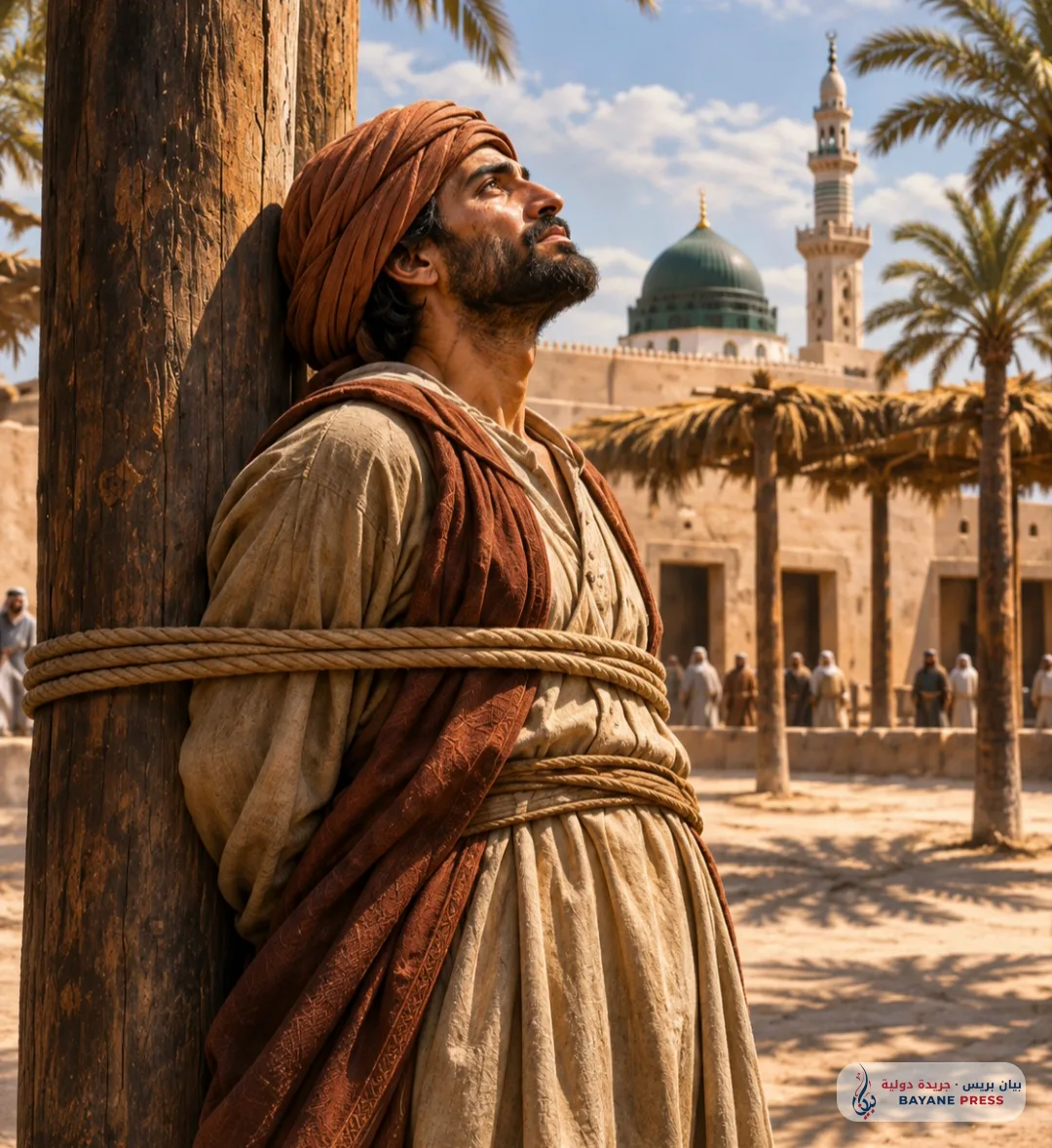
He could never have imagined that the moment he lost his freedom would become the beginning of the greatest transformation of his life, nor that the man he despised most would become the dearest person to his heart. He entered Medina as a captive, harboring in his chest deep hostility toward Islam and its Messenger, yet he departed as a believer in God, proclaiming the testimony of Oneness, after discovering that true power does not always manifest in the ability to punish, but rather in pardoning those who fall under the victor's authority.
This is the true story of Thumamah ibn Uthal al-Hanafi, a leader of Banu Hanifah and the people of Yamamah, as narrated by the companion Abu Hurairah, may God be pleased with him, and recorded by Imams Al-Bukhari and Muslim in their Sahihs. It is one of the well-established events in the Prophetic biography that reveals how honorable treatment managed to open the heart of a man who previously saw in Islam nothing more than a hostile religion, and in the Messenger of God, may God's peace and blessings be upon him, nothing more than a detested adversary.
The events began when the Prophet, may God's peace and blessings be upon him, dispatched a cavalry detachment toward Najd. It returned with a man from Banu Hanifah named Thumamah ibn Uthal, though the authentic narrations do not provide detailed circumstances of how he was taken captive. Thumamah held a prominent status among his people, to the extent that Imam Muslim described him in his narration as the leader of the people of Yamamah—a rank that made his captivity an event of great significance due to his considerable influence and social standing.
Thumamah arrived in Medina, and the Muslims tied him to one of the pillars of the Prophet's Mosque. There, he found himself in an unfamiliar situation; he had become a captive of the man he once opposed, awaiting a decision that would determine his fate. Little did he know that the next few days would completely overturn his perspective on Islam.
The Messenger of God, may God's peace and blessings be upon him, went out to him and asked about his condition and what he had to say. Thumamah responded with words reflecting his pride and status, explaining that if he were killed, a man of consequence would be killed; if he were treated kindly, he would be grateful; and if wealth was demanded, he was prepared to pay it.
It was the response of a man who understood the gravity of his situation, yet he did not resort to humiliation or pleading, instead presenting the options before him. Nevertheless, the Prophet, may God's peace and blessings be upon him, did not order his execution, nor did he demand a ransom, but left him without settling his fate.
The first day passed, and the Messenger of God, may God's peace and blessings be upon him, returned to him the following day, asking him about his stance. Thumamah did not change his answer. The Prophet left him once more until the third day arrived, when the question was repeated along with the exact same answer, as if the man were still viewing events from the perspective of a captive awaiting the victor's verdict.
However, the surprise came when the Messenger of God, may God's peace and blessings be upon him, commanded his companions, saying: "Release Thumamah."
There was no bargaining over money, no condition set for declaring Islam, and no request for a pledge to guarantee the man's loyalty after his release. The order for his release was issued, and Thumamah became a free man to go wherever he pleased.
At this point, the story took a completely different turn. Instead of leaving Medina to return to his people, Thumamah headed toward a water source near the mosque, washed himself, and then returned to the Prophet's Mosque—not as a captive awaiting his fate, but as a man who had chosen of his own free will to declare his Islam.
He stood before the Messenger of God, may God's peace and blessings be upon him, and uttered the Shahada (testimony of faith), declaring his belief in God and His Messenger, and then revealed with sincere words the profound transformation that had taken place within him.
He informed the Prophet, may God's peace and blessings be upon him, that there was no one on the face of the earth more detested by him than him, yet now he had become the dearest of people to him. He added that the religion he had despised the most had become the most beloved religion to his heart, and that the city he once hated had become the dearest land to him.
These words were not merely an announcement of a change in religious affiliation, but an explicit testimony to a complete turnaround in feelings and attitudes. Hatred had turned into love, hostility into faith, and aversion into a profound connection with the religion he once rejected.
What is striking about this incident is that Thumamah did not declare his Islam while bound to the pillar of the mosque, but only after he was freed and granted the freedom of choice. This is a detail of profound significance, showing that his conversion came after he was pardoned, not as a price for his liberation.
Nor did the matter stop there; Thumamah informed the Messenger of God, may God's peace and blessings be upon him, that the horsemen who captured him had intercepted him while on his way to perform Umrah, and asked what he should do now that he had embraced Islam. The Prophet gave him glad tidings and commanded him to complete his Umrah.
Thus, Thumamah set out from Medina toward Mecca, but the man who arrived there no longer held the same creed he possessed before his captivity. His stance toward Islam and its Messenger had changed, and he was ready to declare it before those who had known him under a different faith.
When he reached Mecca, someone expressed astonishment at what had come over him, asking whether he had abandoned the religion of his people. He replied that he had accepted Islam with Muhammad, the Messenger of God.
He then announced a new stance toward Quraysh, swearing that not a single grain of wheat would reach them from Yamamah unless permitted by the Messenger of God, may God's peace and blessings be upon him. This statement carried special weight because Yamamah was known as a region of grain production, and Thumamah was a figure of influence there.
Yet the most prominent meaning in the story does not lie in this economic stance, but in the transformation that preceded it. Thumamah could have returned to his people after his release without changing his belief, but he chose Islam, and then proclaimed his new identity in Mecca without concealing it from the people.
This incident aligns with the grand principle established by the Holy Quran in the Almighty's saying: ﴿There is no compulsion in religion. Rectitude has become clear from error﴾ [Surah Al-Baqarah: 256], and recalls His saying: ﴿Repel [evil] by that [deed] which is better; and thereupon the one between whom and you is enmity [will become] as though he were a devoted friend﴾ [Surah Fussilat: 34].


Comments (0)
No comments yet. Be the first to react!