


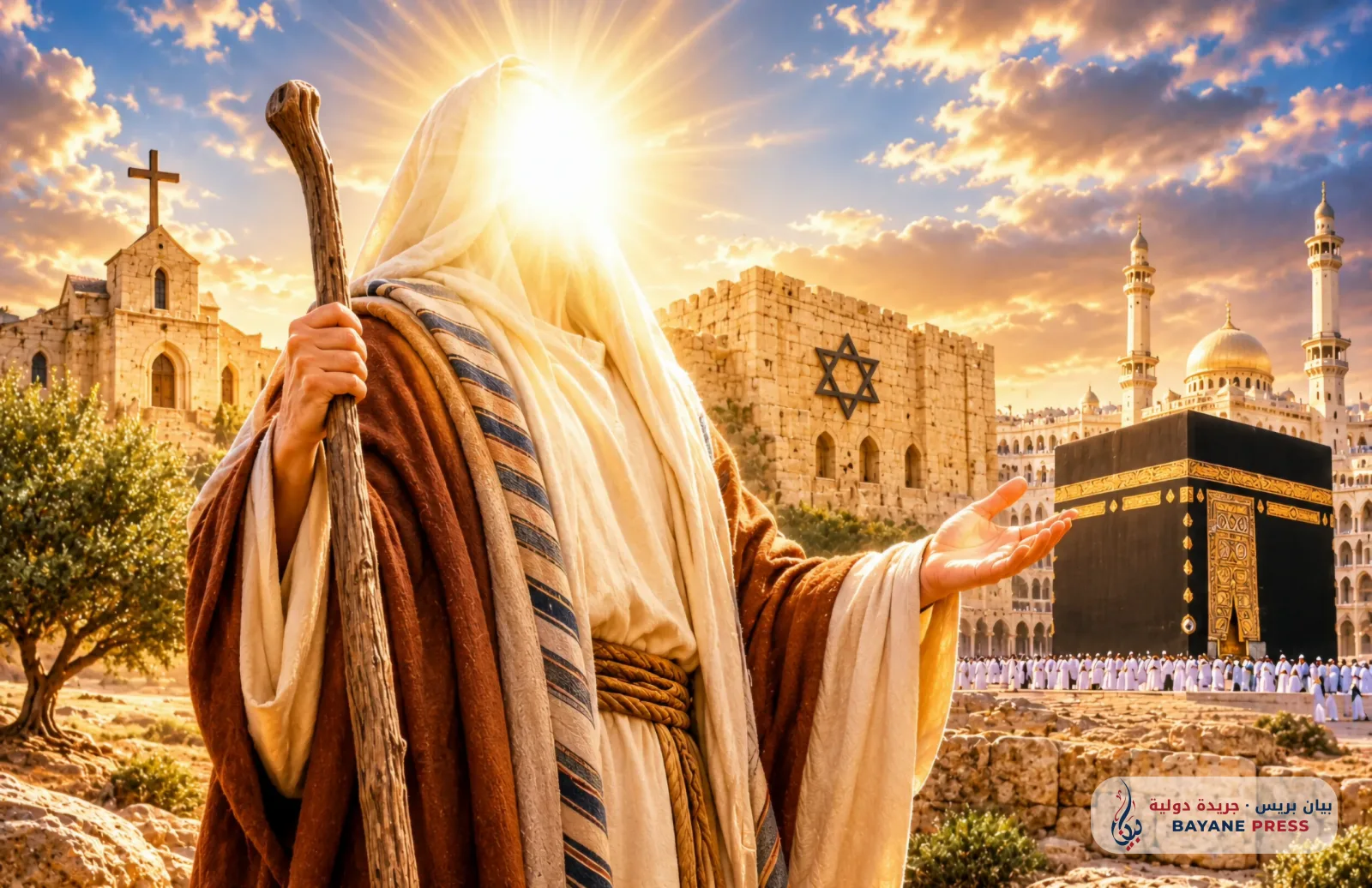
For thousands of years, the name of Abraham (peace be upon him) has remained a central presence in humanity's spiritual memory, transcending geographical and religious boundaries to hold an exceptional place in Islamic, Jewish, and Christian consciousness. He is a pivotal figure in all three heavenly laws, a symbol of belief in the One God, and one of the most prominent models invoked by sacred texts when discussing monotheism, loyalty, obedience, and sacrifice. Although these traditions converge upon his personality and draw an important part of their spiritual narrative from it, they differ in certain details of his biography, the interpretation of the divine covenant's implications, and the position of his offspring within historical and spiritual continuity.
The importance of Abraham (peace be upon him) stems from his role as a unifying link among these religious traditions—not merely through lineage, but through the overarching meanings associated with his life story. Foremost among these are faith in the One God, the rejection of idolatry, steadfastness in creed, and responsiveness to God's command regardless of the hardship involved. This standing has made him a spiritual father and a foundational symbol in the religious memory of the followers of all three faiths, even if doctrinal approaches differ in defining the nature and meaning of this lineage.
In the Jewish tradition, Abraham occupies a central place in the Book of Genesis, where his story is presented as the beginning of a turning point in the history of the Children of Israel. The Torah recounts God's call to him, his departure from his ancestral land, and the subsequent association of his name with the divine covenant, which includes the promise of offspring, land, and blessing. The Book of Genesis—particularly chapter 17—highlights the theme of the covenant as a fundamental bond between God, Abraham, and his descendants, making circumcision the physical sign of this covenant.
The Biblical narrative indicates that Ishmael, Abraham's son by Hagar, was not excluded from the circle of divine blessing, noting his blessing, the abundance of his progeny, and the extension of his descendants. However, the text itself distinguishes between this blessing and the continuation of the covenant, which is tied to Isaac and his descendants. From Isaac comes Jacob, later known as Israel, whose lineage connects to the twelve tribes that form the historical genealogy of the Children of Israel in the biblical narrative.
In Christianity, Abraham retains a prominent position in both the Old and New Testaments, though the New Testament endows his life with theological dimensions that go beyond the concept of physical descent. The epistles of Paul—particularly Galatians and Romans—invoke him as an example of faith and trust in God's promise, linking spiritual belonging to Abraham's offspring through faith rather than ethnic affiliation alone. From this perspective, Abraham in Christian theology became a model of faith transcending national borders and a symbol of the spiritual bond between believers and the divine promise.
In Islam, the status of Abraham (peace be upon him) is manifested with utmost clarity. He is a prophet, a messenger, a close friend of God (Khalil al-Rahman), and one of the resolute messengers (Ulu al-Azm). The Quran describes him as a "Hanif," meaning one inclined away from polytheism and devoted to pure monotheism. The Quran emphasizes that Abraham was neither a Jew nor a Christian, but rather a submissive monotheist to God, as stated in the verse: «Abraham was neither a Jew nor a Christian, but he was one inclining toward truth, a Muslim [submitting to Allah]. And he was not of the polytheists» (Al-Imran: 67). This verse affirms, in the Islamic vision, that the true essence of Abraham's message preceded subsequent religious labels, and that the core of his call was the sincere worship of God alone.
The Quranic narrative grants Ishmael (peace be upon him) a special place in the continuation of his father's mission, mentioning his participation in raising the foundations of the Sacred Kaaba in a scene embodying the unity of faith, action, and obedience. He stated: «And [mention] when Abraham was raising the foundations of the House and [with him] Ishmael, [saying], "Our Lord, accept this from us. Indeed, You are the Hearing, the Knowing"» (Al-Baqarah: 127). Thus, Abraham's name in Islam is linked to the building of the Holy House, the establishment of the rituals of monotheism, and a prayer whose resonance has echoed in Islamic consciousness across the centuries.
One of the most prominent points revealing differences in narratives among the three faiths is the story of the sacrifice, which represents one of the most significant episodes in Abraham's life. In the Book of Genesis, the name of Isaac is explicitly mentioned as the son Abraham was commanded to offer as a sacrifice, before an angel intervened and he was ransomed with a great sacrifice. As for the Quran, it presents the story in Surah Al-Saffat without explicitly naming the son; instead, it brings the glad tidings of a forbearing boy, followed by Abraham's vision and his obedience to God's command, concluding with the ransom of the son through a great sacrifice.
Islamic commentators have differed regarding the identity of the intended son. Some—including Imam Al-Tabari in his preferred view—maintained that it was Isaac, while others favored Ishmael, a view adopted by a number of major exegetes, including Ibn Kathir. Therefore, attributing the view of Ishmael to a total consensus of Muslims is not entirely accurate, just as the Quran itself did not settle the matter by mentioning the name, requiring a distinction between the Quranic text and the interpretations of exegetes.
This story, despite its varying details, reveals the shared meaning celebrated by the three faiths in Abraham's biography: submission to God, trust in His promise, and readiness to sacrifice for the sake of faith. However, the differing identification of the son in religious narratives remains a textual and doctrinal divergence that must be presented faithfully, without confusing what the texts explicitly state with what later commentaries added.
Furthermore, the concept of the covenant holds a fundamental place in understanding Abraham's image among the followers of the three faiths, yet it does not carry the same meaning across all texts. In the biblical narrative, the covenant is tied to offspring, the promise of land, and blessing, with the covenantal lineage continuing through Isaac and his descendants according to Genesis. In the Christian reading, the meaning broadens to encompass the spiritual dimension of faith and affiliation with God's promise. In the Quran, the covenant appears in a special context when God addresses Abraham: «[And mention] when his Lord tried Abraham with commands and he fulfilled them. [Allah] said, "Indeed, I will make you a leader for the people." [Abraham] said, "And of my descendants?" [Allah] said, "My covenant does not reach the wrongdoers"» (Al-Baqarah: 124). This verse addresses divine leadership and the condition of barring wrongdoers from attaining this covenant; its significance cannot be reduced to or equated with the biblical concept of the covenant.
Despite Abraham's widespread presence in sacred texts, historical and archaeological research has not yet yielded direct, conclusive evidence proving all the details of his biography as presented in religious traditions, nor is there a final scientific consensus on determining the exact timing of his life. The absence of decisive archaeological evidence does not mean denying his existence; rather, it reflects the limits of what historical and archaeological tools can prove regarding a figure belonging to a very ancient era and approached by religious texts from multiple theological and faith-based angles. Hence, the necessity arises to distinguish between religious faith in the sacred narrative and what historical research can prove according to its methodologies and evidence.
Abraham (peace be upon him) is not merely a shared name in the books of the three faiths; he represents a major convergence point in the history of human faith and spiritual imagination. His biography embodies the meanings of monotheism, certainty, and obedience, and through him, narratives of prophecy, covenant, lineage, blessing, and sacrifice intersect. Nevertheless, this convergence does not eliminate differences between texts and interpretations; rather, it makes understanding and comparing them a scholarly responsibility requiring precision, fairness, and respect for the distinctiveness of each religious tradition.
Thus, Abraham (peace be upon him) remains a figure who transcends narrow affiliations—a spiritual and historical bridge connecting the three heavenly laws, and a symbol of the core meaning of faith upon which all messages agree, even if they differ in some narrative details and interpretive meanings. Perhaps the deepest value in invoking his biography today lies in reclaiming what unites humanity in the worship of God and adherence to values, rather than turning historical and doctrinal differences into new causes for division and conflict.


Comments (0)
No comments yet. Be the first to react!