

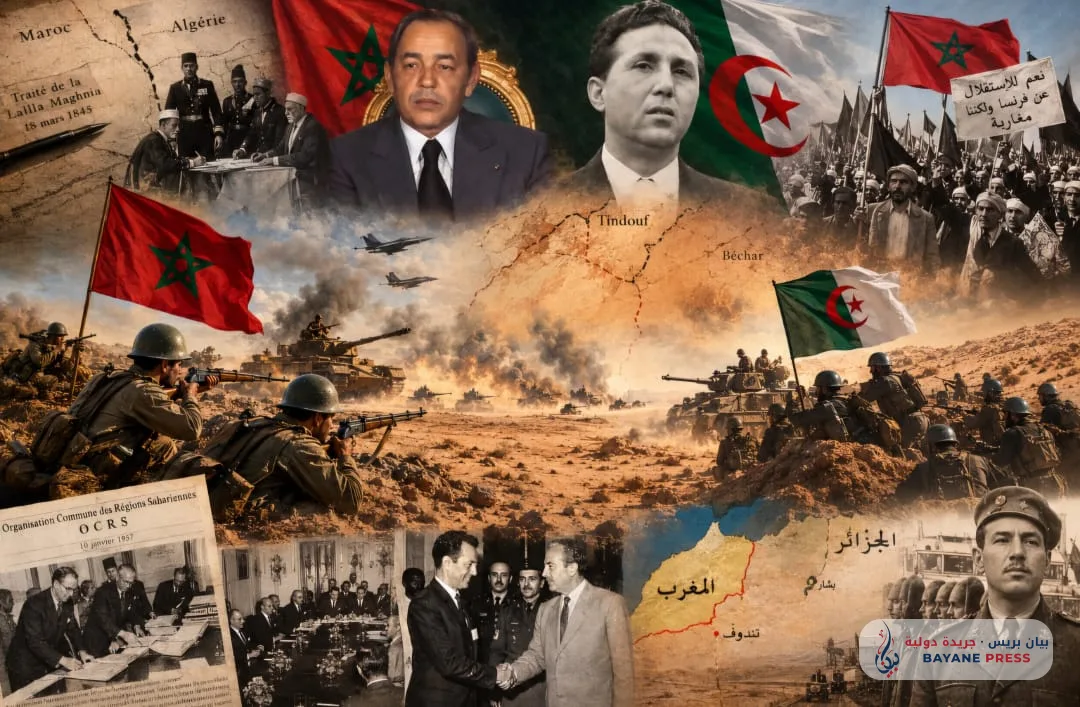
The historical roots of the Sand War, which broke out between the Kingdom of Morocco and the People's Democratic Republic of Algeria in the autumn of 1963, date back to the complex colonial legacies left by the French administration in North Africa since the 19th century. This lightning-fast military confrontation was not the result of a passing moment, but the outcome of more than 100 years of geographical trimming and mobile military lines drawn by French officers in the depths of the eastern Sahara. Following the defeat of the Moroccan army at the Battle of Isly in 1844, France forced Sultan Mulay Abd al-Rahman ibn Hisham to sign the Treaty of Lalla Maghnia on March 18, 1845. In this treaty, Paris set out to precisely delimit the borders along a mere 160 kilometers from the Mediterranean coast to the Teniet el-Sassi area, leaving the Saharan space extending southward without geographical demarcation. Under the pretext of Article 4 of the treaty stating that «Saharan land is neither watered nor cultivated, so there is no need to delimit it», it contented itself with mentioning the affiliation of tribes and their camps to the Moroccan and French authorities. However, French military penetration at the beginning of the 20th century toward the oases of Touat, Gourara, and Tidikelt, followed by the control of Colomb-Béchar and Khenadsa, up to the entry of French forces into the city of Tindouf in 1934, altered the map on the ground through unilateral administrative and military lines, known in the French military archive as the «Varnier line» of 1912 named after High Commissioner Maurice Varnier, and later the «Trinquand line» of 1938 named after Colonel Trinquand. This territory acquired extreme strategic and economic importance in the 1950s following the discovery of huge iron deposits in Gara Djebilet, south of Tindouf, with estimated reserves of about 3.5 billion tons, in addition to coal and manganese mines and indications of oil and gas in the Béchar basin.
When Morocco regained its independence on March 2, 1956, the French government attempted to win over the late Moroccan monarch, King Mohammed V, to demarcate the Saharan borders and recover parts of those territories through bilateral negotiations with Paris, in exchange for halting Moroccan logistical and military support to the Algerian National Liberation Front and closing the rear bases of the liberation army in Oujda and the eastern region. However, the Moroccan archive documents the flat refusal of King Mohammed V to what was then termed the «suspicious agreement», preferring to postpone the border dossier until after Algeria's independence so that history would not record that Rabat negotiated with the colonizer over the blood of the Algerian insurgents. This stance was also reaffirmed by Istiqlal Party leader Allal al-Fassi, who led the campaign claiming the kingdom's historical borders from Tindouf and Béchar to the Senegal River. In response to the Moroccan rejection, the French parliament passed a law on January 10, 1957, creating the Joint Organization of the Saharan Regions (OCRS) to administratively and militarily separate the Sahara from both Morocco and Algeria, in a desire by Paris to retain mineral and oil wealth, as well as the French nuclear test base in Reggane and the chemical weapons testing base in B2 Namous, south of Béchar. Aware of the gravity of French maneuvers, the young King Hassan II, a few months after ascending the throne, signed an archival document of immense importance on July 6, 1961 in Rabat with Ferhat Abbas, President of the Provisional Government of the Algerian Republic. The text explicitly stipulated that «the regional problem arbitrarily imposed by French colonialism between the two countries will find its solution within the framework of direct bilateral negotiations between the Moroccan government and the government of independent Algeria», agreeing to establish a joint Moroccan-Algerian commission to meet as soon as possible after Algeria's independence, and stressing that any agreement the provisional Algerian government might sign with France would not be binding on Morocco regarding its historical territories.
However, the political winds that blew in Algeria from the signing of the «Evian Accords» on March 18, 1962, and the declaration of independence on July 5, 1962, completely upended the situation. French President Charles de Gaulle handed over the administrative sovereignty of the Sahara to the Algerian state in exchange for France retaining oil privileges and its military and nuclear bases in the Sahara for 5 years. Subsequently, the alliance of the «Tlemcen Group», led by Ahmed Ben Bella and the General Staff of the «Border Army» stationed in Oujda under the command of Colonel Houari Boumediene, overthrew the provisional government headed by Ferhat Abbas and later by Ben Youssef Ben Khedda. Thus, a radical socialist-oriented revolutionary elite came to power, viewing the Moroccan monarchy with suspicion and considering that the agreement of July 6, 1961, was not binding on the young Algerian state. The first sparks on the ground erupted in the summer and autumn of 1962 in the city of Tindouf, where archival documents reveal that the sheikhs of the Reguibat and Tekna tribes raised Moroccan flags and banners with the slogan «Yes to independence from France, but we are Moroccans» during the self-determination referendum. Many locals abstained from participating in the elections to the Algerian Constituent Assembly on September 20, 1962, which led the forces of the Algerian National Liberation Army to intervene with the force of arms to suppress the tribal rebellion in Tindouf, amid dozens of deaths and the flight of tribal delegations to Rabat to pledge allegiance to King Hassan II and demand military protection.
In an attempt to contain the growing tension, King Hassan II made his first official visit to independent Algeria between March 13 and 15, 1963, a visit whose details the Moroccan monarch recounts in his memoirs «The Challenge» and «The Memory of a King», stating that he discussed the matter alone with President Ahmed Ben Bella regarding the implementation of the Ferhat Abbas agreement. Ben Bella asked him for patience, saying: «I beg you to give me time until I can establish constitutional institutions and assume the reins of power as the elected president of the republic; then we will resolve our border problem». However, the assassination of Algerian Foreign Minister Mohamed Khemisti on April 11, 1963, and the appointment of the young Abdelaziz Bouteflika (26 years old at the time) as his successor coincided with a deep political and ideological breach between both capitals. Following the approval of the Algerian constitution and the election of Ben Bella as president on September 15, 1963, the Algerian leader went back on his promises and declared in his speeches that «Algerian soil is indivisible, and land liberated with the blood of 1.5 million martyrs cannot be subject to negotiation for even a single centimeter». This coincided with the reception in Algeria of prominent Moroccan dissidents from the «National Union of Popular Forces» following Rabat's announcement on July 16, 1963, of the discovery of a plot to assassinate the king and overthrow the regime. On the other hand, an armed rebellion broke out in Algeria on September 29, 1963, in the Kabylie region led by the Socialist Forces Front of Hocine Aït Ahmed and Colonel Mohand Oulhadj. President Ben Bella and his Foreign Minister, Abdelaziz Bouteflika, rushed on September 30, 1963, to formally accuse Morocco of supporting the Kabylie rebels and moving its troops on the border, which was followed by the expulsion of thousands of Moroccan workers and merchants from western Algeria and the confiscation of their property, to which the Moroccan authorities responded by expelling Algerian merchants from the city of Oujda.
«I beg you to give me time until I can establish constitutional institutions and assume the reins of power as the elected president of the republic; then we will resolve our border problem»
With the arrival of the last days of September and early October 1963, the conflict shifted from media rhetoric to the burning sands. King Hassan II and General Mohamed Oufkir ordered units of the Moroccan Auxiliary Forces stationed in Taconite to advance toward the outposts of Hassi Beïda and Tinjoub to position themselves there, two strategic points located in the undemarcated Saharan zone that controlled the vital route connecting Colomb-Béchar, Tindouf, and the Sahara then under Spanish colonial rule. Despite the holding of an emergency meeting in the city of Oujda on October 5, 1963, in which Morocco's interim Foreign Minister Ahmed Reda Guedira and his Algerian counterpart Abdelaziz Bouteflika agreed on a temporary truce and preparations for a bilateral summit between Hassan II and Ben Bella, the dawn of October 8, 1963 brought the spark of actual war. Units of the Algerian National Liberation Army launched a surprise and violent attack against the garrisons of Hassi Beïda and Tinjoub, resulting in the death of 10 Moroccan soldiers, the capture of others, and the seizure of both outposts by Algerian forces.
King Hassan II, who had established his political and military headquarters in Marrakech, urgently sent Minister of Information, Youth and Sports Abdelhadi Boutaleb on October 9 to Algiers to lodge a strong protest and prevent a slide into generalized war. Boutaleb recounts in his memoirs «Half a Century in Politics» that his meeting with Ahmed Ben Bella and Houari Boumediene hit an impassable wall, as Ben Bella indicated to him in a sharp tone that Hassi Beïda and Tinjoub were Algerian soil, rejecting any withdrawal or negotiation over their sovereignty. When the Moroccan envoy returned empty-handed on October 10, King Hassan II convened a ministerial and military council in which he ordered the Royal Armed Forces, under the command of General Driss Ben Omar El Alami, to retake the outposts by force. At dawn on October 14, 1963, columns of the regular Moroccan army, supported by heavy artillery and French-made AMX-13 tanks, as well as air cover from Fouga Magister and T-6 fighters, succeeded, after fierce fighting, in repelling Algerian forces and regaining full control of Hassi Beïda and Tinjoub. What is more, they continued their advance southward until they stood at the gates of the city of Tindouf, just 12 kilometers away, in a strange historical paradox where French garrisons still stationed in the bases of Béchar and Reggane followed the details of the fighting closely and without direct intervention.
The rapid fall of Hassi Beïda and Tinjoub caused a strong shock in Algiers. The Algerian army, whose general staff was led by Colonel Tahar Zbiri and whose logistics on the western front were supervised from Oran by Commander Chadli Bendjedid and Captain Mohamed Salah Yahiaoui, despite having about 48,000 men and extensive experience in guerrilla warfare during the independence revolution, was still in the process of transforming into a regular army and lacked combat aviation, heavy armor, and Saharan logistics, compared to the Moroccan army, smaller in number (about 35,000 soldiers) but more professional, equipped, and armed. On October 15, 1963, President Ahmed Ben Bella declared general mobilization and appeared the following day, October 16, before the Constituent Assembly and at a massive rally in Martyrs' Square in Algiers dressed in his khaki military uniform alongside his Defense Minister, Houari Boumediene. There he delivered his famous speech in which he combined classical Arabic and the Algerian dialect to lift spirits, exclaiming his phrase immortalized by audiovisual archives: «We have been humiliated! We have been humiliated by the Moroccans!», calling on independence war veterans to take up arms and march toward the border under the slogan «Arms, arms, to the border!», and promising not to take off his military uniform until defeating what he called «feudal imperialist aggression». This mobilizing speech succeeded in immediately unifying the Algerian internal front: Hocine Aït Ahmed and Colonel Mohand Oulhadj announced from Tizi Ouzou the suspension of their armed rebellion in Kabylie to join the ranks of homeland defense, while the Algerian military command opened a new northern front between October 15 and 18 by attacking the Moroccan border outpost of Ich and bombarding the oasis of Figuig with artillery to relieve the suffocating military pressure on the Tindouf front in the south.
«We have been humiliated! We have been humiliated by the Moroccans!»
On the other hand, King Hassan II delivered a historic speech from Marrakech in which he launched forceful messages both internally and externally. In his speech and in his protest letter addressed to President Ben Bella, he noted: «Morocco has never been an aggressor country, and we have recently demonstrated our loyalty to the brotherhood of struggle; however, Morocco's dignity and the unity of its territory are above all else, and we will not accept that our patience and loyalty be rewarded with attacks on our outposts and the death of our soldiers. Whoever knocks on our door with arms will find us prepared». Morocco in turn witnessed widespread popular and political backing around the monarchical institution, led by the Istiqlal Party and the Popular Movement, with the exception of Mehdi Ben Barka, leader of the National Union of Popular Forces in exile, who issued a statement from Cairo on October 16 condemning the war and describing it as a «reactionary war aimed at striking the Algerian revolution and distracting the Moroccan people from their internal crisis», a stance that cost him a death sentence in absentia for treason handed down by the Rabat military tribunal in November 1963. Among the precise military details revealed by the Moroccan archive and Hassan II's memoirs is that Colonel Driss Ben Omar El Alami telegraphed the king asking for authorization to storm the city of Tindouf after it was left militarily exposed before the royal forces. However, Hassan II refused to give the order to enter the city, uttering his famous phrase: «Do not enter Tindouf; entering militarily is easy, but exiting its political and diplomatic consequences will be difficult», aware with his strategic sense that the occupation of Tindouf would turn Morocco before the international community and the nascent Organization of African Unity from a «defender of its borders» into an «invading country», and would give Algeria's allies a pretext to internationalize the conflict militarily.
«Do not enter Tindouf; entering militarily is easy, but exiting its political and diplomatic consequences will be difficult»
The Sand War indeed acquired burning international dimensions that turned it into one of the flashpoints of the Cold War in the Arab world and Africa. Egyptian President Gamal Abdel Nasser fully aligned himself with Ben Bella's socialist regime, and the «Voice of the Arabs» radio station from Cairo launched a fierce media campaign against the Moroccan monarchy. Nasser even sent an air and maritime bridge of Soviet weapons and Egyptian military troops to support the Algerian army, while Cuban leader Fidel Castro launched a secret operation baptized in Havana's archives as «Operation Boniato», with Cuban ships «Aracelio Iglesias» and «González Lines» and the Soviet ship «Aralsk» setting sail for the port of Oran in late October 1963, transporting a special Cuban military unit of 686 soldiers, 22 T-34 tanks, 18 122mm mortars, and 18 57mm anti-tank guns under the command of Commander Efigenio Ameijeiras, positioning themselves in the Sidi Chami camp on the outskirts of Oran, ready to enter combat on Algeria's side. On the other hand, declassified secret documents from the CIA and the US State Department reveal that President John F. Kennedy's administration, a few weeks before his assassination, refused to fulfill a Moroccan request for urgent aerial military supplies, for fear that direct US intervention would push Ben Bella's regime to become a permanent Soviet and Cuban base in the Mediterranean basin. Amidst this regional interference, one of the most striking episodes of the war archives was recorded on October 20, 1963, when an Algerian military helicopter was forced to land by mistake on Moroccan soil in the Ain Sghir area, on the outskirts of Bouârfa and Figuig, carrying on board 4 Algerian officers and 5 senior officers from the air force and intelligence services who were on a reconnaissance mission to study the theater of operations. Among these Egyptian officers was Colonel Pilot Mohamed Hosni Mubarak, who would later become President of the Arab Republic of Egypt. Minister Abdelhadi Boutaleb presented the captured Egyptian officers and their official passports to the international press in Marrakech after their initial attempt to pass themselves off as journalists, an event that led Morocco to break diplomatic relations with Cuba and recall its ambassador to Cairo and Syria. However, King Hassan II knew how to use the card of the Egyptian prisoners later with exceptional political skill by taking Hosni Mubarak and his companions with him to the Arab League summit in Cairo in January 1964 and handing them over to President Nasser without preconditions as a gesture to turn the page on differences.
With the intensification of fighting on the Hassi Beïda and Figuig fronts, and growing African and Western fears that the conflict would degenerate into a destructive regional war as Cuban tanks approached the front, African diplomacy intervened under the baton of Ethiopian Emperor Haile Selassie, who was on an official visit to Morocco in mid-October, and Malian President Modibo Keïta. Following arduous shuttle contacts and the failure of an initial meeting in Marrakech on October 20, the two African leaders succeeded in convincing King Hassan II and President Ahmed Ben Bella to sit at the table of direct negotiations in the Malian capital, Bamako, on October 29 and 30, 1963. The minutes of the «Bamako Conference» document the climate of extreme tension that prevailed in the early sessions when military maps were spread on the table; King Hassan II argued that official French documents themselves never referred to the «Varnier» and «Trinquand» lines as «international borders», but literally described them as «lines of operations and police surveillance». African pressure finally bore fruit with the signing by the 4 leaders (Hassan II, Ahmed Ben Bella, Haile Selassie, and Modibo Keïta) on October 30, 1963 of the historic «Bamako Agreement», which stipulated an immediate ceasefire starting on the night of November 1-2, 1963, the formation of a quadripartite military commission composed of Moroccan officers (under the command of Colonel Mohamed Medbouh), Algerian, Ethiopian, and Malian officers to delimit a demilitarized zone, and the deployment of military observers from Ethiopia and Mali to ensure compliance with the truce in said zone. Likewise, the Council of Foreign Ministers of the Organization of African Unity was summoned to an urgent extraordinary session in Addis Ababa to constitute a special arbitration committee tasked with determining responsibilities in the outbreak of fighting, studying the substance of the border dispute, and presenting proposals for its resolution.
Although artillery sounded heavily again around the Figuig oasis and the heights of Beni Ounif on November 1, 1963, in a final attempt by each side to improve its negotiating positions before the entry into force of the truce, the ceasefire took effect between November 2 and 5, 1963. Thus, the war came to an end after approximately a month of fighting that left, according to cross-referenced archival estimates, hundreds of dead and wounded on both sides (Algerian sources spoke of between 300 and 850 dead, while Moroccan losses were estimated between 39 and 200 dead), in addition to about 379 Algerian prisoners and about 50 Moroccan prisoners. Between November 15 and 18, 1963, the OAU Foreign Ministers met in Addis Ababa, where Ahmed Reda Guedira and Abdelaziz Bouteflika presented extensive defenses: Morocco relied on historical arguments and bilateral agreements signed before independence, while Algeria entrenched itself in the principle of «inviolability of borders inherited from colonization». The meeting concluded with the creation of the special arbitration committee composed of 7 countries: Ethiopia, Mali, Senegal, Ivory Coast, Sudan, Tanganyika, and Nigeria. Military and diplomatic efforts culminated in the signing of a definitive disengagement agreement on February 20, 1964, by virtue of which Moroccan forces withdrew from Hassi Beïda and Tinjoub to their pre-October 1 positions, in exchange for the withdrawal of Algerian forces from the heights overlooking Figuig and the Ich outpost, the establishment of the demilitarized buffer zone, and the consequent prisoner exchange between the two countries in mid-April 1964.
Thus the Sand War concluded militarily with the return to the situation on the ground prior to its outbreak, with no changes to the border map. Algeria triumphed diplomatically by enshrining the principle of the «inviolability of borders inherited from colonization» during the OAU summit in Cairo in July 1964, while the Moroccan monarchical regime gained tactical-military superiority and strong internal cohesion. Although both countries subsequently closed the chapter of tensions with the signing of the «Ifrane Treaty» of good neighborliness and brotherhood on January 15, 1969 between King Hassan II and President Houari Boumediene (who overthrew Ben Bella in the June 19, 1965 coup d'état), and the subsequent signing of the «Rabat Agreement» for border demarcation and joint exploitation of the Gara Djebilet mine on June 15, 1972, the wounds of the autumn of 1963 remained present in the military and political doctrine of both nations. The Sand War thus remains in the Maghreb archive as the fundamental turning point that shaped the equations of regional competition and cast its heavy shadow over the course of Moroccan-Algerian relations for decades to come.
Comments (0)
No comments yet. Be the first to react!