


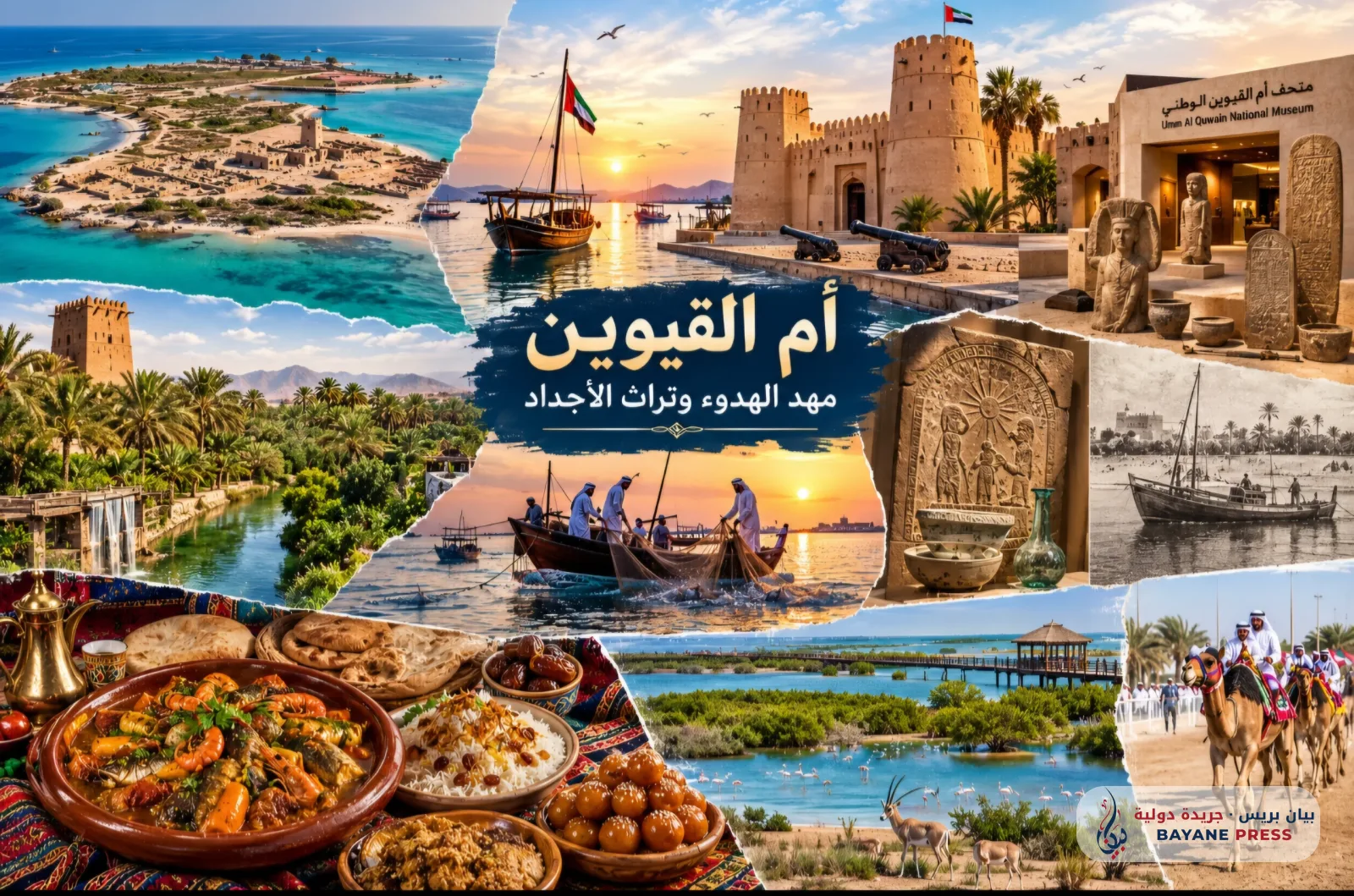
Umm al-Quwain is one of the oldest and most deeply rooted human settlements in the United Arab Emirates and the entire Persian Gulf, with its vestiges plunging into the depths of human history for more than seven thousand years; archaeological excavations at the sites of "Tel Abraq" and "Al-Dur" have revealed major civilizational centers dating back to the Bronze Age, the Iron Age, and the Hellenistic period. The site of "Al-Dur" was considered one of the largest ancient commercial ports along the spice route and maritime navigation between Mesopotamia, the civilization of India, and the Roman Empire. In modern history, the current coastal core emerged around 1775 AD, when the prominent Arab tribe of "Al Ali", under the leadership of Sheikh Majid bin Rashid Al Mualla, relocated from their ancient settlement on Al-Siniyah Island to the fortified coastal peninsula of Umm al-Quwain, establishing a hereditary rule that cemented the pillars of an independent emirate and built its imposing fortress to protect its maritime routes and wide natural creek. The inhabitants of Umm al-Quwain lived in harmony with the sea, engaging in fishing, pearl diving, and shipbuilding, in addition to cultivating palm groves in the fertile inland oasis of "Falaj Al Mualla", until the emirate became one of the founding pillars of the federation of the United Arab Emirates on December 2, 1971 AD, under the leadership of the late Sheikh Ahmed bin Rashid Al Mualla, preserving its authenticity and tranquil character as an oasis of heritage, serenity, and genuine Gulf tradition.
Umm al-Quwain overflows with exceptional historical and archaeological testimonies that have few equals in the region, headed by the imposing "Umm al-Quwain Fort", built by Sheikh Rashid bin Majid Al Mualla in 1768 AD to serve as the center of government, the seat of the emirate, and a defensive bastion comprising two main towers: the Al-Liwarah tower and the Al-Mansoor tower. Today it houses the Umm al-Quwain National Museum, which hosts heritage halls and the unique discoveries from the "Al-Dur" archaeological site, among which are the remains of the "Sun Temple", the only one discovered in the Arabian Peninsula dedicated to sun worship in the early centuries of our era, featuring sculpted stone statues, Aramaic inscriptions, Roman glass pieces, and clay incense burners. Offshore shines the historic "Al-Siniyah Island", a natural reserve and pristine archaeological site whose excavations have revealed the oldest Christian monastery, a historic church, and a pearl-fishing town dating back to the 6th century AD, surrounded by mangrove forests, sea birds, and free-roaming Reem gazelles. Deep inland, the oasis of "Falaj Al Mualla" stands out with its historic fort, square and circular towers, and palm groves watered by traditional underground water channel systems (Aflaj), alongside pristine mangrove beaches and traditional camel racing tracks in Al-Labsa.
Western travelers and chroniclers abounded in their descriptions of the historical importance of Umm al-Quwain's location and its islands; orientalist studies indicate that the location of the "Al-Dur" archaeological site in Umm al-Quwain coincides with the historic commercial port of "Omana" (Omana), mentioned by Roman sailors in the famous navigation guide "Periplus of the Erythraean Sea" in the 1st century AD. In the modern era, British historian John Gordon Lorimer recorded in his encyclopedia "Gazetteer of the Persian Gulf" the geography of Umm al-Quwain and its unique natural fortifications, as it lies on a narrow marine tongue surrounded by creek waters and shallow coastal lagoons, describing the bravery of its rulers from the Al Ali tribe, the courage of its sailors, the availability of diverse supplies in its markets, and the reception in its creek of hundreds of vessels dedicated to fishing and the pearl trade. Furthermore, researchers from the international French, Danish, and British archaeological missions who have excavated in the emirate since the 1970s recorded their astonishment at the continuity of uninterrupted human and commercial activity in the land of Umm al-Quwain for thousands of years and its civilizational connection to the greatest empires of the ancient world.
The traditional cuisine of Umm al-Quwain draws its rich identity from its shallow coastal lagoons and its creek, which abounds in the finest varieties of fish and prawns. The "Prawn and Safi Fish Saloona" dish holds a place of honor on its popular table: fresh prawns or small Safi fish are carefully cleaned, seasoned with a blend of Emirati spices (Bazar), turmeric, and salt, and lightly fried in a pot containing finely chopped golden onions, garlic, and jumble-fresh ginger. A well-cooked fresh tomato sauce and pieces of zucchini, eggplant, and potato are then poured over them, adding a sprig of fresh coriander, hot chili peppers, and pierced desert limes so that the ingredients simmer until the broth is infused with marine flavors and thickens its rich sauce, served accompanied by white rice flavored with cardamom and decorated with "Hashu" (a stuffing prepared with toasted onions, split chickpeas, raisins, and powdered lime). The Umm al-Quwain table also includes the traditional dish "Al-Qars Al-Mafruk", a thick whole-wheat flatbread baked on hot embers and sand, which is then cleaned, finely crumbled while still hot, and kneaded with Khalas dates, pure clarified butter (Ghee), and black pepper to offer a nutritious winter breakfast. Meals are crowned with crispy "Luqaimat" sweets, tinted with saffron and rose water and submerged in natural date molasses, as well as the "Bathaith" sweet, infused with the aroma of cardamom and pure butter.
Comments (0)
No comments yet. Be the first to react!