


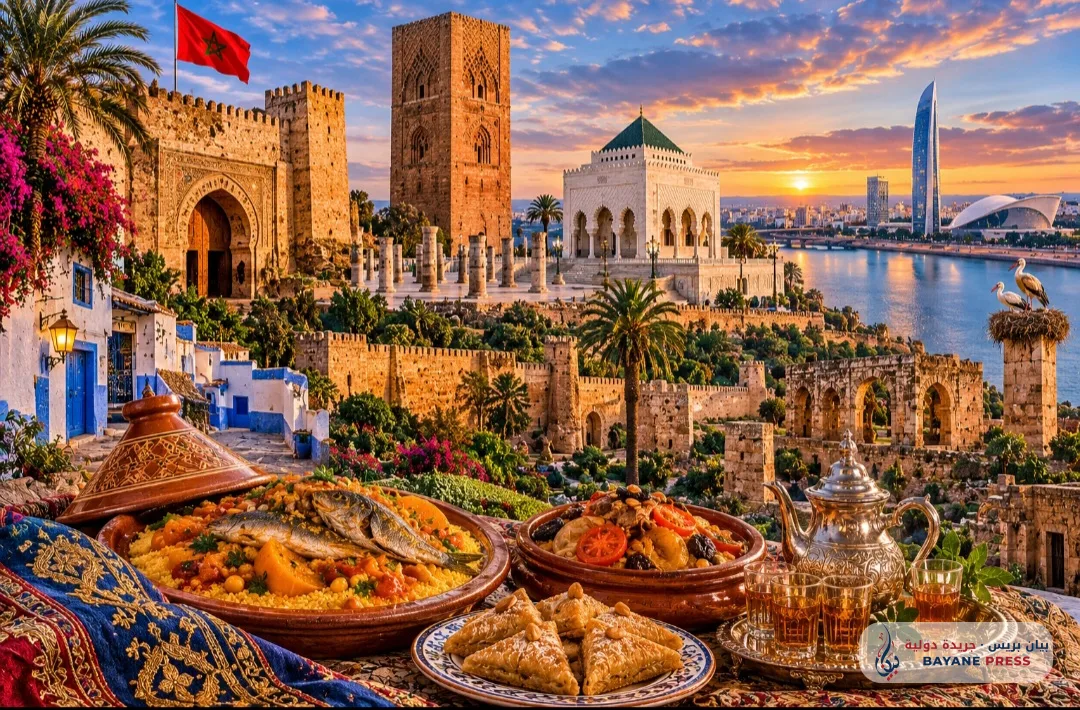
Founded on the southern bank of the Bouregreg river estuary, facing the Atlantic Ocean, in the mid-sixth century AH (around 545 AH / 1150 AD) by the first Almohad caliph, Abd al-Mumin ibn Ali al-Kumi, who chose this strategic fortified location to erect "Ribat al-Fath" (the camp of victory), conceived as a military fortress and base to gather battalions of fighters departing by sea to aid the Muslims and consolidate the foundations of the State in al-Andalus. The ambition of his grandson, the Almohad caliph Yaqub al-Mansur, soon elevated the city to an unprecedented imperial horizon, eager to turn it into a great metropolis worthy of the glories of his empire. He planned the construction of a grand capital surrounded by imposing stone walls and a congregational mosque considered the largest in the entire Islamic world at that time. With the decline of Almohad influence and the fall of al-Andalus, the city welcomed successive waves of Morisco refugees (Andalusians expelled from their homes) at the beginning of the 17th century, who settled in the kasbah and the old medina, founding a unique political entity historically known as the "Republic of Bouregreg", independent and dedicated to corsair piracy, which restored commercial and maritime splendor to the port until it became part of the honorable Alawite dynasty, becoming in the year 1912 the administrative and political capital of the Kingdom of Morocco, achieving a unique urban synthesis that earned it UNESCO World Heritage status for being a city that combines the authenticity of historical heritage with the demands of contemporary modernity.
The Hassan Tower rises into the Rabat sky as an enduring testament to the genius of Almohad architecture; its square tower, built in pink sandstone, reaches forty-four meters in height, and was planned to exceed eighty meters were it not for the death of its founder, al-Mansur, in 1199, and the famous earthquake that subsequently shook the region. In the uncovered courtyard of the mosque, hundreds of marble and stone columns are distributed, bearing witness to the monumentality of the original project. Next to the tower stands the Mausoleum of Mohammed V as a unique and modern Alawite architectural masterpiece, with its dome covered in green tiles, its walls sculpted with verses from the Holy Quran, Kufic calligraphy arts and royal tiles, and its cedarwood ceiling inlaid with gold, where the mortal remains of the late kings Mohammed V and Hassan II rest. Perched on a rocky cliff overlooking the ocean and the river estuary sits the Kasbah of the Udayas, with its imposing monumental Almohad gate decorated with intertwined polylobed arches, whose blue-and-white painted interior paths lead to the lush Andalusian garden of orange and oleander trees, and the old Moorish café. To the south of the city stretch the captivating ruins of Chellah, where the remains of the Mauritanian-Roman city (Sala Colonia) merge with the necropolises of the Marinid kings, its superb mosque and the legendary eel pool, surrounded by fig trees and willows in the shade of centuries-old stork nests. The Almohad walls are completed with historical gates of great beauty, such as the imposing Bab er-Rouah, which hosts plastic art exhibitions, and Bab Zaer.
The authenticity of Rabat is complemented by its contemporary architectural projection, embodied in the great modern monuments bordering the Bouregreg valley, notably the Grand Theatre of Rabat, designed by the international architect Zaha Hadid in a fluid and futuristic style inspired by the movement of river waves; the imposing Mohammed VI Tower, considered the tallest skyscraper in Africa and the embodiment of advanced ecological architecture techniques; as well as the Mohammed VI Museum of Modern and Contemporary Art, which hosts Moroccan and international plastic art creations. Meanwhile, the historic Consuls' Street, in the old medina, beats with the pulse of diplomatic memory having been the residence of ambassadors and consuls of European powers during the era of the Republic of Bouregreg, standing today as a traditional market of the most renowned weavers of traditional Rabat carpets and silver craftsmanship.
Travelers and artists from all over the world have immortalized the charm and majesty of Rabat. Ibn Battuta stopped in it, praising the position of its ribat and its solidity. The French romantic painter Eugène Delacroix, during his visit to Morocco in 1832 and his passage through Rabat as part of his diplomatic mission, recorded his deep astonishment at the purity of the Atlantic light reflected on the walls of the Kasbah of the Udayas and in the flow of the Bouregreg waters, dedicating ample space in his memoirs and watercolor sketchbooks to immortalizing the attire of its horsemen and the dignity of its elders. The English traveler Walter Harris wrote about the majesty of the kasbah resisting the furious ocean waves, describing the image of the river dividing Rabat and Salé as one of the most beautiful landscapes in the Mediterranean basin. For his part, Leo Africanus accurately recorded the magnitude of Yaqub al-Mansur's walls, which extended for miles, underlining that the vast expanse of empty spaces inside the walled enclosures was intended to host large armies and crowds of fighters heading to decisive battles.
The millenary Andalusian heritage of Rabat is reflected in its intangible arts, notably the traditional Rabat embroidery, of Andalusian lineage, characterized by its brilliant work of silk thread on white linen fabric leaving no trace of knots on the reverse, a true artisanal prodigy transmitted from generation to generation. In the mansions and palaces of Rabat resonate the melodies of Andalusian music and the rhythms of "Tarab al-Ala", where the noubas of Hijaz, Raml al-Maya and Ushshaq intersect with the Sufi chants of devotional choirs in the Harraqiyya and Darqawiyya zawiyas.
Rabat gastronomy is distinguished by the nobility of its culinary traditions, heirs to the Andalusian and Bouregreg tables. The quintessential dish is Rabat Badaz with fish, an exceptional couscous not made with wheat semolina as is usual in the rest of the country, but with pure millet flour that is rolled and steam-cooked three consecutive times with utmost care and delicacy to avoid lumps, then drizzled with a dense and concentrated broth in which fresh daily catch fish —such as sea bass or grouper— is cooked alongside pieces of large red pumpkin, onion, tomato, fresh cilantro, pure oil and chili pepper, resulting in an exquisite seafood dish where the lightness of the millet allies with the tenderness of the fish and the sweetness of the pumpkin. Rabat also stands out for its traditional Tagine al-Maqful, in which tender lamb meat seasoned with saffron and ginger is stewed, upon which generous layers of thin slices of fresh onion and tomato are arranged; the pot is hermetically sealed so that the vegetables melt with the rising steam and caramelize with cinnamon and powdered sugar, achieving a thick and syrupy sauce that contrasts with the succulence of the meat. Rabat banquets are crowned with Mahnacha Rabat, a spiral pastry made with very thin phyllo dough sheets filled with almond paste flavored with distilled orange blossom water and gum arabic, arranged in a snake shape, decorated with chopped almonds and dusted with cinnamon.
Comments (0)
No comments yet. Be the first to react!