


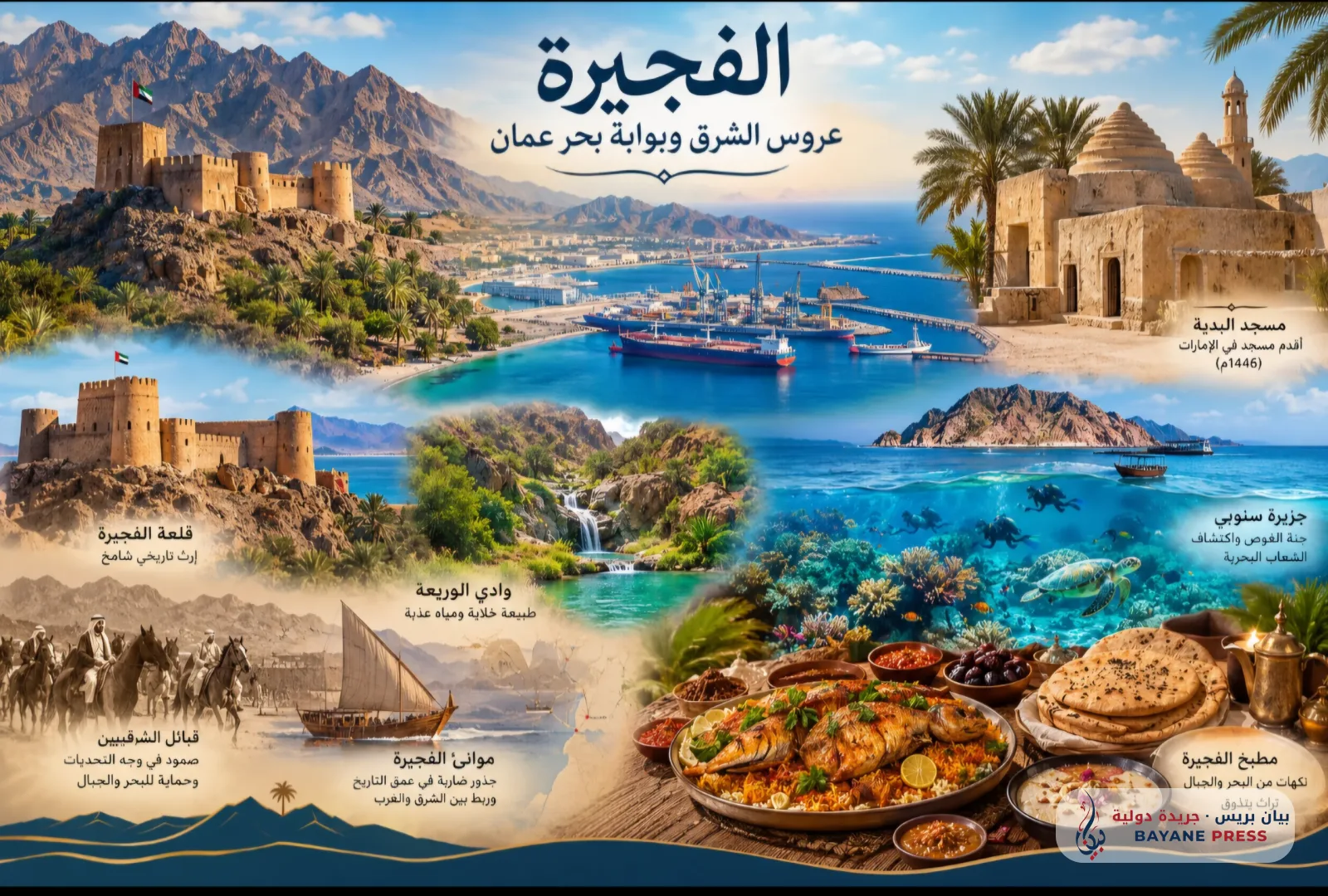
Fujairah boasts an exceptional geographical and strategic location stretching along the entire eastern coast of the United Arab Emirates, with direct views of the Gulf of Oman and the Indian Ocean. It is protected to the west by the rugged Hajar mountain range, which in the past isolated it from the desert sands and provided it with a climate and nature rich in springs and river valleys. The origins of its settlement date back to prehistoric times and the Wadi Suq civilization, linking it to the ports of Dilmun and Magan, as well as the frankincense and myrrh trade across the Arabian Sea. The region was inhabited by the genuine Arab tribes of the Sharqiyin, who made the fortified mountain valleys a refuge and firmly resisted the attempts of Portuguese hegemony in the 16th century AD and foreign control over the eastern coast's ports. Fujairah maintained its mountainous and maritime sovereignty and independence under the banner of its rulers from the honorable Al Sharqi family, until Sheikh Mohammed bin Hamad Al Sharqi led the consolidation of the emirate's pillars and international recognition of its government. Thus, Fujairah joined the blessed federation at the time of its founding in 1971, advancing towards a comprehensive renaissance that has today made its port one of the largest and most important bunker fuel supply and oil storage centers in the entire world, outside the Strait of Hormuz.
Fujairah abounds with profound historical architectural remains, led by the iconic Al Bidyah Mosque, the oldest standing historical mosque where prayers are still held in the United Arab Emirates. Its construction dates back approximately to 1446 AD and it stands out for its unique architectural style based on clay, fired stone, and plaster, crowned by four overlapping helical domes resting on a single central pillar in a harmonious architectural symmetry devoid of wood and iron. In the heart of the city stands the imposing Fujairah Fort, built in the 16th century AD on a twenty-meter-high rocky hill to protect the oasis and the city. It features three round towers, a square tower, and a defensive wall overlooking the palm groves and the Fujairah National Museum, which houses rare archaeological finds from the Bronze Age. Defensive fortresses are distributed throughout the emirate, such as Al Bithnah Fort, protector of the Wadi Ham mountain valley passes built in 1735, and Al Hayl Fort, which served as the summer residence of the ruling family, in addition to the impressive nature of the Wadi Wurayah mountain reserve with its waterfalls and freshwater springs, and the coral beaches of Al Aqah surrounding the famous Snoopy Island, ideal for diving and exploring turtles and rare marine reefs.
Travelers and historians have written with great admiration about the nature of the eastern coast and Fujairah's fortified ports. Muslim geographers and travelers of the Middle Ages documented the ports of Shamilah, Al Bidyah, Khor Fakkan, and Dibba as key commercial hubs whose waters were sailed by ships heading to Gujarat, Ceylon, and Hormuz. In the early 20th century, John Gordon Lorimer dedicated detailed chapters in his encyclopedia Gulf Gazetteer to the Shamiliyah region and the Emirate of Fujairah, describing the bravery of the Sharqiyin tribes and their attachment to the freedom of their mountainous land, and noting the fertility of its valleys, the abundance of its springs, and the date and citrus orchards spreading between the mountain slopes and sea waves. Likewise, the military records and documents of the British Crown reflected the difficulty of taming Fujairah's horsemen and their skill in defensive mountain warfare behind imposing castles and fortresses that blocked the natural accesses of the valleys. Meanwhile, foreign archaeological researchers on recent excavation missions spoke about the exceptional value of the discoveries of the Dibba Al Fujairah tombs, which connected Mediterranean civilizations with the Far East.
Fujairah's unique environmental diversity is reflected in its traditional dishes, which combine the crops of the agricultural mountain valleys with the rich marine bounty of the Gulf of Oman. Fresh fish machbūs and seafood salūna are the jewels of its coastal table; in them, kingfish, amberjack, or grouper are cooked with abundant golden onions, crushed garlic, tomato pieces, and fresh cilantro, and seasoned with Fujairah's spice blend flavored with cardamom seeds, cloves, cinnamon, black pepper, and dried black lemons (loomi), carefully pierced so their acidity infuses the broth until the sauce thickens and acquires a brownish-red color. Next, basmati rice is added to cook slowly by steaming, absorbing the fish's fat and its fragrant spices. The mountain villages are famous for preparing regag bread stuffed with egg and cheese and spread with clarified butter, jamir bread decorated with sesame seeds and saffron, as well as dishes of harees and zareed with tender mountain lamb meat flavored with dried wild herbs. Meals conclude with traditional jabisa, flavored with lamb fat, mountain rose water, and freshly ground cardamom.
Comments (0)
No comments yet. Be the first to react!