


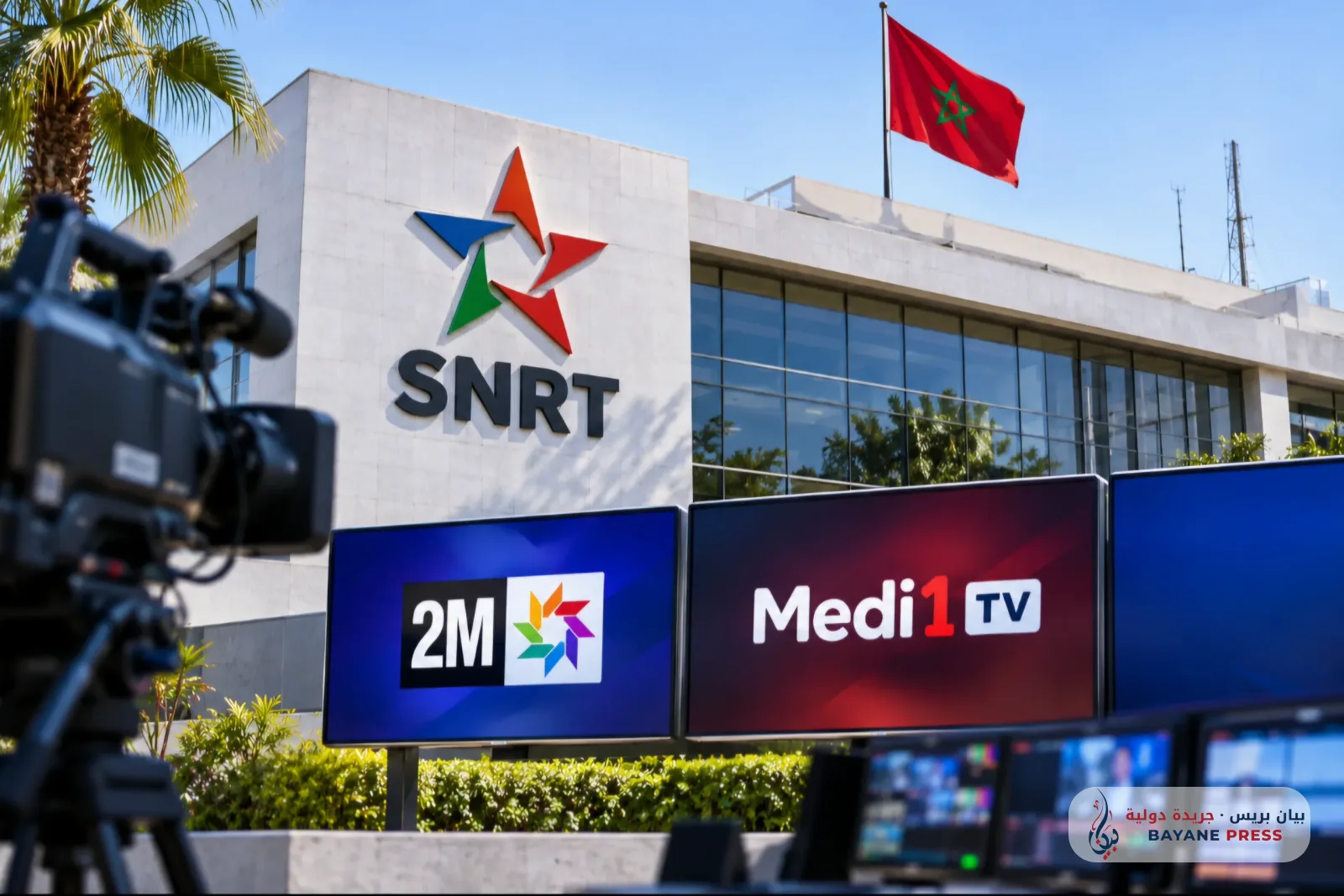
The Moroccan audiovisual landscape is undergoing a vast institutional and financial transformation, as the National Society for Radio and Television (SNRT) nears the completion of its project to consolidate several major public media institutions under a single administrative umbrella. This includes the second channel "2M", "Medi1 TV", "Medi1 Radio", and the specialized advertising firm "Regie 3". This shift occurs in the context of restructuring the public media landscape and seeking a new model for managing financial, human, and technical resources, at a time when official reports reveal persistent economic challenges, despite the expanding television and digital presence of these institutions.
Data from the 2026 communication sector report, presented during the discussion of the 2027 budget bill, indicates that the SNRT now owns 99.9 percent of the capital of "Soread", the owner of the second channel, and 100 percent of the capital of "Medi1 TV", in addition to 86.3 percent of the capital of the Mediterranean International Radio "Medi1 Radio", and the same percentage of "Regie 3". These contributions reflect the transition of the National Company from an entity managing its own television and radio channels to a parent company overseeing a broader group of actors in the public audiovisual sector.
This development is not a recent decision but part of a reform process whose executive features date back to 2021, when the idea of consolidating public media institutions into a unified structure was more clearly proposed. The goal is to overcome the multiplicity of decision-making centers and the fragmentation of technical and financial resources, and to establish a model that allows for the sharing of equipment and services and the coordination of investments, while preserving the programmatic specificities of the institutions involved.
The project has passed through successive legal milestones, most notably the Competition Council's decision issued on June 13, 2024, which authorized the SNRT to assume exclusive control of "Medi1 TV" by acquiring its entire capital and associated voting rights. This decision was a fundamental step in the legal process of consolidating media institutions, before attention shifted to finalizing the status of the second channel within the new group.
On December 3, 2025, the Competition Council published a notice regarding the project for the SNRT to assume exclusive control of "Soread" by acquiring 99.99 percent of its capital and associated voting rights. The document showed that the SNRT's capital at that time reached 1.275 billion dirhams, compared to 1.461 billion and 307 thousand dirhams for "Soread". These figures represent the capital of the two companies and do not reflect the financial value paid for the acquisition.
On December 25 of the same year, the Competition Council announced that the operation related to the SNRT assuming exclusive control of "Soread" was not subject to mandatory notification, a decision that differs legally from the authorization previously granted for the "Medi1 TV" acquisition. A comparison of the documents also reveals a slight difference in the announced contribution percentage to "Soread's" capital, as 99.99 percent was mentioned in the acquisition project notice, compared to 99.9 percent in the 2026 sector report, without any published clarification explaining this discrepancy.
The project saw tangible progress on April 24, 2026, when the total state contributions in "Soread 2M" were transferred to the SNRT, making the latter the majority shareholder in the second channel's capital. This step followed a financial operation witnessed by "Soread" during 2025, which involved increasing its capital by about 1.102 billion dirhams, from 359 million dirhams to nearly 1.461 billion dirhams, by converting state-owed debts into equity in the company's capital.
However, completing the consolidation of ownership does not mean the end of the entire restructuring project, as the next phase aims to unify several administrative and commercial functions, primarily the management of advertising, which constitutes one of the most important sources of commercial funding for television and radio institutions.
In this context, the roadmap announced for 2027 includes attaching "Regie 3" to the SNRT, in preparation for creating a unified advertising agency that will market advertising space for the various institutions of the public pole. This trend is expected to allow for the coordination of commercial offers, the pooling of marketing capabilities, and the improvement of relationship management with advertisers, rather than continuing the multiplicity of structures tasked with this function within the group's subsidiaries.
However, this shift raises economic questions regarding the impact of pooling advertising resources on market balance, especially since private media institutions also rely on advertising revenues to fund their activities. The concentration of large advertising spaces within a single commercial structure could make the conditions of competition, price transparency, and mechanisms for accessing advertisers issues worthy of monitoring, while taking into account the legal provisions and commitments related to economic concentration operations previously addressed by the Competition Council.
In addition to the advertising aspect, the restructuring plan includes launching a study on the gradual alignment of the statutes of employees of the merged institutions, and studying ways to bring collective agreements, salary structures, and human resource management mechanisms closer together. This workshop is of particular importance given the different administrative and professional situations of employees working in the concerned institutions, and the associated acquired rights, promotion paths, and compensation systems.
Nevertheless, the announcement of the preparation of this study does not mean a final decision has been made to unify all salaries or cancel existing collective agreements, as the implementation of this trend remains linked to the results of studies and subsequent regulatory decisions, and the legal, administrative, and social arrangements they may require.
The program also includes preparing new specifications that define the nature of the public channels' obligations and the content of the media service they must provide, in addition to concluding a program contract between the State and the SNRT, in its capacity as the parent company of the public audiovisual pole.
This contract is supposed to provide a clearer framework for the relationship between public funding and professional and production obligations, by defining the required goals and the resources allocated to achieve them, including the development of national production, territorial coverage, cultural and linguistic diversity, digital transition, and the modernization of technical structures.
The Minister of Youth, Culture, and Communication, Mohamed Mehdi Bensaid, confirmed during the presentation of the ministry's sub-budget for 2027 before the Education, Culture, and Communication Committee in the House of Representatives on November 4, 2026, that work continues on restructuring the public audiovisual pole. The measures he reviewed included the creation of the unified advertising agency, the adoption of new specifications, the preparation of a program contract with the State, and the launch of a study to gradually unify employee statutes and salary structures.
The importance of these reforms is more clearly highlighted when returning to the financial situation of the concerned institutions, as the report on public institutions and enterprises attached to the 2027 Finance Bill revealed that the SNRT and "Soread 2M" recorded net losses during 2025 totaling 487 million dirhams, distributed between 131 million dirhams for the SNRT and 356 million dirhams for the second channel.
Although the SNRT managed to reduce its losses compared to 2024, when its net deficit reached 410 million dirhams, it was unable to achieve financial balance. Its turnover increased from 439 million dirhams in 2024 to 672 million dirhams in 2025, an increase of about 53 percent, contributed to by revenues from the fee allocated to the promotion of the audiovisual space, which reached 428 million dirhams.
These revenues included the collection of arrears worth 155.5 million dirhams owed by the National Office for Electricity and Drinking Water for the period from 2022 to 2024, which explains part of the increase recorded in turnover, without necessarily reflecting a similar growth in the institution's regular commercial activity.
The report also stated that the SNRT benefited from state financial contributions amounting to about 1.502 billion dirhams, while its completed investments decreased from 283 million dirhams in 2024 to 197 million dirhams in 2025, a significant portion of which was allocated to audiovisual equipment, television broadcasting equipment, and information systems.
As for 2026, the financial forecasts in the report indicate the possibility of the SNRT recording a turnover of around 624 million dirhams, against a negative net result that could reach 463 million dirhams. These figures remain estimates linked to the expected closing of the fiscal year and are not a final audited result.
The situation of the second channel also appears complex, as "Soread 2M" recorded a net loss of 356 million dirhams in 2025, compared to 360 million dirhams in 2024, despite its continued strong presence in the Moroccan television advertising market.
According to the report, the second channel captured 65.8 percent of gross television advertising investments during 2025, but its turnover decreased by about 10 percent to settle at 375 million dirhams, of which 357 million dirhams came from advertising revenues. The company also recorded an operating deficit of around 303 million dirhams, reflecting the persistent gap between generated resources and activity costs.
These figures reveal that advertising power alone is not enough to ensure financial balance, and that the success of the consolidation project will remain linked to its ability to address expenditure imbalances, improve investment profitability, and diversify income sources, not just by transferring ownership or unifying administrative structures.
In parallel with these economic challenges, the 2026 digital report shows a noticeable expansion in the reach of public media content online. The first channel recorded about 1.62 billion views on the "YouTube" platform, in addition to 15.42 billion impressions of thumbnails associated with its content, which is an indicator of how much material is displayed to users, not an additional number of actual views.
The cumulative number of downloads for the "Faracha" application reached about 5.68 million downloads as of September 15, 2026, while the "SNRTlive" platform recorded a total of 84 million cumulative views, and the company's official website achieved about 4.2 million views during the period from January 15 to September 15 of the same year.
These results indicate the growing importance of digital platforms within the strategy of public media institutions, but the nature of the indicators and the different time periods used to calculate them do not allow for direct comparison with traditional television viewership rates.
At the level of television programs, the sectoral report showed the first channel recording 444.15 hours within 629 episodes, while the announced result for the Tamazight channel reached 681 hours distributed over 667 program segments, compared to 1657 hours for the sports channel within 368 segments.
The Laayoune channel recorded 166 hours of productions, distributed between 97 hours of Hassani cultural programs, 39 hours of documentary works, and 30 hours of drama series, while the volume recorded for the Moroccan channel exceeded 590 hours, in addition to 1182 self-produced news bulletins and 690 reports.
As for the cultural channel, its output reached 158 hours and 12 minutes, distributed over 21 programs and 319 episodes, while the Mohammed VI Holy Quran Channel recorded 2299 hours within the announced broadcast indicators.
In the radio field, the total broadcast hours for the National Radio, "Chaîne Inter", and the eleven regional radios reached about 66 thousand and 150 hours, while the Amazigh Radio recorded 6570 hours of annual programming, compared to 4067 hours of total broadcast for the Mohammed VI Holy Quran Radio. These data differ between production, programming, and broadcast hours, according to the nature of the indicator adopted for each institution.
Regarding the second channel, the 2026 report showed that internal production accounted for 65 percent of its programming grid, compared to 11 percent for external production, with the completion of 92 creative works, including four television films, seven series and short series, ten theatrical works and live performances, 62 documentaries, and nine feature films.
As for "Medi1 TV", it recorded during the period from January to September 2026 more than 910 million views for videos posted on social media platforms, led by "Facebook", "Instagram", "YouTube", and "TikTok", in addition to a programming output of 3888 hours.
The channel's roadmap for 2027 includes developing its news offering by launching new segments in Arabic and French, strengthening national and regional coverage, expanding its presence in African issues, in addition to accelerating digital transformation and developing analytical and news content.
Regarding the future of editorial identities, the CEO of the SNRT, Faisal Laraichi, had previously confirmed during a parliamentary meeting on January 7, 2025, that the consolidation of public media institutions would not lead to the cancellation of their editorial specificities or the unification of their programs, explaining that each channel would retain its identity and editorial line.
Laraichi also clarified that the project is not based on creating a new independent company called a "holding", but on transforming the existing National Company into a parent institution that owns the other institutions and oversees the management of some of their common functions, allowing for the unification of several technical and commercial services and the coordination of training programs and equipment procurement deals.
However, maintaining editorial pluralism within a unified administrative structure will remain one of the most prominent tests facing this transformation, especially since the different nature of the channels, their audiences, languages, and programming choices are part of the diversity of the Moroccan media landscape.
The new specifications are expected to play a fundamental role in defining the limits of administrative coordination and the extent of the institutions' independence in choosing their content, in addition to regulating public service obligations and ensuring the diversity of opinions, programs, languages, and territorial representation.
Consolidating media institutions under one management also raises a question regarding how to achieve a balance between rationalizing expenditures and maintaining quality, as cost-cutting should not turn into a reduction in national production, a weakening of field coverage, or a decline in investment in journalistic and technical talent.
Conversely, coordination between institutions could provide opportunities to develop co-productions, exchange expertise, and benefit from equipment, archives, and digital resources, provided that these measures are linked to measurable goals and that their results are subject to periodic evaluation that clarifies their actual impact on financial performance and content quality.
Thus, the Moroccan public audiovisual pole project goes beyond the limits of acquiring "2M" and "Medi1", to enter a more complex phase related to rebuilding the management, funding, and production model, and defining the relationship between media institutions, the State, the advertising market, and the audience.
Despite the progress made in arranging ownership, the completion of all elements of the new structure has not yet been linked to a announced deadline, with regulatory and contractual measures continuing to be programmed during 2027. The main bet will be the SNRT's ability to transform this vast range of capabilities into a more efficient and financially stable media pole, without compromising editorial diversity or violating competition conditions, making the reform impactful on the quality of public media, rather than just a change in structures and names.
Comments (0)
No comments yet. Be the first to react!