


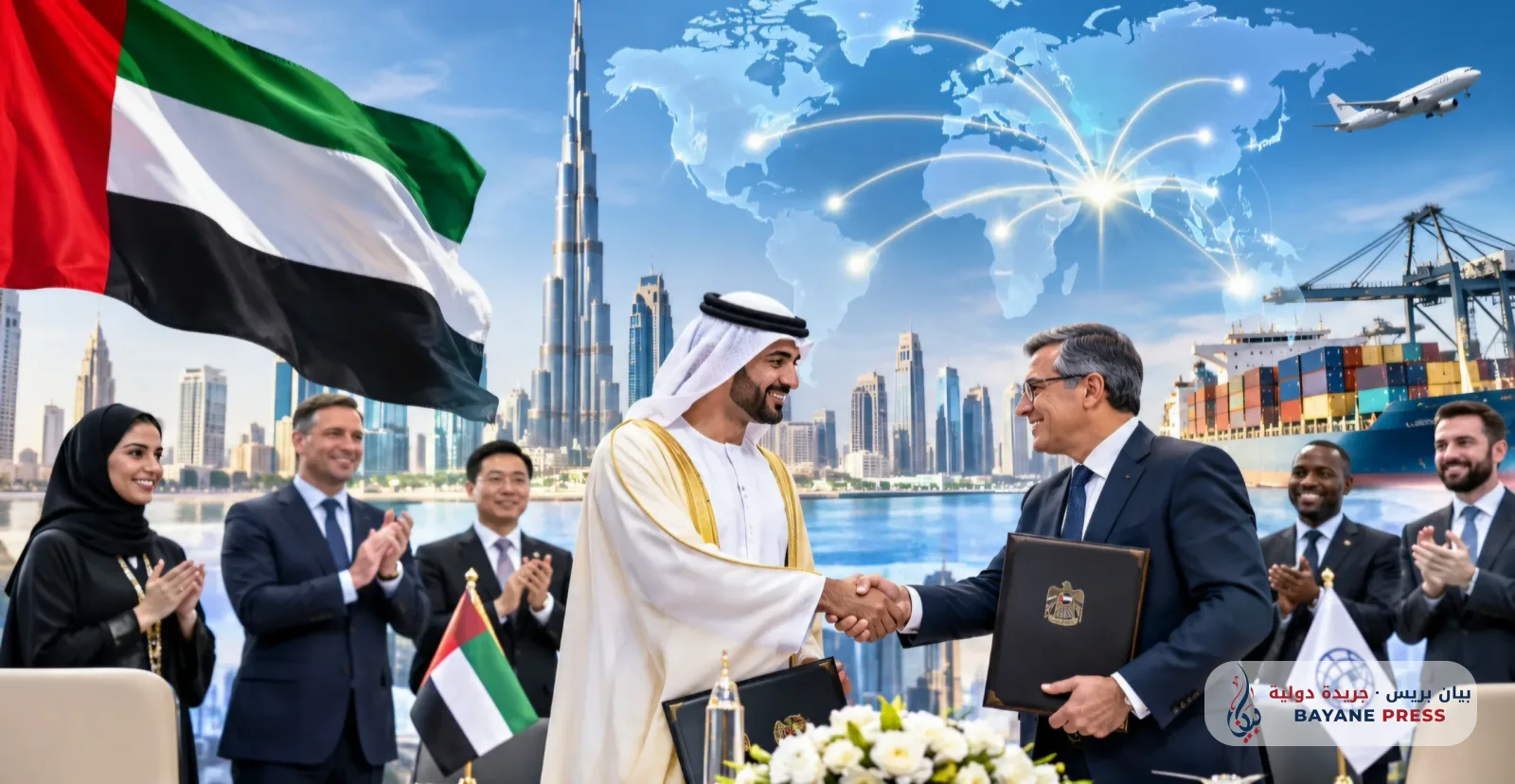
The UAE continues to expand its international economic network, relying on the Comprehensive Economic Partnership Agreements program, which has become a key tool for diversifying markets and boosting non-oil trade.
An economic report published by the newspaper "Al-Ittihad" on Monday, November 9, 2026, revealed that the number of Comprehensive Economic Partnership Agreements signed by the country reached 40 by the end of last October. 20 of these have already entered into force, while the others are in various stages of completing the necessary procedures for implementation.
This year has seen the signing of new agreements with countries including Nigeria, Sierra Leone, Gabon, the Philippines, Canada, and Benin, signaling the UAE's growing interest in emerging economies and markets with promising trade and investment potential.
This expansion has extended to the African continent, where the partnership agreement with the Democratic Republic of the Congo recently entered into force, opening additional horizons for the movement of goods and investments, particularly in the industrial, mining, and logistics sectors.
Furthermore, the partnership with the Eurasian Economic Union has become effective, providing a preferential trade framework for engagement with its five member states: Russia, Belarus, Kazakhstan, Armenia, and Kyrgyzstan.
In Asia, the UAE has made progress in expanding its trade relations, including agreements that have entered into force with countries such as Vietnam and South Korea, in addition to concluding trade negotiations with Thailand in preparation for finalizing the agreement between the two nations.
Through these initiatives, the UAE aims to reach a value of four trillion dirhams in its non-oil foreign trade by 2031, a goal based on expanding access to global markets and developing economic partnerships with multiple countries.
This record reveals a shift in UAE trade policy toward building a vast network of long-term economic relations that are not limited to traditional markets, but extend to regions possessing natural resources and growing industrial and consumer capabilities.

Comments (0)
No comments yet. Be the first to react!