


The mud village of Kipchak at the foothills of the Kopet Dag mountains, northwest of the capital Ashgabat, witnessed on February 19, 1940, the birth of Saparmurat Atayevich Niyazov within a clan of the ancient Turkmen Tekke tribe, amidst harsh conditions where fate wrote successive chapters of loss. His father, Atamurat, was killed on the Caucasus front lines in 1942 during World War II, leaving him a child in his second year. Only six years later, the historic Ashgabat earthquake struck his village in 1948, destroying the entire city and swallowing under its rubble his mother, Gurbansoltan, and his two younger brothers, Niyazmurat and Mohammadmurat. Saparmurat miraculously survived the disaster at the age of eight, finding himself alone without a family, and was transferred to a Soviet orphanage in the town of Kizyl-Arvat. There, he grew up in a harsh environment that stamped his personality with isolation, teaching him secrecy, self-control, and the instinct for survival, before moving briefly to live with distant relatives away from his birthplace.
His academic excellence in his early youth led him to the prestigious Leningrad Polytechnic Institute, graduating in 1967 as an electrical power engineer. There, he married Muza Melnikova, of Russian descent, and had two children with her, Murat and Irina. Niyazov returned to his homeland to work as an engineer and manager at the Bezmein power plant, where his administrative efficiency and strict party discipline caught the attention of Communist Party leaders. He thus engaged in the corridors of the bureaucratic apparatus, rising with deliberate graduation from neighborhood committees in Ashgabat to membership in the Central Committee, and was then transferred to work at the party headquarters in Moscow within the organization and inspection department. With Mikhail Gorbachev coming to the head of Soviet power in 1985 and the launch of purges against regional corruption networks and the so-called cotton mafia, the central leadership saw in the quiet Turkmen technocrat a trusted man. In December of the same year, he was appointed First Secretary of the Central Committee of the Communist Party of Turkmenistan, and then Chairman of the Supreme Soviet of the Republic in 1990, taking a firm grip on the country's levers on the eve of major transformations.
With the collapse of the Soviet Union in late 1991, Niyazov declared Turkmenistan's independence, working to consolidate his presidential authority with a vote share approaching ninety-nine and a half percent in the 1992 elections, then via a 1994 public referendum to extend his rule, leading up to the parliament's unanimous vote in 1999 to install him as president for life. Saparmurat managed a unique foreign policy, isolating his country in December 1995 with official UN recognition of its permanent positive neutrality from military alliances and raging civil wars in its neighborhood. He dealt with rare pragmatism with the Taliban movement in Afghanistan to secure his southern borders and negotiate the strategic TAPI gas pipeline. Internally, he employed massive natural gas reserves to buy social peace, granting citizens free quotas of gas, water, electricity, and salt, adopting this as a rentier contract that institutionalized his absolute individual rule and eliminated any voice of opposition. Meanwhile, he kept his wife and two children completely out of the political scene, preferring their permanent residence in Moscow, London, and Vienna to cut off any ambitions for dynastic succession or the expansion of family influence.
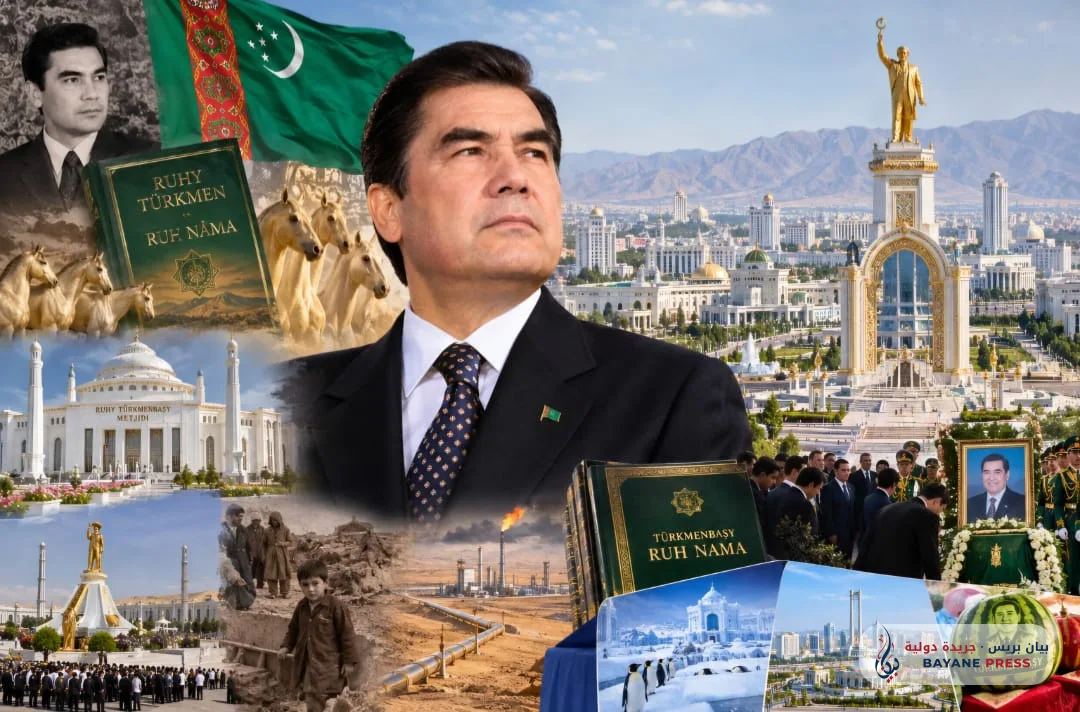
During the second half of his rule, Niyazov transformed himself into a legendary figure after officially adopting the title 'Turkmenbashi', meaning Leader of the Turkmen, establishing one of the strangest cults of personality phenomena in contemporary history. He authored his ideological book, the Ruhnama, making it a mandatory reference taught in schools and universities, a basic requirement for employment, and even a subject to pass driver's license tests. He built a giant mechanical monument to himself in the capital that opens automatically every evening, blaring excerpts in the president's voice. In 2002, he redrew the national calendar by changing the names of the months of the year and days of the week, replacing January with 'Turkmenbashi' and April with 'Gurbansoltan' in honor of his mother, whose name he also gave to traditional bread to erase its traditional Turkmen name. His features were printed on denominations of the national currency, the manat, from the smallest to the smallest, and his images extended to the facades of commercial products, tea boxes, and water bottles, leading to the creation of a new variety of watermelon bearing his name and the establishment of an annual national holiday called Turkmen Melon Day.
The president rebuilt the capital, Ashgabat, in a surrealist manner, employing French and Turkish companies to demolish old buildings and cover hundreds of palaces and government institutions with the finest types of white marble imported from Italy, earning the city a Guinness World Record as the world's most white-marble-dense city. Huge gilded statues of him were erected in the squares, most notably his statue atop the Neutrality Arch, which rises seventy-five meters and rotates with a hydraulic motor so that his face always faces the sun throughout daylight hours. Alongside this, Niyazov issued a package of unusual social decrees: he banned opera and ballet performances, circus arts, and lip-syncing at concerts; prohibited gold dental implants, advising young people to chew bones to strengthen their teeth; banned television announcers from wearing makeup and cosmetics; prohibited keeping dogs in the capital; and imposed a $50,000 insurance deposit in the state treasury on any foreign man wishing to marry a Turkmen citizen. He also showed an exceptional fondness for the golden Akhal-Teke horse breed, establishing a national authority for them and banning their export without his personal permission, and forcing his cabinet members annually to walk the thirty-six-kilometer concrete mountain health trail on foot while he watched them from his presidential helicopter.
The cultural and educational system suffered a severe shock during his reign; in 1998, he ordered the abolition of the Turkmen Academy of Sciences on the pretext of its practical uselessness, and reduced basic education to just nine years and university education to two academic years followed by two years of unpaid field work, dedicating one-third of the curricula to studying his book, the Ruhnama, which stripped Turkmen academic degrees of their international recognition. He also abolished the medical Hippocratic Oath and replaced it with an oath obligating doctors to pledge loyalty to the president and his book, and ordered the closure of hospitals and public libraries in the provinces and rural areas, laying off thousands of doctors under the pretext that a real patient should go to the capital, alongside freezing pensions for broad categories of the elderly. He also directed state resources toward massive projects in the heart of the sands, such as the Golden Age Lake 'Altyn Asyr' project to collect agricultural wastewater in a desert depression amid environmental warnings of a desertification disaster, and his plan to build an ice-skating palace in the middle of stifling desert heat complete with a zoo housing penguins.
The alleged assassination attempt on his motorcade in November 2002 marked a bloody turning point of repression; he launched an unrelenting political purge targeting former officials and opposition figures, spearheaded by former Foreign Minister Boris Shikhmuradov, which ended with expedited secret trials and the imprisonment of dozens in the notorious Ovadan Tepe prison deep in the desert. In his hometown of Kipchak, Niyazov built his massive religious monument, the Ruhi Turkmenbashi Mosque, whose walls were decorated with verses from the Holy Quran alongside texts quoted from the Ruhnama, and attached to it an opulent family mausoleum where the remains of his parents and two brothers were transferred from the old earthquake cemeteries to finally reunite them symbolically. The president's health deteriorated in secret due to his chronic suffering from cardiovascular diseases and undergoing delicate coronary artery bypass surgery in Germany, until a fatal heart attack struck him at dawn on December 21, 2006, at the age of sixty-six. With his sudden departure, the security apparatus rushed to disrupt the constitutional path; the parliament speaker Ovezgeldy Atayev was deposed and faced swift criminal charges to prevent him from temporarily assuming the presidency, paving the way for the rise of Health Minister and Deputy Prime Minister Gurbanguly Berdimuhamedow. Turkmenbashi's body was laid to rest in his mausoleum in the village of Kipchak, closing a political chapter unparalleled in Central Asia, in which the earthquake orphan turned into an absolute ruler who left behind a country resting on seas of gas, white marble, and the myths of eternal leadership.



Comments (0)
No comments yet. Be the first to react!