

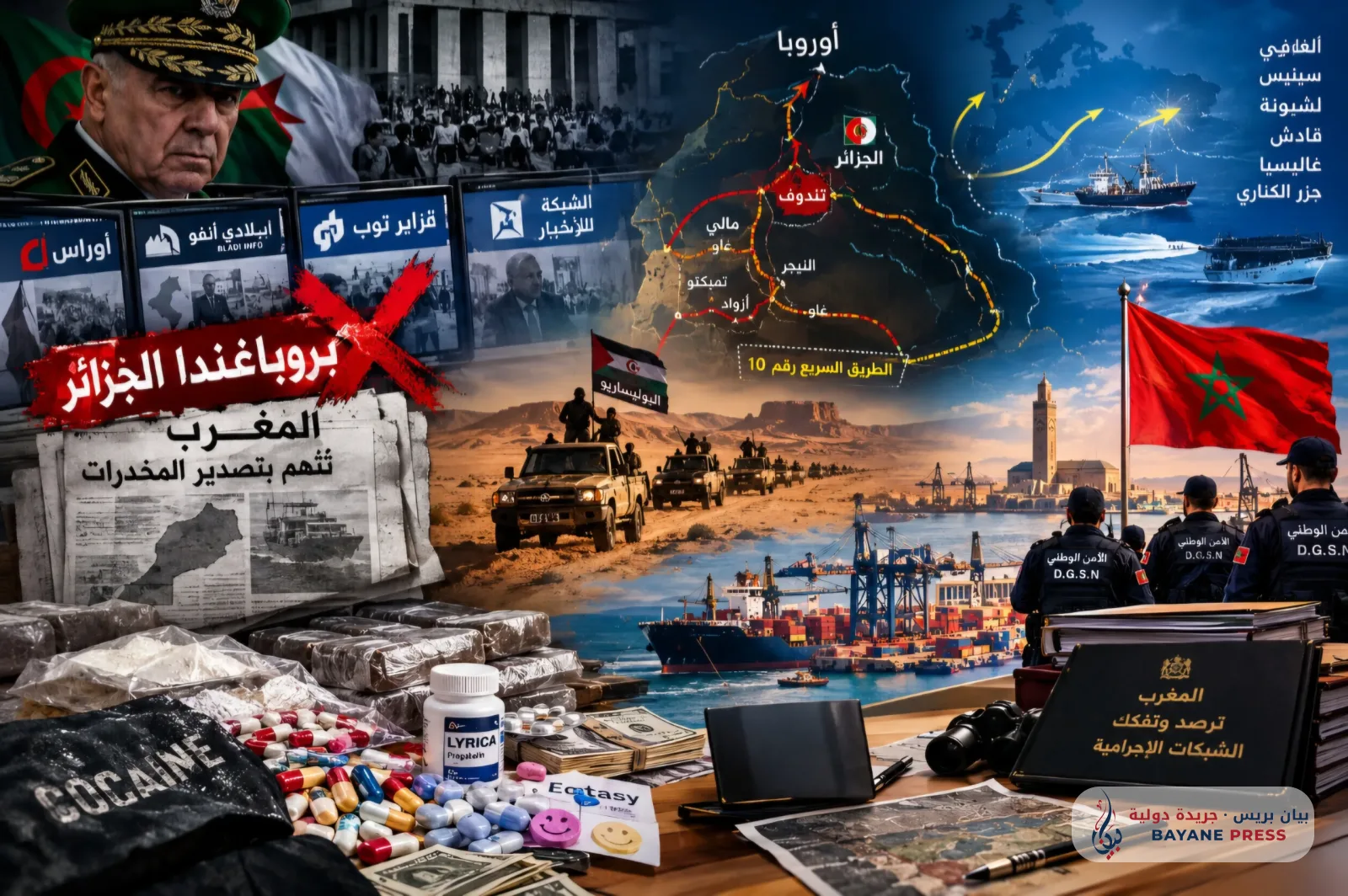
A prudent observer of the North African media landscape needs little effort to realize that the Algerian propaganda apparatus, with its various digital and print arms such as the platforms "Oueras", "Beladi Info", "Dzair Tube", "Algeria Direct", and the "Algerian News Network", has mortgaged its professional existence and editorial creed to a single objective: relentlessly targeting the Kingdom of Morocco around the clock. While the Moroccan media is busy covering major development projects and the Kingdom's strategic positioning continentally and internationally, these websites, under the direct guidance of the rulers of the El Mouradia palace, chose to practice systematic lying and make Morocco their sole news material to cover up the suffocating structural crises plaguing the Algerian regime. This propaganda behavior is manifested in its finest forms of psychological and political projection; these platforms desperately market the decaying separatist thesis by amplifying staged propaganda images inside the corridors of the United Nations or fabricating fake uprisings to disrupt UN Security Council resolution drafts, in parallel with their desperate attempts to pin the blame for exporting drugs to Europe on Morocco through selective promotion of routine seizures in Spain. They deliberately ignore that geographically and security-wise documented facts place the Algerian military regime at the heart of the largest continental network for hard drug trafficking and chemical poisons in the Mediterranean basin and Africa.
Opening the documented records of international institutions, foremost among them the reports of the United Nations Office on Drugs and Crime (UNODC) and the European Monitoring Centre for Drugs and Drug Addiction (EMCDDA), as well as the archives of the US Drug Enforcement Administration (DEA) and the Global Initiative against Transnational Organized Crime, exposes the falsehood of the Algerian narrative. It tangibly reveals that tons of hard drugs cross daily through the African Sahel region and sub-Saharan countries, specifically via what is security-termed "Highway 10", extending from the coasts of the Gulf of Guinea into the depths of the Sahara Desert. Intelligence reports and field facts, supported by the research of French criminologist Xavier Bougeron and reports from the European Intelligence for Strategic and Security (ESISC) in Brussels, confirm that major cocaine cartels in Colombia and Mexico—led by the Sinaloa Cartel, the Jalisco New Generation Cartel, and the Clan del Golfo networks—would not have been able to establish their logistical bases in West Africa and the Sahel without direct understandings and personal dealings with the highest military leadership in Algeria, specifically Army Chief of Staff Said Chengriha and the inner circle of generals controlling border crossings and maritime fronts. International archival memory still holds explosive facts exposing this complicity, starting with the notorious "Air Cocaine" scandal in the Tarkint area of northern Mali, passing through the arrest of the baron "Omar Sahraoui" and the dismantling of the "Sultan Ould Badi" networks which exposed the field interdependence between major smugglers and crossing protectors in southern Algeria, up to the scandal of seizing over 701 kilograms of raw cocaine at the Port of Oran—a case known media-wise as the "Kamal El Bouchehi" file that shook the foundations of the Algerian state after preliminary investigations touched prominent figures in the military and security institutions before being hastily covered up.
This systematic involvement does not stop at securing transcontinental cocaine routes; it extends to managing a dirty chemical war targeting Moroccan and regional societal security by manufacturing and smuggling millions of psychotropic pills, popularly known as "Karkoubi", Pregabalin drugs, and Ecstasy derivatives. These flow under the direct supervision of Algerian military units stationed along the Kingdom's eastern border strip. The sheer volume of massive shipments of psychotropic substances that Moroccan security agencies thwart attempts to introduce almost daily proves that this is not about isolated smuggling gangs, but an official doctrine supervised by Chengriha's wing to flood the region with poisons. This is a fully-fledged criminal file that merely requires a fair and independent international investigation, far from petty political calculations, to reveal the blinding truth to global public opinion and bring to light the full list of names of generals, intermediaries, and foreign bank accounts managing this black economy.
At the heart of this cross-border criminal engineering, the separatist "Polisario" front plays the role of the armed militia and functional logistical tool tasked with protecting and securing Chengriha's drug caravans overland through the rugged routes of the Sahara. This has been documented by reports from the Carnegie Endowment for International Peace and European parliamentary and security investigations that have repeatedly warned of the organic shift of Polisario elements into "caravan guards" for smuggling cartels. These militarily protected overland routes originate from unloading points in the Gulf of Guinea, cross Niger territory through the Agadez axis, enter Malian territory passing through the triangle of Gao, Kidal, and Taoudenni in the Azawad region, and from there via the Timbuktu-Ber axis, the In Khalil corridor, and Bordj Badji Mokhtar under Algerian military control, reaching the Tindouf camps used as a rear base for storage and redistribution, alongside the strategic "Salvador Corridor" line at the intersection of the borders of Algeria, Niger, and Libya. From those rear bases in Tindouf and the desert tracks adjacent to northern Mauritania, the secured tons are shipped toward the Atlantic and Mediterranean maritime fronts to be smuggled via modified fishing vessels and high-speed boats toward European shores, specifically the coasts of the Algarve and the ports of Sines and Lisbon in Portugal, as well as the Gulf of Cádiz, the coasts of Galicia, and the Canary Islands in Spain.
Aware of the billions accumulated from the revenues of this smuggling, and seeking to infiltrate the Moroccan economic and security fabric, directed Algerian groups resorted to hybrid warfare by establishing dummy corporations and cross-border commercial fronts, supported by a complex intelligence network utilizing specific cities and ports such as Alicante, Valencia, and Algeciras in Spain, and Porto and Lisbon in Portugal, as rear headquarters to manage operations and disguise financial movements. These intelligence cells, disguised as foreign investors, attempted to forge suspicious relationships and business partnerships with Moroccan actors and contractors under the cover of civil activities whose apparent facade is trade exchange and the export/import of specific goods such as fabrics, textiles, ceramic materials, and electronic devices, while their hidden core is the laundering of drug money and the creation of logistical gateways to infiltrate and build spy networks inside Moroccan territory. However, the high acumen of Moroccan citizens and economic actors, backed by the proactive vigilance of Moroccan security and intelligence institutions that have accumulated globally renowned expertise in dismantling complex networks, successfully detected these suspicious movements from their very first steps. They uncovered the secret threads connecting those dummy companies in the Iberian Peninsula to the operations rooms in Algiers, disrupting the calculations of the El Mouradia generals and ruining their schemes, leaving the daily media screaming on Algerian websites as merely an echo of the impotence of a regime that failed in the diplomatic field and was exposed in the paths of the Sahel and the Sahara.


Comments (0)
No comments yet. Be the first to react!