


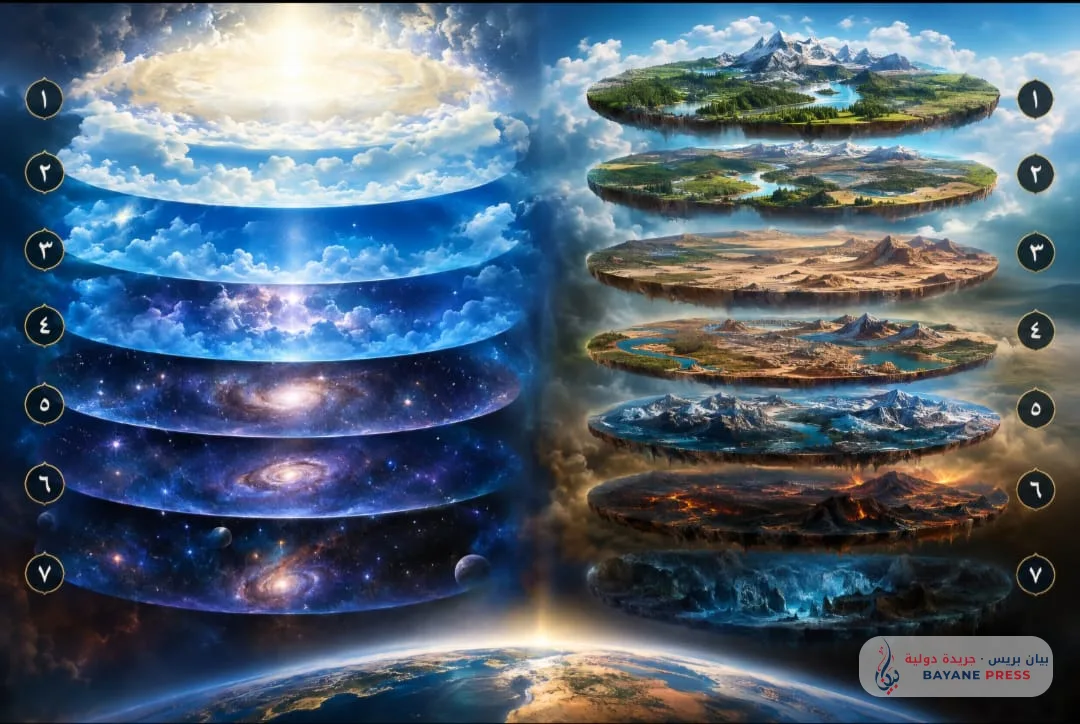
The question of the creation of the seven heavens and seven earths is one of the major cosmological issues that has occupied a prominent place in Islamic intellectual heritage. The texts of the Noble Quran, the explicit and purified Prophetic Sunnah, and the subsequent commentaries of the Imams of exegesis and Hadith have all converged to establish this truth, affirming that it is neither a mythological concept nor a baseless claim, but rather a firm cosmological reality grounded in decisive texts and definitive proofs.
Regarding the seven heavens, the Quran mentions them in a definitive phrasing that leaves no room for linguistic interpretation other than the actual number. Allah Almighty states in His decisive revelation: "It is He who created for you all of that which is on the earth. Then He directed His attention to the heaven and fashioned them [as] seven heavens, and He is Knowing of all things" [Al-Baqarah: 29]. This affirmation is repeated in various places, such as His statement in Surah Al-Mulk: "[He] who created seven heavens in layers. You do not see in the creation of the Most Merciful any inconsistency. So return your vision [to the sky]; do you see any breaks?" [Al-Mulk: 3], as well as in Surahs Nuh, Fussilat, and Al-Mu'minun, describing them as cohesive layers without inconsistency, and confirming that this sevenfold formation represents a guarded ceiling and an integrated system through which divine commands descend.
As for the earth, the Quranic reference to it came with extreme precision at the conclusion of Surah At-Talaq in the Almighty's saying: "It is Allah who has created seven heavens and of the earth, the like of them. The [divine] command descends among them" [At-Talaq: 12]. The elite scholars of exegesis and linguistics have settled upon the view that the likeness mentioned in the verse undoubtedly refers to the number. It is inconceivable to suggest a likeness in magnitude, capacity, or attributes given the apparent contrast between the upper nature of the heaven and the lower nature of the earth. Rather, the explicit indication is to show that the number of earths is seven just as the heavens are seven. This has been transmitted by early exegetical imams such as Ibn Jarir al-Tabari, Al-Qurtubi, and Ibn Kathir, who saw in this context a brilliant proof of the plurality of earth's layers or worlds numbering seven.
The purified Prophetic Sunnah came to lift any ambiguity and remove any possibility of metaphor regarding the number of earths, through authentic and sound narrations of the highest degree in Sahih al-Bukhari and Sahih Muslim. Among the most prominent evidences is what was established in the two Sahihs from the Hadith of Sa'id ibn Zayd, may Allah be pleased with him, that the Prophet, peace and blessings be upon him, said: "Whoever wrongfully takes a span of land will be encircled by it from the seven earths on the Day of Resurrection." In another wording narrated by Aisha, may Allah be pleased with her, also in the two Sahihs: "Whoever wrongfully takes the width of a cubit of land, it will be collared around him from seven earths." This encasement and sinking mentioned does not hold up linguistically or factually unless the earths are indeed seven distinct entities that can be sunken into and encircle the unjust. These proofs are further reinforced by what has been authentically reported in the Sunan and supplications transmitted from the Prophet, peace and blessings be upon him, such as the Hadith of Abdullah ibn Umar, may Allah be pleased with them both, that when the Prophet, peace and blessings be upon him, arrived at a town he wished to enter, he would say: "O Allah, Lord of the seven heavens and what they overshadow, Lord of the seven earths and what they carry, Lord of the devils and what they lead astray, Lord of the winds and what they scatter...", which proves the complete correspondence in existence and number between what the heaven overshadows and what the earth carries.
Regarding consensus and creedal understanding, no significant disagreement arose among the scholars of the Ummah on the foundational proof of the number seven for both the heavens and the earth. Rather, the consensus of Ahl al-Sunnah wal-Jama'ah was established on acknowledging these texts and letting them pass according to their decisive apparent meanings without nullification or distortion. They considered belief in the existence of seven heavens and seven earths to be an inseparable part of affirming what infallible revelation has reported. The efforts and discussions of scholars thereafter focused on explaining the modality and nature of this plurality. While a broad majority of commentators, jurists, and Hadith scholars maintained that the seven earths are stacked layers, one above the other, with a specific creation separating each layer—just as is the case in the layers of the heavens—another group viewed the possibility that they are seven regions, continents, or adjacent bodies and worlds in cosmic space united by the same composition and agreeing in their earthly nature. This disagreement, confined to the modality, does not detract in any way from the foundational proof and number. Instead, it confirms that the issue is deeply rooted and taken for granted in the Islamic creedal consciousness, and that denying it or claiming its falsehood contradicts explicit, recurrent texts and the consensus of the early and later generations of the Ummah. Thus, the reality of the seven heavens and seven earths remains a firm cosmological and faith-based pillar resting upon the strongest proofs of transmitted revelation.



Comments (0)
No comments yet. Be the first to react!