


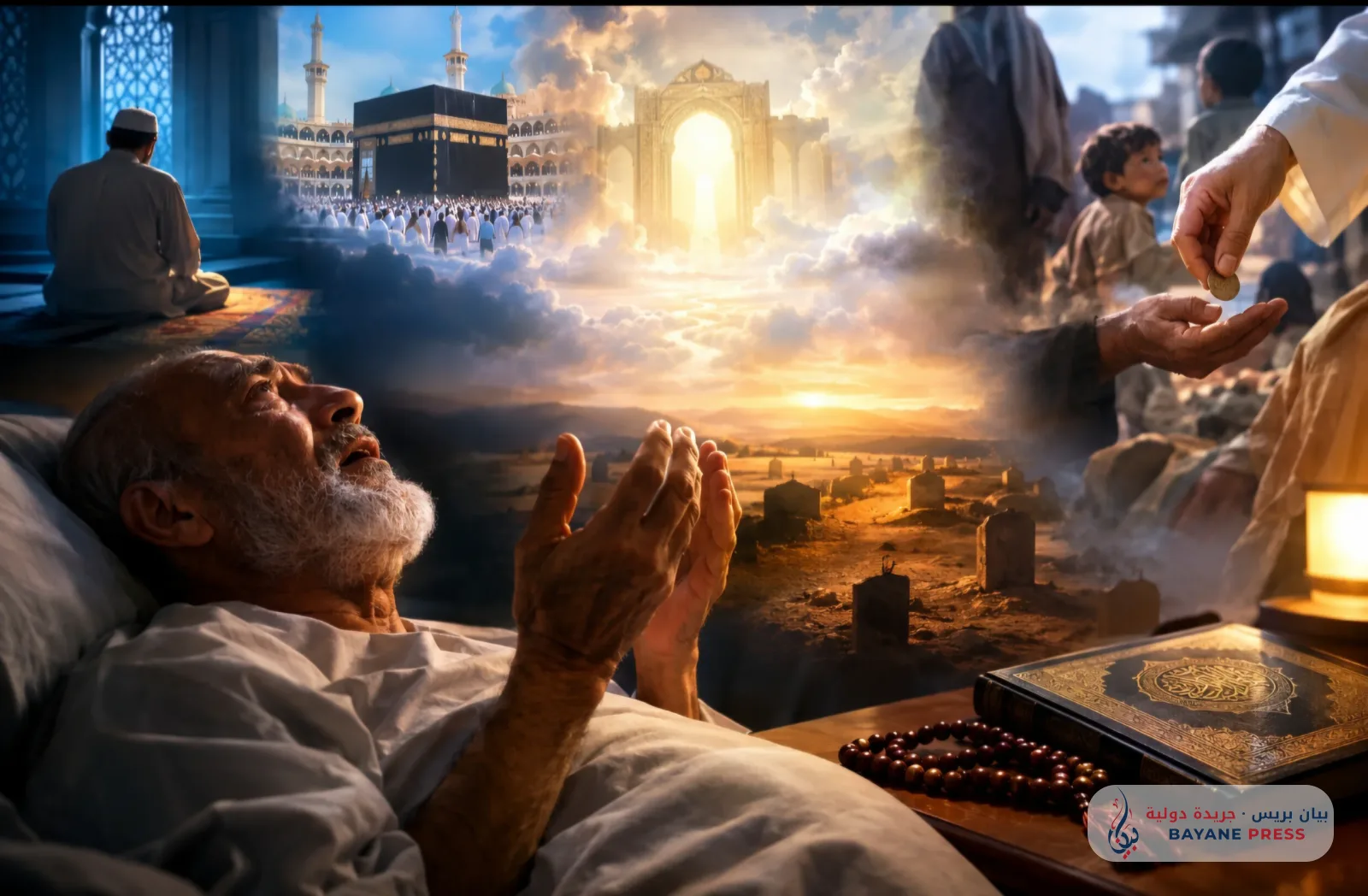
The moment of agony represents the dividing line between the abode of deeds and the abode of recompense. It is the decisive hour when the veil is lifted from human insight, dispersing worldly illusions and revealing realities stripped of the falsehood and adornment that long engrossed the minds of the heedless. Within the context of divine warning against the temptation of engrossment in hoarding debris—distracting oneself with wealth and children from the ultimate purpose of human existence—the Noble Quran places us at the conclusion of Surah Al-Munafiqun before an imposing visual scene that encapsulates the regret of the human soul when death overtakes it suddenly while it has been negligent of its duty to God. Thus, man utters his final cry, wishing for a brief span of time in which to rectify what he has missed, as articulated by the Almighty: "My Lord, if only You would delay me for a brief term so I would give charity and be among the righteous."
Meditation upon the graphic and linguistic structure of this noble verse reveals precise rhetorical secrets reflecting the psychological and emotional state of the dying person at that critical moment. This supplication opens with the word «Rabbi» (My Lord) after omitting the vocative particle and the first-person pronoun, contenting itself with the kasra indicating it. In this phonetic reduction lies a deep indication of the scarcity of time, the succession of breaths, and the intensity of supplication—as though the dying person is crying out like a drowning man who lacks the luxury of elongating his expression, resorting to the attribute of Lordship with all the meanings of care, gentleness, and reform it carries. This is followed by the exhortation particle «lawla» (if only), which in this context conveys a sense of remorse, regret, and urgent pleading to attain a matter whose scroll has been folded and whose time has passed, coupled with a request for respite until a «brief term.» He does not covet eternal immortality nor ask for a prolonged life spanning decades; rather, he is content with a very brief reprieve after realizing the true value of time, knowing that a single hour in the realm of accountability is priceless.
Grammatical inimitability reaches its peak in the words "fa-asaddaqa wa akun" (so I would give charity and be), where the first verb is put in the accusative case following the causal fa' in response to the wish, while the second verb is altered to the jussive as a coordination to the position and an estimation of a latent condition rooted in the speaker's conscience, as if he were saying: "If You delay me, I will give charity and be among the righteous." In this inflectional transition lies a graphic indication of the degree of certainty and conviction filling the dying person's heart with his sincere resolve to fulfill his promise if his request is answered.
The testimonies of the Glorious Book corroborate across various places to confirm this meaning and deepen its significance. This wish is not a passing event; rather, it is a consistent pattern recurring with everyone who has neglected to prepare for meeting God. In more than one verse, the Quran links witnessing the horrors of the end with the desire to return to worldly life for righteous deeds and spending in avenues of goodness. This interconnection is manifested in the Quran's depiction of the negligent when they ask to be returned so they might do other than what they used to do, and in the scene where the wrongdoers ask to be delayed for a near term so they might answer God's call and follow the messengers, alongside verses linking the denying expression with man's immense love for wealth and his failure to urge the feeding of the poor, leading up to the moment when the soul reaches the collarbones and he regrets not having given charity nor prayed—proving that the miserliness of the soul with wealth is the formidable obstacle which, once transcended by the servant, makes all other acts of obedience easy for him.
The purified prophetic Sunnah elucidates the motives of this Quranic scene and establishes its practical and educational framework in the life of a Muslim. The Prophet (PBUH) guided his nation in authentic, extensive traditions regarding the vast disparity in the scale of reward between voluntary charity in health and forced charity at death's door. He explained that the greatest charity in status before God is that which a person gives while in full health and vitality, miserly with his wealth, fearing poverty and hoping for wealth and longevity, while warning against procrastination and waiting until the soul reaches the throat, at which point the patient distributes wills, saying: "Give such and such to so-and-so," whereas the wealth at that hour has already effectively left his grasp and passed to his heirs. The prophetic guidance also revealed the unseen secret behind remembering charity specifically upon leaving the world, as the Chosen One (PBUH) informed us that charity is a shining proof of the sincerity of faith because it opposes the soul's innate love for possession, extinguishes the servant's sin just as water extinguishes fire, protects its owner from the heat of the graves, and serves as a shady canopy for the believer on the Day of Resurrection when the sun draws close to heads. Thus, when the dying person witnesses the angels of death and sees what awaits him in the realm of Barzakh, he realizes that nothing is swifter to rescue him and secure his fright than a sincere charity he put forth.
Guided by this decisive Quranic text and the subsequent verse, "And never will Allah delay a soul when its time has come," and by the aggregate of authentic prophetic traditions, the scholars of the nation in creed and jurisprudence have unanimously agreed upon a set of established, unquestionable rules. Scholars have unanimously agreed that the lifespans of creation are ordained and fixed in God's eternal knowledge, and that once the decreed hour for the end of earthly life arrives, delaying it by a single moment or bringing it forward is impossible, thus cutting off false hopes and prolonged expectations. There is also doctrinal consensus that the door of initial repentance and the acceptance of newly initiated deeds closes completely when the soul reaches the throat and the unseen world is witnessed; for accountability is built upon belief in the unseen and free choice, and once the unseen becomes manifest and compulsory, the meaning of trial falls away and regret is of no avail.
From a legislative standpoint, jurists unanimously deduced the rule restricting a person's financial transactions during fatal illness, where their financial estate loses its full eligibility for absolute donation to protect the rights of creditors and heirs. Their gifts and wills at that time are only executed within the limit of one-third of the estate. This is a marvelous jurisprudential legislation that corroborates the Quranic truth, as the negligent person at the hour of death is deprived even of full freedom to dispose of his wealth—which he spent his life collecting—thereby multiplying his regret for wasting the opportunity to spend it when he was healthy, unrestrained in hand, and influential over his fortune.
The Imams of exegesis, prominent pious predecessors, and masters of insight have paused at length over the precise question raised by the verse: Why did the dying person specifically mention charity in his ultimate wish, saying "fa-asaddaqa" (so I would give charity), rather than saying "so I would pray," "so I would fast," or "so I would strive in jihad"? Scholars' views in answering this question varied in a manner of integration and enrichment. The nation's interpreter, Abdullah ibn Abbas (may Allah be pleased with them both) and a group of Tabi'in like Qatadah and Ad-Dahhak went so far as to say that the verse was revealed concerning one who neglected the obligatory Zakat and mandatory financial rights, so he asked for respite to pay the Zakat on his wealth by saying "fa-asaddaqa", and to perform the pilgrimage and other physical obligations by saying "wa akun min al-salihin" (and be among the righteous), so that in his wish he would have combined repairing what he ruined regarding the rights of creation through financial expenditure, and repairing what he neglected regarding the Creator's rights through obedience and worship.
Another group of verifiers and Imams of exegesis—such as Imam Fakhr al-Din al-Razi, Ibn al-Jawzi, and Ibn al-Qayyim—deduced profound spiritual and social nuances to explain this specification. They pointed out that when a dying person's soul is extracted, he is shown the immense reward of charity and its multiplied recompense with God, seeing with the eye of certainty the rank of those who give and the dignity and security prepared for them, causing him to belittle everything he owns and wish he had given it all away. Scholars also highlighted the fundamental difference between purely physical acts of worship like prayer and fasting, and financial worship represented by charity. Physical acts of worship have benefits restricted in origin to their doer, whereas charity is an act whose benefit extends to creation: comforting the poor, feeding the hungry, mending the broken-hearted, and sustaining the welfare of the nation. Whatever has extended benefit is more beloved to Allah, more enduring in effect, and greater in weight on the scale.
Added to this is the psychological dimension realized by the dying person when he sees his wealth standing before his eyes while he is unable to take it with him. At that moment, he becomes certain that this wealth—for which he was distracted from his Lord, made enemies, and was deprived of peace of mind—will be left behind him as cold spoils for his heirs, who will enjoy its pleasures without toil, while he remains alone in his grave mortgaged to its reckoning and consequences. Thus, he wishes he were returned to the world to place his wealth ahead of him in the Hereafter instead of leaving it behind in the world.
Mindful meditation upon this noble verse and its legal objectives places every living human being before a brilliant, indisputable truth: that everyone breathing the air of life today and reading these words with their eyes is actually living in the very heart of that "brief term" which the dead in their graves wish for and regret missing. The respite for which the dying person cried out and was denied is the absolute possession of the living at this very moment. Health still endures, the hand remains outstretched, the door of acceptance remains wide open, and the dirham that a person spends today with a willing soul, hoping for the countenance of Allah, is the enduring provision and true capital preceding him to the abode of permanence before the scrolls are folded, the pens dry, and a barrier is placed between man and what he desires.

Comments (0)
No comments yet. Be the first to react!