


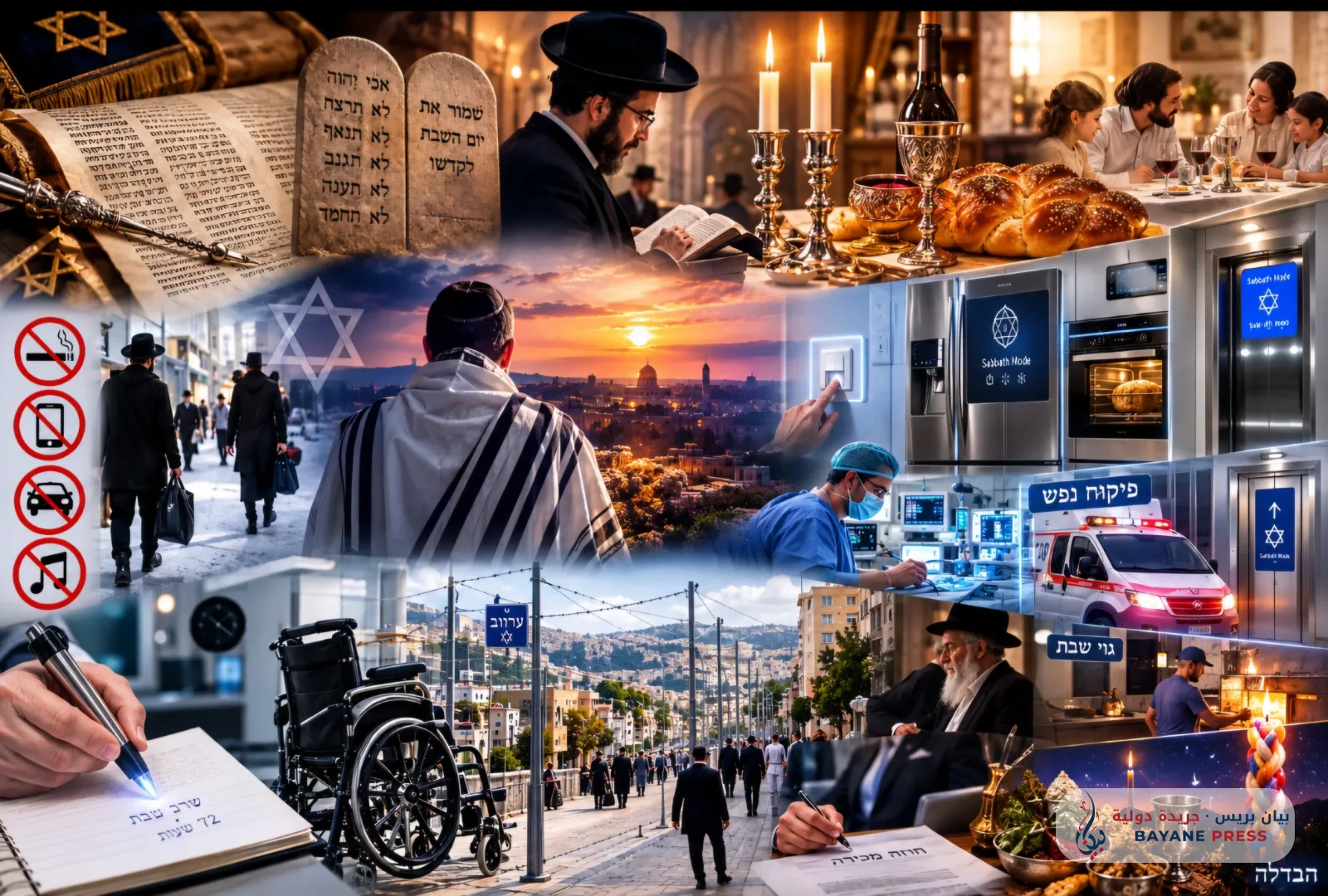
The Sabbath law, known in Hebrew as "Shabbat," occupies a central and core place in the Jewish religious and legislative system, drawing its direct sanctity from Torah texts in the books of Genesis and Exodus as a commemoration of the Creator's rest on the seventh day after the completion of the universe's creation, and as the embodiment of the fourth commandment firmly established among the Ten Commandments, which obligates the Children of Israel to completely cease from all forms of work. The concept of "work" prohibited in Talmudic jurisprudence is not measured by the extent of physical exertion or muscular hardship, but by the creative ability to bring about a voluntary and purposeful change in the matter surrounding man; a principle detailed by the Talmudic rabbis in tractate "Shabbat" by deducing thirty-nine primary classifications of prohibited works, conventionally known as the "principal labors" (Avot Melachot), which are the crafts and tasks historically practiced for the purpose of constructing the Tabernacle (Mishkan) during the wandering in the wilderness. These origins branch out into a major circle encompassing the stages of agricultural and food production such as plowing, sowing, harvesting, kneading, baking, and cooking, textile manufacturing from shearing wool, bleaching, spinning, weaving, sewing, and tearing, leather preparation, writing and erasing letters, building and demolition, moving or carrying any object from a private domain to a public domain or vice versa, and kindling and extinguishing fire. To protect these origins from any unintentional violation, the rabbinic institution imposed a "fence around the Torah," which included the prohibition of touching or moving a wide category of tools and possessions known as "Muktzah" (the isolated possession), such as money, crafting tools, and pens, alongside the prohibition of driving vehicles, commerce, engaging in worldly talk, and using electricity, which modern jurists considered a contemporary manifestation of kindling fire or completing construction by closing circuits.
These prohibitions extend to encompass the minutest details of personal hygiene and usual daily care, as it is forbidden for the observant to cut toilet paper along the perforation line or to a specific size due to the suspicion of falling under the prohibition of "cutting to a specific measure" (Mehathech) and the prohibition of "demolishing and building," which requires them to provide themselves with pre-cut papers before the Sabbath begins or to tear them randomly without lines. Furthermore, rubbing a solid bar of soap is forbidden as it is considered smoothing and leveling solid matter (Mim-ḥaq), and it is replaced with highly fluid liquid soap. Washing dishes with traditional porous sponges is prohibited to avoid wringing out the water trapped inside, which falls under the prohibition of "wringing" (Sechita), necessitating the use of plastic mesh scourers with spaced networks that do not absorb liquids. The prohibition extends to combing hair with stiff combs that inevitably lead to pulling out fallen hair, bringing it under the rule of "shearing" (Gozaz), restricting grooming to gently arranging it with fingers or a very soft brush, in addition to preventing nail clipping or plucking skin tags, and prohibiting playing any musical instrument for fear that a string might break and the player would have to tighten or tie it, which is considered in Talmudic jurisprudence a violation of the prohibition of "putting the finishing touch to repair and prepare tools" (Makeh Be-Patish).
In contrast, the Sabbath law is not based on passive abstinence and stagnation alone, but is directly aimed at achieving spiritual and physical bliss called "Oneg Shabbat" (Sabbath delight) and "Kavod Shabbat" (Sabbath honor). These rituals begin before the setting of the sun on Friday when the housewife lights Sabbath candles in welcome of the holy day, after which worshippers head to synagogues to perform "Kabbalat Shabbat" (welcoming the Sabbath) prayers and chant traditional hymns such as "Lecha Dodi." Returning home is followed by the "Kiddush" ritual to sanctify the day over a cup filled with wine before meals, as the law obligates believers to partake in three luxurious festive meals containing the finest foods, and eating is opened with the blessing of breaking the double braided "Challah" bread, signaling the heavenly manna that descended in double portions upon the Children of Israel in the wilderness on Friday. Sabbath daytime is dedicated to reciting the Torah and delving into its texts, gathering with the family, complete rest, and sleep. Indeed, marital relations and intimacy on Friday night are considered a great virtue and a Mitzvah (beloved commandment) that imparts doubled sanctity to the relationship. A person is permitted to walk and stroll as long as it is confined within the geographical boundary defined for the city or village, known as "Techum Shabbat."
Faced with this stark contrast between the harshness of prohibitions and living requirements, Jewish legal schools over the centuries developed complex strategies of "jurisprudential adaptation and circumvention" (Ha'aramah), which are advanced legal and technical solutions relying on the strict literalness of jurisprudential texts to allow what is forbidden without breaking the explicit text of the Torah. Foremost among these solutions is the legislation of the "Eruv," a legal fiction that transforms the vast public domain into a virtual private domain; the entire neighborhood or city is enclosed by a thin wire stretched on poles at specific heights to act as a "symbolic wall and doorways," thereby lifting the biblical prohibition on carrying objects outside homes, making it permissible to carry keys, books, push baby strollers, and carry medicines in the streets without violation. To bypass the prohibition of kindling fire and cooking during the Sabbath without depriving families of hot foods and beverages, jurists formulated the rule permitting the heating of fully cooked foods prior to sunset on condition that they are not cooked anew. Thus, they invented the Sabbath hot plate (metal or electric plate) which remains at a constant temperature all day long to place pots of "Cholent" or "Hamin" stew upon, alongside keeping electric hot water boilers plugged in and pre-set to provide tea and coffee.
With the emergence of the Industrial Revolution, the era of electricity, and digitization, contemporary jurisprudence resorted to the principle of automation and self-operation of machines, considering that the machine operates by prior human direction rather than by the work of his hand on the Sabbath. Hence arose the mechanical "Sabbath clock" which is set on Friday to automatically disconnect and connect lighting, air conditioning, and heating systems at scheduled times, and the "Shabbath elevator" programmed to ascend, descend, and stop automatically at every floor periodically to prevent elevator passengers from pressing buttons and closing prohibited electrical circuits. Major home appliance manufacturing companies have forged partnerships with major rabbinic oversight organizations to include "Sabbath Mode" in modern ovens and refrigerators, where this system disables digital displays and lights that turn on when doors are opened, and links motor and fan operation to a specific and random time programming unrelated to temperature changes caused by a person opening the door. Specialized technological institutes, such as the "Zomet" Research Institute in Israel, have also spearheaded a revolution based on the rule of "Gramma" (indirect effect), which is the design of devices that issue commands with a time delay and varying electrical pulses so that the direct action is not attributed to humans. This technique was applied in inventing the "Sabbath pen" with volatile ink that completely disappears and fades within seventy-two hours to circumvent the prohibition of permanent writing and use it to record vital notes by doctors, as well as manufacturing wheelchairs for patients operating on a continuous voltage difference adjustment system instead of opening and closing electrical circuits.
These legislative maneuvers did not stop at technical and personal matters, but extended to regulate the flow of money and business through fictitious "sales contracts" (Shtar Mechira), where owners of companies, hotels, and factories whose production lines cannot be shut down or whose furnaces cannot be extinguished resort to selling their businesses in a legal and legitimate manner to a non-Jewish person throughout the Sabbath, ensuring the flow of profits without the Jew bearing responsibility for managing them on the forbidden day. Furthermore, society employs what is known as a "Goy Shabbat" (Sabbath Gentile) to perform necessary tasks such as lighting heaters on freezing winter nights according to precise Talmudic verbal regulations relying on indirect hinting without issuing a direct verbal command. Above all these legislative details stands a major foundational rule, "Pikuach Nefesh" (saving a human life), by which the law suspends all biblical and rabbinic prohibitions without exception whenever a danger threatens a person's life or health. Medical and surgical intervention, driving ambulances, operating phones, and launching defensive military operations are then permitted, stemming from the Talmudic principle: "Violate one Sabbath for the sake of the patient, so that he may live and observe many Sabbaths." With the appearance of three stars in the Sunday night sky, the chapter of the Sabbath is closed with the "Havdalah" ritual (separation and distinction), where wine is poured, a multi-wick braided candle is lit, and the fragrance of sweet spices is inhaled as a consolation to the soul for the departure of the "extra soul" bestowed upon the worshipper throughout the Sabbath, allowing man to return after this precise separation to the rhythm of ordinary worldly life.



Comments (0)
No comments yet. Be the first to react!