

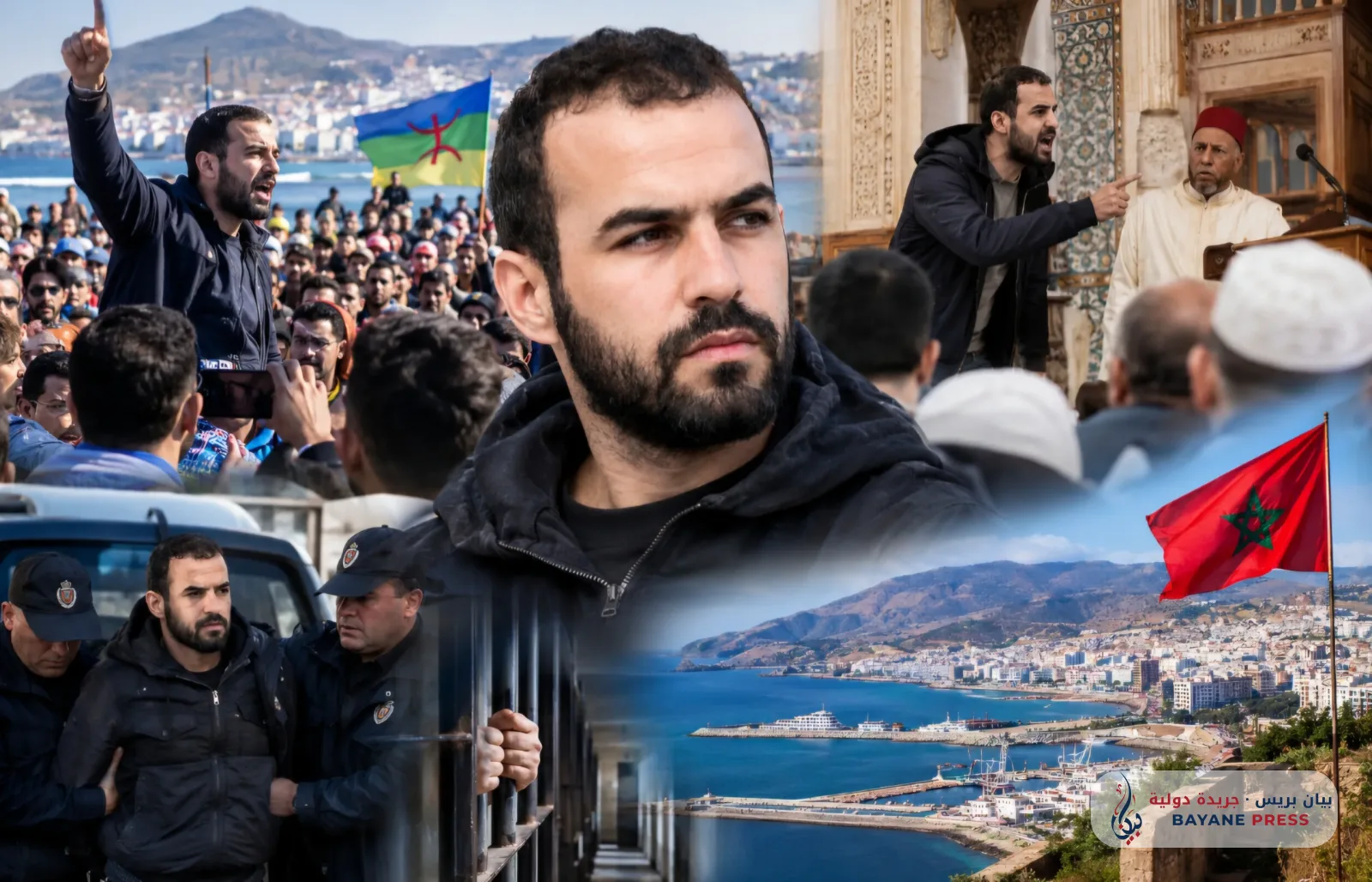
The story began on a cold autumn night in October 2016, when the quiet city of Al Hoceima was shaken by a tragic incident that claimed the life of young fishmonger Mohcine Fikri inside a garbage compaction truck. This prompted residents to take to the streets in spontaneous marches filled with grief and tension, raising slogans demanding justice, dignity, and a transparent investigation to determine responsibilities. That moment served as the spark for what became known media-wise and popularly as the "Rif Hirak", where citizens' voices united behind a clearly defined social and developmental demands agenda. This agenda focused essentially on building a specialized cancer treatment hospital, establishing a university nucleus, breaking geographical isolation by completing infrastructure, and providing job opportunities for the region's youth. Amidst these mass gatherings, the name Nasser Zefzafi emerged. A young man with no prior background in structured partisan or trade union work, he possessed a booming voice, passionate body language, and a remarkable ability to stir emotions and appeal to the popular psyche using Moroccan Arabic mixed with Tarifit. Within a few weeks, he transformed from an ordinary demonstrator into a public square orator and the unofficial spokesperson for the protesters. These marches initially maintained complete pacifism amidst widespread national sympathy and official understanding of the legitimacy of demands that would never have led their holder to prison in a country witnessing thousands of peaceful protests annually under the umbrella of the 2011 Constitution.
However, a deep reading into the intricacies of that phase reveals that the Hirak was born and grew during a highly complex political timing. It coincided with what was known in Rabat as the governmental blockage following the October 2016 legislative elections, as political consultations to form a government entered a dead end lasting nearly six months, leaving the country managed by a caretaker government with limited powers and initiative. This governmental paralysis created a dangerous political and communicative vacuum in the Al Hoceima province, accompanied by hidden factional conflicts and the settling of partisan scores among local and regional elites. Foremost among them were leaders dominating the scene in the Tanger-Tetouan-Al Hoceima region at the time, led by Ilyas El Omari, who initially tried to politically contain the Hirak before completely losing control of the street. This fatal institutional vacuum left the field open for the rise of Zefzafi's inflammatory rhetoric. He committed his first strategic error by turning the protest movement into a personalized phenomenon, cutting all bridges of communication by adopting a harsh treasonous discourse that dismissed all intermediary institutions—parties, unions, associations, and elected officials—describing them as "political shops" and "pawns", thus making himself the sole interlocutor and absolute authority of the street.
As the protests dragged on, external parties entered the fray, finding in Al Hoceima's boiling point a lucrative catch and a historical opportunity to settle scores with the Moroccan state. Here emerged the most dangerous hidden thread that changed the nature of the file from a social movement to an issue touching the internal security of the state: the Dutch "Rosendal" network led by former Moroccan parliamentarian fugitive in the Netherlands, Said Chaou, founder of the so-called "September 18 Movement for the Independence of the Rif".
Moroccan security and intelligence services detected the pumping of funds, financial transfers, and organized media guidance from abroad aimed at internationalizing the issue and pushing the Hirak youth towards direct confrontation with public forces. This triggered a severe diplomatic crisis between Rabat and Amsterdam, reaching the point where Morocco recalled its ambassador to The Hague demanding Chaou's extradition. Behind the scenes in the field, pages funded from abroad practiced a form of "treason terrorism" against every moderate voice inside Al Hoceima. When the state dispatched a high-level ministerial delegation in May 2017 to accelerate projects, activists and community figures who called for sitting at the negotiation table faced fierce smear campaigns accusing them of "selling out the cause". Zefzafi himself became a prisoner of the euphoria of "live streaming" and the radical posturing in Europe, leading to the raising of historical regional banners in the squares with the deliberate absence of the national flag, along with dangerous statements undermining the kingdom's territorial integrity and antagonizing security and sovereign institutions.
This slide reached its dramatic peak on Friday, May 26, 2017, a day that marked the point of no return and the fatal criminal error that stripped Zefzafi of his peaceful cover. While the imam of the "Mohammed Fridays" Mosque in Al Hoceima was delivering the Friday sermon speaking about the values of security and stability and warning against discord (fitna), Zefzafi interrupted him amidst the rows of worshippers with frantic shouting. He advanced towards the pulpit, turning the house of worship into a scene of political bickering, shouting his famous phrase documented by cameras: "Are these mosques the houses of God or the houses of the Makhzen?", and adding in an inflammatory tone: "Who are the instigators? Are we who demand a hospital and a university, or are you?". This act was not merely a fleeting protest, but a blatant violation of Articles 221 and 222 of the Moroccan Criminal Code, which criminalize the disruption of freedom of worship, and a flagrant assault on the sanctity of mosques, which fall within the spiritual security of Moroccans exclusively tied to the Commander of the Faithful. The Public Prosecutor's office immediately issued an arrest warrant, and he was apprehended a few days later after attempting to flee, being referred along with his companions to the Criminal Chamber of the Casablanca Court of Appeal.
During the trial, which captured national and international public opinion, human rights readings were divided between two angles. International organizations such as Amnesty International, Human Rights Watch, and some local associations focused on criticizing the harshness of the sentences issued in June 2018, which sentenced Zefzafi to twenty years in prison, considering that the trial was marred by restrictions and that the origin of the Hirak was peaceful and demand-driven. In contrast, the National Human Rights Council (CNDH) and official institutions explained with conclusive evidence that the state did not prosecute freedom of expression, but rather prosecuted proven criminal acts including conspiracy, receiving suspicious funding to destabilize stability, incitement that led to the burning of buildings and the injury of hundreds of public force personnel with varying degrees of severity, and the storming of a house of God. Concurrently with this judicial resolution, the Moroccan state proved that it does not deal through a purely security logic, launching a rigorous investigation via the Court of Audit into the reasons behind the stumbling of the "Al Hoceima, Lighthouse of the Mediterranean" projects. This led in October 2017 to the so-called "political earthquake", where King Mohammed Sixth dismissed a number of active ministers and punished former ministers and dozens of territorial officials whose negligence in serving the region's population was proven. This sent a profound message that the state recognizes the legitimacy of social demands and holds negligent officials accountable, but never tolerates anyone who breaks the law or tampers with the nation's security.
Chapters of the story did not stop behind the walls of "Oukacha" prison in Casablanca or later Tangier prison. Quiet negotiations and humanitarian and political mediations led by statesmen and prominent human rights defenders—foremost among them the late Ahmed Herzni, former president of the Advisory Council for Human Rights—took place behind the scenes to forge an exit leading to the permanent closure of the file. The idea was based on detainees signing a document of political revisions in which they confirmed their adherence to national constants and the kingdom's territorial integrity, cutting the road off to separatist exploiters abroad without compromising their dignity. This path indeed resulted in royal pardons issued in successive batches, through which hundreds of Hirak youth left prison walls and returned to their normal lives. However, the obstinacy of the hard core at the last moment, and internal disputes followed by audio leaks from inside prison in 2019, hindered the completion of that initiative at the time. Thus, the file of Nasser Zefzafi and those remaining with him remains the subject of ongoing civil and human rights appeals, aspiring for the path of major developmental reconciliation witnessed in Al Hoceima in recent years to culminate in a moment of comprehensive humanitarian relief, after everyone has grasped the deep historical lesson that the nobility of social demands can never be achieved by leaping into the unknown or gambling with the stability of the homeland.
Comments (0)
No comments yet. Be the first to react!