

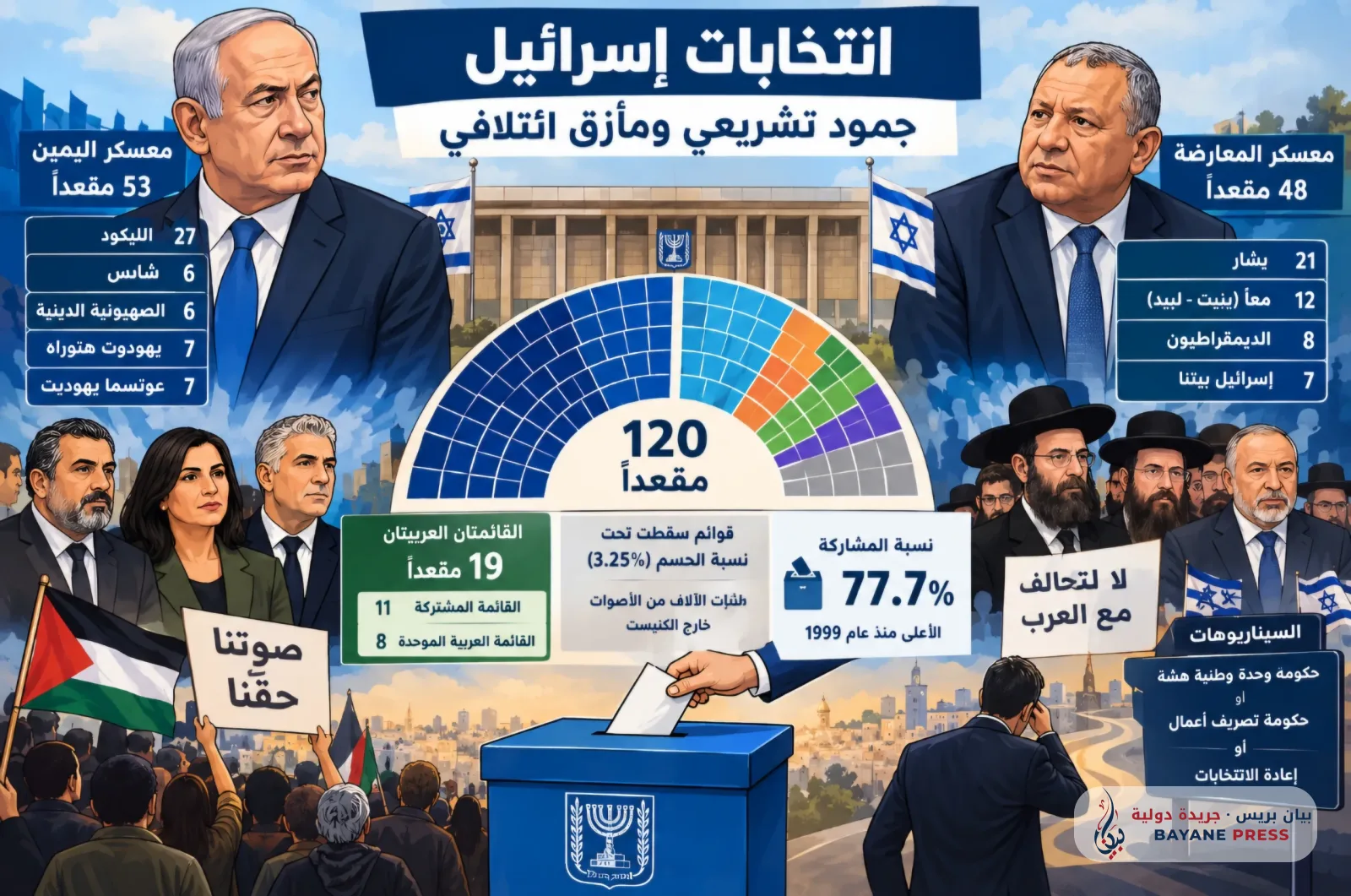
The ballot boxes in Israel have produced a complex parliamentary landscape that threatens to plunge the country into a new tunnel of institutional paralysis, as competing political camps failed to secure the crucial threshold of 61 seats required to form a government. This occurred amid a record voter turnout of approximately 77.7%, the highest since 1999, transforming the entire electoral process into an open-ended referendum that neither ended the crisis of legitimacy nor resolved the struggle for political survival.
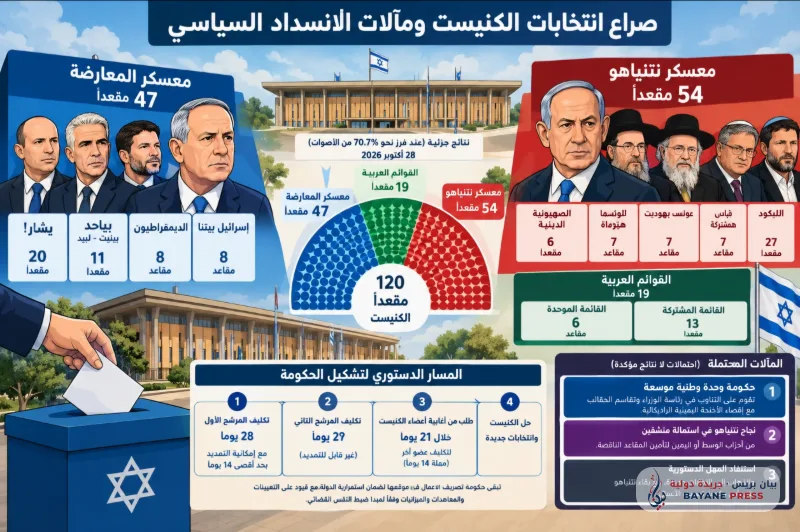
The final vote-tally results cemented a striking decline for the right-wing and far-right bloc led by Prime Minister Benjamin Netanyahu, whose tally dropped from 64 seats in the 2022 Knesset to 53 seats. These were distributed among the Likud party (27 seats), the Shas and Religious Zionism movements (6 seats each), alongside United Torah Judaism and Otzma Yehudit (7 seats each). In contrast, the opposition camp led by former military chief of staff Gadi Eizenkot settled at 48 seats, spearheaded by his rising party "Yashar" with 21 seats, followed by the "Together" alliance led by Naftali Bennett and Yair Lapid with 12 seats, the Democrats party with 8 seats, and Avigdor Lieberman's Yisrael Beiteinu with 7 seats.
The most significant shift was manifested in the historic surge of representation for Palestinian citizens of Israel, with the two Arab lists securing 19 seats (11 seats for the "Joint List" and 8 seats for the "United Arab List"). This marks their broadest parliamentary presence in the history of the Knesset, placing them at the heart of tactical calculations despite systematic political exclusion attempts. This landscape coincided with the collapse of numerous party and protest lists below the electoral threshold (3.25%), including movements representing army reservists and emerging economic currents. The dissipation of hundreds of thousands of these votes outside the Knesset walls deepened the arithmetic deficit for both camps, depriving either side of benefiting from surplus seats to break the negative tie.
In a preemptive move reflecting the intensity of polarization, the opposition camp did not wait for official presidential consultations by President Isaac Herzog. Instead, it rushed to activate its combined numerical strength of 67 seats alongside Arab MPs to move toward ousting Likud's Knesset Speaker Amir Ohana and imposing a new legislative speaker to guarantee control over the parliamentary agenda. This move was met with fierce resistance from the Likud party, which demanded an immediate halt to the voting procedures, arguing that relying on the votes of Arab blocs lacks a legitimate political mandate.
These moves coincided with an escalation by Netanyahu and his allies, who questioned the integrity of the results by leveling accusations of "systematic forgery" and "external interference" that funded the rise of the Arab lists, in an effort to absorb the shock of losing the majority. However, this narrative quickly collided with decisive stances from official institutions. The Central Elections Committee denied the existence of any widespread fraud, confirming the stability of seat distribution even after counting hundreds of thousands of "double envelopes." Meanwhile, the Israeli police confirmed the absence of any intelligence indicators or evidence supporting the thesis of vote theft, and the Shin Bet limited its investigations to foreign cyber-influence attempts that did not affect the core field counting process. On the diplomatic front, the Qatari Foreign Ministry categorically denied Israeli claims regarding support for any party, considering them an exploitation of narrow partisan agendas—a point strongly emphasized by the leadership of the Arab lists, who condemned the campaigns of incitement and defamation.
Today, any figure tasked with forming a government faces a complex web of political landmines. These begin with the Haredi parties' insistence on passing legislation exempting seminary students from military service—a red line for the "Yashar" and "Yisrael Beiteinu" parties. They extend through the veto on alliances with Arab parties, rejected by opposition figures like Lieberman and Bennett alongside strict conditions set by Eizenkot regarding Zionist identity, and culminate in the Netanyahu knot, represented by the opposition's categorical refusal to sit under his leadership versus Likud's insistence on him as the sole leader for this phase. Faced with this compound deadlock, the Israeli arena appears bound to extremely narrow scenarios: either an arduous path toward forming a fragile national unity government, or Netanyahu remaining at the head of a caretaker government for a prolonged period, which could revive the cycle of returning to the ballot boxes and entrenching internal political paralysis.
Comments (0)
No comments yet. Be the first to react!