


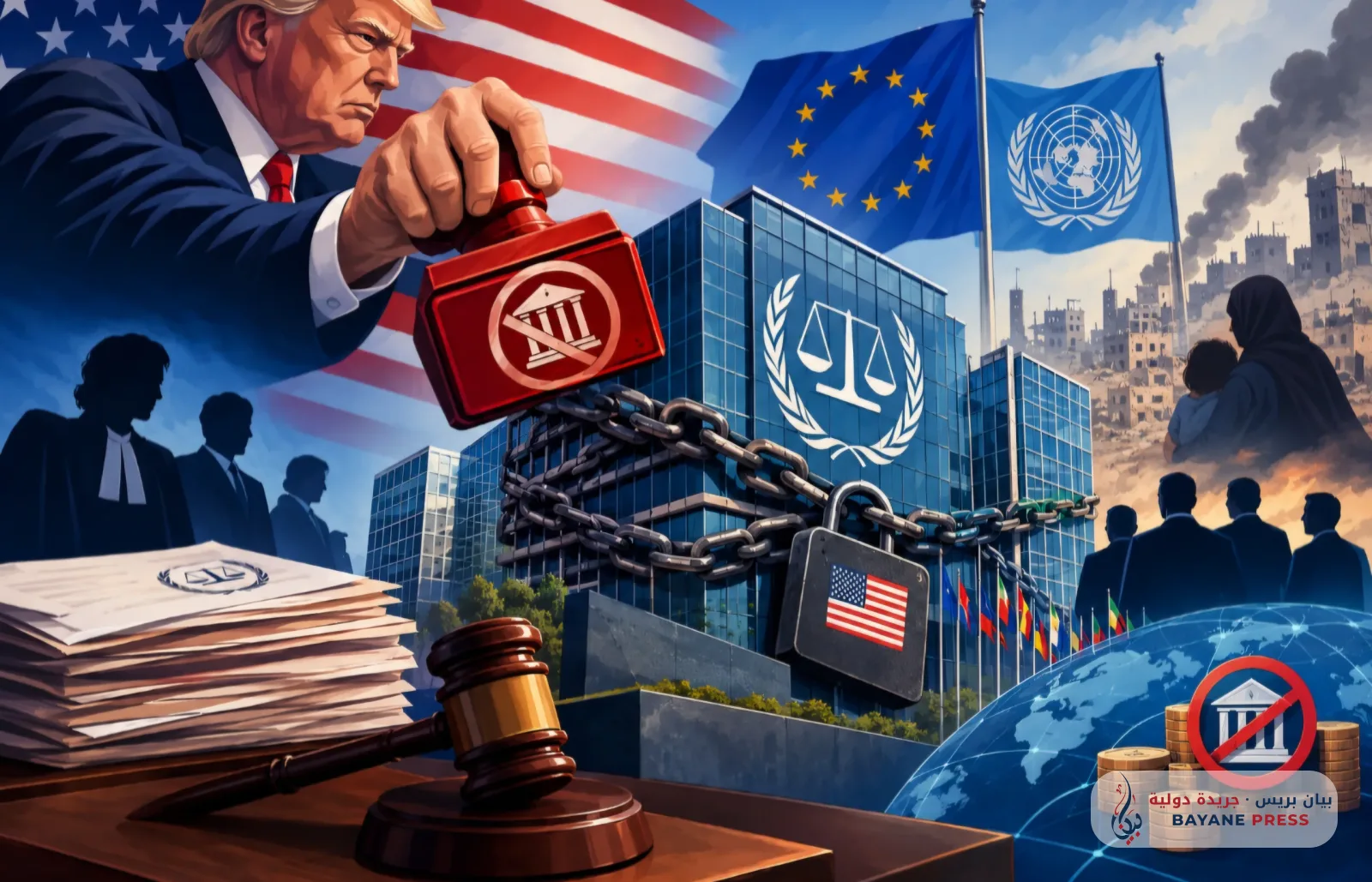
The open confrontation waged by the United States against the path of international justice no longer stops at the limits of individual intimidation or the selective targeting of judges and prosecutors. Instead, it has slipped into a dangerous historic turning point aimed at undermining the institutional framework of international criminal justice from its roots. When the U.S. administration decides to place the International Criminal Court itself on sanctions lists, it places the path of accountability for crimes committed in the Gaza Strip before a severe existential test, raising burning questions about the ability of this judicial institution and its member states to safeguard their independence and ensure the continuity of their work in the face of a storm of political and financial blackmail.
These rapid transformations, with all their legal, political, and operational complexities, form the core of an in-depth reading presented in a recent research paper issued by the Palestinian Center for Policy Studies under the title: «From Targeting Individuals to Choking the Institution: U.S. Sanctions on the International Criminal Court and the Limits of Protecting the Gaza Accountability Path.» The study traced the threads of American escalation up to anticipating the prospects of containing its repercussions in the coming months. Ever since the issuance of U.S. Executive Order No. 14203 in February 2025, Washington has escalated its punitive steps; it began by targeting the prosecutor, judges, and individuals associated with the court, then expanded the target circle to include Palestinian human rights institutions playing a pivotal role in documenting crimes, before reaching the peak of this path on October 9, 2026, by listing the court as a full entity on the Specially Designated Nationals list. This officially shifted the battle from the box of pressureing individuals to an attempt to encircle and completely choke the institution.
However, a careful examination of the architecture of the American decision reveals a tactic that combines legal restriction with temporal maneuvering. Listing the court on the sanctions list did not come in the form of an immediate and absolute closure of all its activities; rather, it coincided with the issuance of four general licenses allowing the continuation of a package of basic transactions and services, such as member state payments, salaries, health insurance, and medical services, until April 7, 2027, with respect to General License No. 13. Yet, the real trap behind this measure lies not only in the text of the direct ban, but in the phenomenon of «over-compliance» that governs the behavior of banks, corporations, and service providers around the world. Their fear of secondary U.S. sanctions drives them to voluntarily rush to cut off their dealings with the court, threatening to paralyze funding channels, technical services, and insurance, and making the issue of protecting the institution a structural dilemma that goes far beyond merely searching for alternative payment methods away from dollar hegemony.
In the face of this systematic siege, the crisis of the international system is manifested in that glaring gap between the diplomatic noise rejecting the sanctions and the absence of practical tools capable of repelling them. Despite successive objections from European countries and announced positions from the European Union and the European Parliament, the activation of the «European Blocking Statute» remains frozen in the realm of theorization without turning into practical action that protects European companies and institutions dealing with the court. This is coupled with a lack of sufficient executive commitments to ensure the smooth flow of the court's payments and safeguard its financial and administrative transactions.
This international schizophrenia does not stop at financial and operational thresholds, but extends to strike at the core of the issue of implementing the arrest warrants issued against the head of the occupation government, Benjamin Netanyahu, and his former defense minister, Yoav Gallant. The fact that listing the court on the U.S. sanctions list has no effect on legally canceling those warrants, nor does it drop the legal obligations incumbent upon states parties under the Rome Statute, collides with the reality that actual implementation remains hostage to the political will of governments and their conduct on the ground. Perhaps the stark divergence in countries' positions illustrates the magnitude of this predicament; Hungary's failure to execute the arrest warrant during Netanyahu's visit in April 2025 represented a dangerous precedent, while other countries' pledges to comply with implementation remain merely announced positions that have mostly not been subjected to a real practical test.
Stepping out of the circle of current paralysis forces international forces supporting justice to quickly transition from merely politically rejecting sanctions to building a system of practical protection tools before it is too late. This path requires real pressure to activate the European Blocking Statute, and the establishment of an independent institutional channel ensuring the flow of court payments and staff salaries, parallel to completing the court's transition toward purely European technical and insurance alternatives. It also demands extracting formal written commitments from states parties to strictly adhere to executing the arrest warrants. Furthermore, the battle necessitates providing a legal and financial protection umbrella for Palestinian human rights organizations listed on U.S. sanctions lists, alongside activating the principle of «universal jurisdiction» in the national courts of countries whose legislation allows it, thereby creating parallel judicial paths that prevent the monopoly or obstruction of the accountability process.
Ultimately, the data of the current landscape indicate that the coming few months are pregnant with prospects for partial containment of the sanctions' repercussions, but this containment will remain tainted by the continued erosion of some of the court's capabilities and its associated vital service network, unless European countries take decisive executive steps before the U.S. deadline expires on April 7, 2027. The current crisis, even if it does not necessarily mean the inevitable collapse of the International Criminal Court, does not grant it an automatic certificate of survival either. The arrest warrants remain valid by force of law, but the future of accountability for Gaza's crimes will remain contingent on the international community's ability to translate political rejection statements into solid, measurable legal, financial, and institutional commitments.


Comments (0)
No comments yet. Be the first to react!