

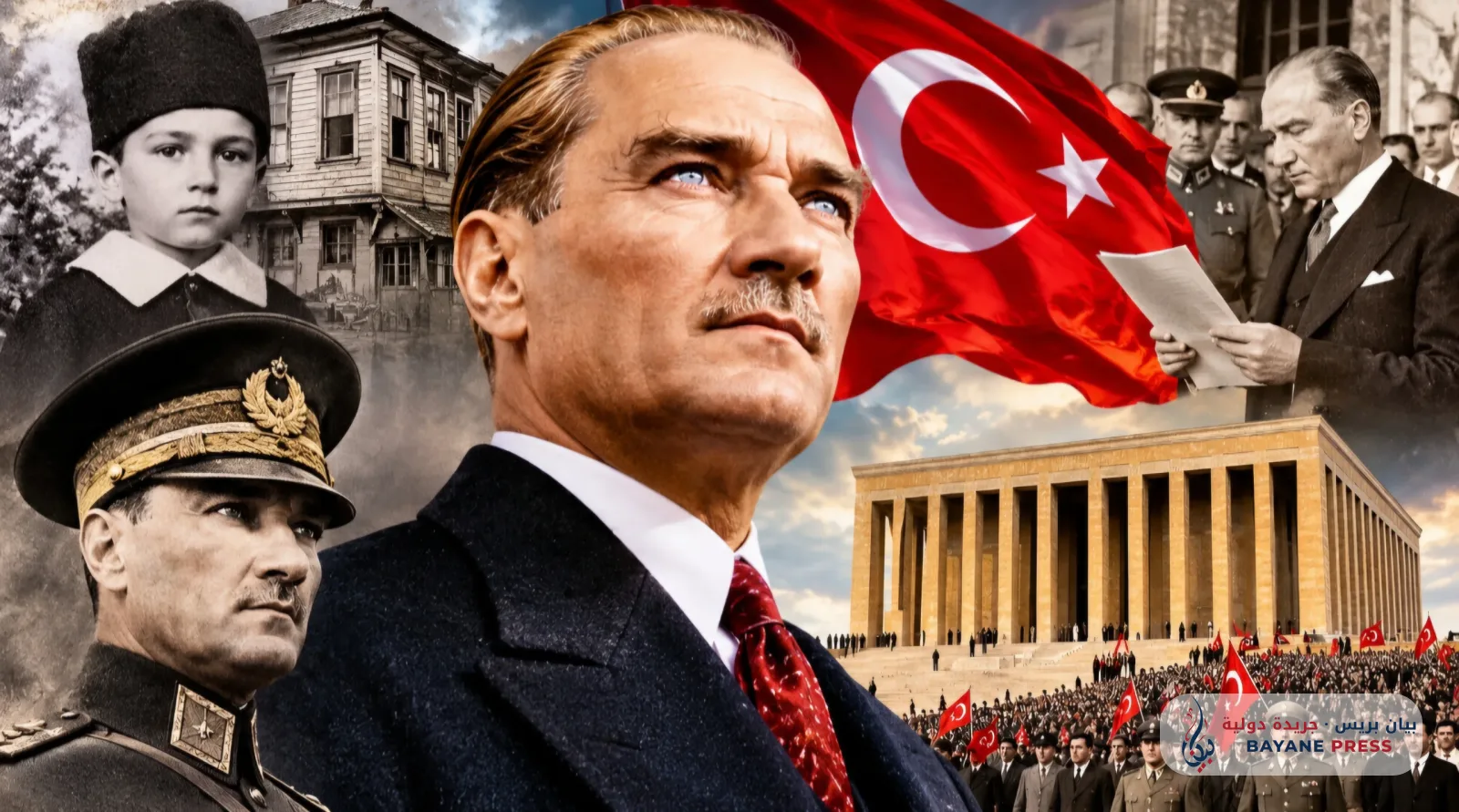
In the spring of 1881, in a three-story pink-painted wooden house located in the "Koca Kasım Pasha" district of the Macedonian city of Thessaloniki—then part of the Ottoman Empire—a child named "Mustafa" was born without an exact birthdate by day and month due to the absence of strict civil documentation at the time. Although he later chose May 19th as a symbolic date for his birth, commemorating the day he landed at the port of Samsun to launch the War of Independence in 1919, his father, Ali Rıza Efendi, was a minor customs and salt administration employee and a former lieutenant in a volunteer battalion before turning to the timber trade. His paternal roots trace back to the "Yörük" Turkmen clans who settled in the village of "Kojajik" in the Debar region on the Albanian-Macedonian border, while his mother, "Zübeyde Hanım"—who was about twenty years younger than her husband—descended from a Turkmen peasant family that settled in the "Langa" area near Thessaloniki. Among the painful and hidden facts of his childhood was that he grew up surrounded by death; his mother gave birth to six children, four of whom died in early childhood—Fatma, Ahmed, Ömer, and Naciye—due to outbreaks of diphtheria and fever. Only Mustafa and his younger sister "Makbule," who lived until 1956, survived.
From the time he reached school age, a cultural conflict emerged within his home between his devout mother, who insisted on enrolling him in the traditional neighborhood religious school with a ceremony of religious chants, and his modern-minded father, who transferred him a few days later to the modern "Şemsi Efendi" school. Among the striking historical details is that the founder of this school, Şemsi Efendi, belonged to the famous Thessaloniki "Donmeh" sect and adopted modern European educational curricula that left their first mark on the young boy's mind. However, the early death of his father in 1888 when Mustafa was seven years old turned the family's life upside down. His mother was forced to take her two children and seek refuge in her brother "Hüseyin Agha's" farm in the village of "Rapla," where the boy temporarily stopped studying and worked for months guarding bean fields and chasing crows with his sister Makbule, before being brought back to Thessaloniki and entering the civil middle school. He left after his teacher, "Kara Muallim," beat him severely, drawing blood following a student brawl, prompting the boy to secretly apply—without his mother's knowledge—for the military middle school entrance exam in Thessaloniki in 1893. There, the mathematics teacher, Captain Mustafa Efendi of Üsküp, gave him the nickname "Kemal" to distinguish him from his name and in appreciation of his arithmetic genius.
In 1896, Mustafa Kemal moved to the military high school in the city of Manastir, where his national and literary consciousness was shaped by his schoolmate, the poet and orator Ömer Namık, who introduced him to the poetry of Namık Kemal and Tevfik Fikret. He also immersed himself in learning French at a Brothers of the Christian Schools monastery in Thessaloniki during his summer vacations to be able to read the works of Voltaire, Rousseau, and Montesquieu in their original language. In fact, in the spring of 1897, he tried to escape from the military school at night with a friend to volunteer in the Greco-Turkish War, but a woman on the road caught him and returned him to his barracks. In March 1899, he joined the Military Academy in Istanbul carrying the famous military number "1283", graduating in 1902 as a lieutenant, and moving on to the Staff College, from which he graduated on January 11, 1905, as a staff captain. However, the covert station rarely told in detail is that no sooner had he received his rank than he rented an apartment in the "Beyoğlu" district with his comrades to publish a handwritten secret newspaper opposing the rule of Sultan Abdul Hamid II. A spy who had infiltrated their group, named "Fathi," betrayed them, leading to the arrest of Mustafa Kemal and his imprisonment in solitary confinement at Yıldz Palace for several months, during which he underwent harsh interrogations that almost ended his military career, before the academy director, Rıza Pasha, intervened to commute the sentence to disguised exile under the guise of field training in the Fifth Army in Damascus.
In Damascus, among the alleys of the Hamidiyah Souq in the autumn of 1906, specifically inside a small shop owned by an exiled merchant named Mustafa Cantekin, Mustafa Kemal founded a secret society named "Homeland and Freedom." He sneaked in disguise via Jaffa, Alexandria, and Athens back to his birthplace Thessaloniki with forged documents to open a branch of his society there, before discovering that the "Committee of Union and Progress" had already penetrated the Third Army. He joined them in October 1907, but remained in sharp and early disagreement with the leadership trio, particularly Enver Pasha, due to his refusal of direct officer intervention in daily politics. Nevertheless, in 1909, he participated as chief of staff in the "Action Army" that marched from Thessaloniki to Istanbul to suppress the March 31 Counterrevolution and depose Sultan Abdul Hamid II. He was then dispatched to France in 1910 to attend the "Picardie" military maneuvers, and in late 1911 he sneaked into Libya via Egypt using a forged passport under the assumed journalistic name "Mustafa Şerif" to fight the Italian invasion in Tobruk and Derna. There, his left eye was injured in January 1912 by a calcareous splinter from an Italian bombardment, spending a month in the Red Crescent hospital. The injury left him with a permanent slight squint in his left eye, which he tried to hide in his photographs throughout his life.
Between 1913 and 1914, he was appointed military attaché in Sofia, the capital of Bulgaria, to distance him from the center of decision-making in Istanbul. In Sofia, he experienced a stormy and unfulfilled romance considered one of his most passionate emotional secrets, as he fell in love with "Dimitrina Kovacheva," known as "Miti," the daughter of Bulgarian War Minister General Stilian Kovachev. He asked for her hand twice from her father, who refused to marry his Orthodox daughter to a Muslim officer, so her image and phantom haunted him until the late years of his life. With the outbreak of World War I, his military star shone at the Battle of Gallipoli in 1915 when he commanded the 19th Division at Ari Burnu and Conk Bayırı, where a shell splinter struck his chest on August 10th, but it hit his metal pocket watch and saved his life—the watch he later gifted to German General Liman von Sanders. He was then promoted to the rank of major general ("Pasha") in 1916 after recapturing the cities of Muş and Bitlis from Russian forces. In the summer of 1918, he traveled to the resort of Carlsbad in Austria-Hungary to treat chronic nephritis that had plagued him since his youth. When the Armistice of Mudros was signed in October 1918, he was commanding the Lightning Army Group on the Syrian front, retreating with his troops north of Aleppo, refusing to surrender his weapons to the British.
On May 19, 1919, Mustafa Kemal arrived at the port of Samsun aboard the old steamship "Bandırma" as an inspector of the 9th Army with an official imperial decree from Sultan Mehmed VI Vahideddin, but he quickly turned his mission from disarming the resistance to organizing it, issuing the Amasya Circular. On the night of July 8, 1919, in the city of Erzurum, he stripped off his military uniform and resigned from the Ottoman army to escape an order for his dismissal and arrest, declaring that he would struggle as an ordinary citizen. The martial court in Istanbul sentenced him to death in absentia in May 1920. Nevertheless, he founded the Grand National Assembly in Ankara on April 23, 1920, and led the Turkish War of Independence. Among the rare details is that before the decisive Battle of Sakarya in August 1921, he fell from his horse and broke three of his ribs, yet he returned from Ankara to manage the historic 22-day battle with a bandaged chest sitting on a wooden chair, subsequently being awarded the rank of "Marshal" and the title of "Gazi" (The Veteran). He then concluded the war with the Great Offensive in August 1922 and the entry into Izmir.
Parallel to his abolition of the Ottoman Sultanate on November 1, 1922, his proclamation of the Turkish Republic on October 29, 1923, and the subsequent abolition of the Islamic Caliphate on March 3, 1924, his private life at the Çankaya Presidential Residence in Ankara was witnessing a silent tragic drama. On January 29, 1923, he married Latife Uşşaki, a young, educated Izmir native and Sorbonne graduate, in an unprecedented marriage contract where the bride herself sat at the judge's table contrary to prevailing traditions. This prompted him to distance his loyal relative "Fikriye Hanım," who had accompanied him and managed his household affairs throughout the war years in Anatolia and loved him madly, sending her to a sanatorium in Munich, Germany, under the pretext of treating her for tuberculosis. However, Fikriye cut her treatment short and returned to Ankara in May 1924. When she was denied entry at the gates of Çankaya Palace, she shot herself in the chest with a small pistol she carried in her bag and died in the hospital days later in an incident wrapped in strict official secrecy and surrounded by long historical suspicions. Meanwhile, his marriage to Latife Hanım lasted only two and a half years before collapsing due to the clash of their strong personalities; he divorced her on August 5, 1925, and never married again. Latife Hanım's memoirs and his letters to her remained locked in the Turkish state's secret vaults even after her death in 1975.
During his years of sole rule, and after thwarting the Izmir assassination plot in 1926—which he used to purge his political rivals and old comrades-in-arms through the Independence Tribunals—Atatürk imposed a series of radical and shocking transformations: he abolished religious courts and Sufi lodges, imposed the Western hat law in 1925, adopted the Swiss Civil Code in 1926, replaced the Arabic alphabet with the Latin alphabet in 1928, and ordered the call to prayer to be chanted in Turkish instead of Arabic in January 1932. He bestowed upon himself the title "Atatürk," meaning "Father of the Turks," through a parliamentary law in 1934 that banned any other citizen from bearing this name. Among the striking intellectual curiosities of the 1930s was his adoption of two anthropological and linguistic theories that were later shelved: the first was the "Turkish History Thesis," which claimed that Turks were the origin of ancient civilizations such as Sumerian and Hittite, and the second was the "Sun Language Theory," which he derived in 1935 from an obscure booklet by an obscure Austrian linguist named Hermann Kvergic, positing that all human languages derived from a primitive Turkish language originating in Central Asia when early man looked at the sun. Atatürk used this very theory to justify keeping stubborn Arabic and Persian words in Turkish on the grounds that they were originally Turkish from the beginning.
Evenings in his palace revolved around what became historically known as the "Atatürk Table," intellectual and political soirées that stretched from evening until dawn, during which he consumed large quantities of the alcoholic drink "Raki," numerous cigarettes, and Turkish coffee daily. He compensated for his childlessness by adopting eight children, most famously Sabiha Gökçen, who became the world's first female fighter pilot, historian Afet İnan, and little Ülkü. From late 1937, symptoms of health deterioration began to appear in the form of emaciation, severe skin itching, nosebleeds, and abdominal swelling. In January 1938, Dr. Nehat Reşat Belger diagnosed his condition for the first time at the Yalova resort as advanced liver cirrhosis accompanied by ascites, a diagnosis confirmed by the French professor "Noël Fiessinger," who was secretly summoned from Paris.
Despite the weight of illness in the spring and summer of 1938, Atatürk pushed himself and traveled to Mersin and Adana in May of that year, standing for hours under the sun to review the army as a deterrent message to France to settle the annexation of the "Sanjak of Iskenderun" to Turkey, which led to a serious relapse in his liver. He was transferred to the presidential yacht "Savarona," anchored in the Sea of Marmara, to spend his quiet weeks aboard. However, the humidity and heat aggravated his condition, and on the night of July 25th he was secretly carried to room number "71" overlooking the Bosphorus Strait in the Dolmabahçe Palace in Istanbul. In that room, he underwent three painful abdominal paracentesis procedures to drain dozens of liters of accumulated fluid from his abdominal cavity, dictated his legal will on September 5th, and lapsed into a first hepatic coma in October, from which he woke for days before falling into his final coma on November 8th after uttering his last recorded words, asking for the time and then repeating "And upon you be peace," until his heart stopped beating at exactly 9:05 AM on Thursday, November 10, 1938, at the age of fifty-seven. His body was embalmed by Professor Lütfi Aksu and placed in a lead-lined rosewood coffin inside the Ethnography Museum in Ankara for a full fifteen years, until it was moved on November 10, 1953, to be laid to rest in his massive mausoleum "Anıtkabir" amidst soil brought from all the provinces of the republic he had created with his own hands.
Comments (0)
No comments yet. Be the first to react!