

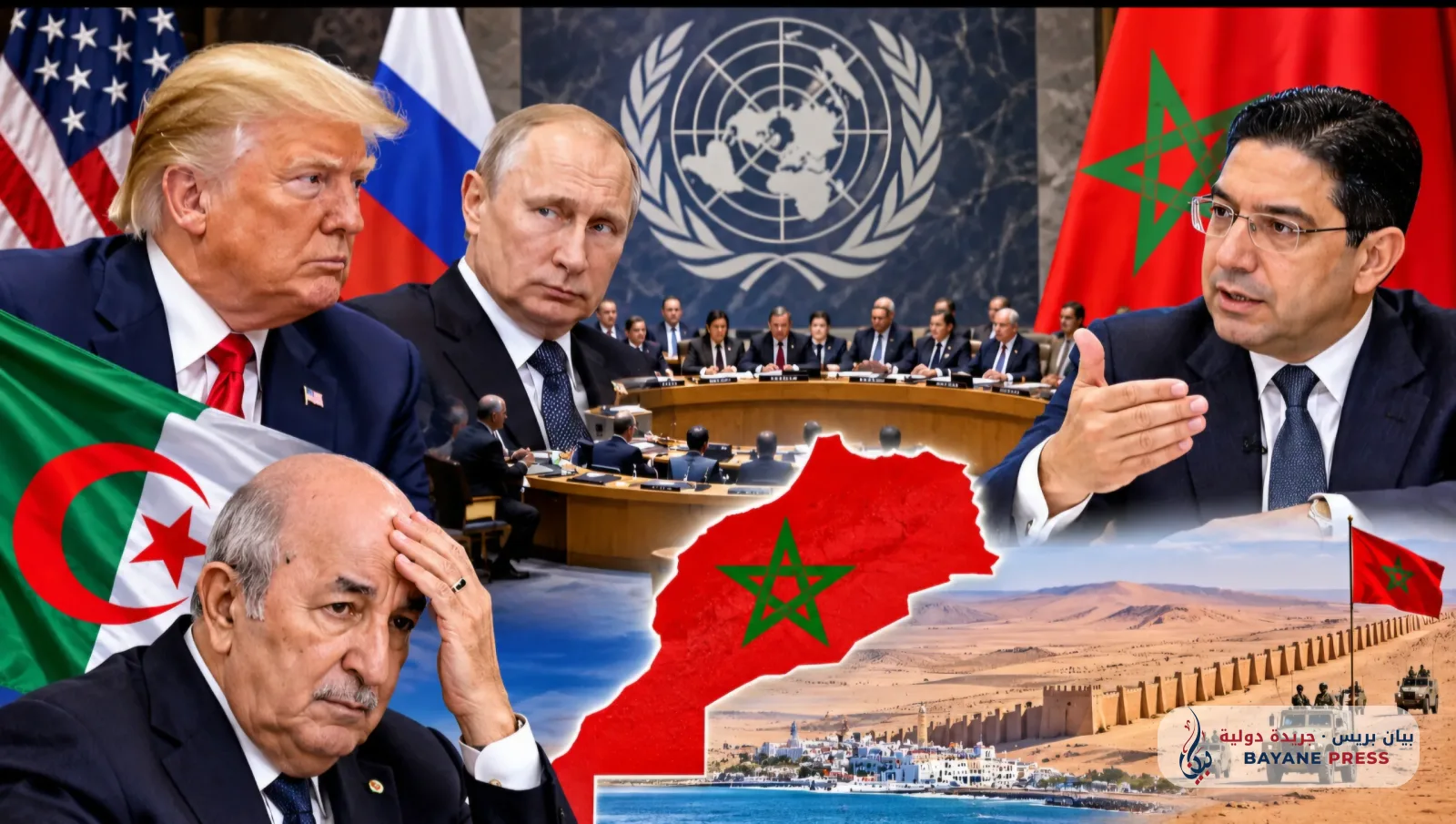
No astute reader of international relations can swallow the media bait portraying recent tensions within the UN Security Council over the Moroccan Sahara file as a Russian ideological awakening to support Algeria or the Polisario Front; hard facts in geopolitics do not recognize emotions, but are rather built on major interest trade-offs. The undeniable proof dismantling the narrative of Russia's principled bias toward the separatist agenda lies in UN Resolution 2797, the most critical and decisive resolution in enshrining Moroccan sovereignty and the autonomy reference, which passed through the Security Council chamber without Moscow raising its veto hand to abort it, before the UN General Assembly's Fourth Committee voted on October 16, 2026, by an overwhelming majority of 152 countries in favor of endorsing this resolution. This confirms that recent Russian maneuvers were nothing more than a carefully orchestrated tactical move on a chessboard far broader than North African borders.
To gauge the extent of prior coordination, it suffices to recall the prompt timing of the meeting between Moroccan Foreign Minister Nasser Bourita and his Russian counterpart Sergei Lavrov in Moscow on Wednesday, October 28, 2026—just 48 hours before the Security Council session, on the sidelines of the 3rd Russia-Africa Ministerial Summit. This direct meeting proves beyond a doubt that Rabat was fully and precisely aware of the session's scenario and details, and that the Russian move was not a treacherous surprise to Morocco, as evidenced by the immediate and decisive readiness of the Moroccan institutional response issued via the Royal Cabinet statement immediately following the session's conclusion.
Deciphering the scene requires looking behind the curtain, where a silent and rapid strategic rapprochement has materialized over the past few days between Donald Trump's administration and the Kremlin led by Vladimir Putin. This rapprochement is based on the logic of grand deals and overlapping vital interests in energy files, security arrangements in Eastern Europe to end the war in Ukraine, and the proposal for a major trilateral summit to divide global spheres of influence in what resembles a new Yalta Agreement encompassing the African Sahel and the Mediterranean. Under this tacit understanding between Washington and Moscow, the mutual veto-waving game becomes a diplomatic play with a pre-agreed upper limit to divide roles and terminate the MINURSO mission without a single party bearing the legal and diplomatic fallout of shutting it down. Washington, as the penholder operating with the logic of financial efficiency to terminate costly UN missions draining roughly 69 million dollars annually to no avail, knows how to draft outcomes preserving Morocco's strategic gains, while granting Moscow room for formal maneuvering to politically and militarily blackmail the Algerian regime and keep it hostage to billions in arms contracts and diplomatic dependency, without a single millimeter changing in the field or legal equation in favor of the Polisario.
The brilliance of this strategic trap is evident in the literal details of the American draft resolution that terrified Algeria. The draft did not merely establish autonomy under Moroccan sovereignty as the sole basis for negotiation in its operational paragraphs 5, 7, and 8; it also included in its first paragraph the official renaming of the mission starting November 1, 2026, from "MINURSO" to "MINUSO"—the official and final removal of the letter "R" symbolizing the word referendum—while obligating the Secretary-General to submit a plan by January 30, 2027, to reduce the number of military observers and close and merge observation posts. When this draft garnered 11 favorable votes out of 15 members, with abstentions from China, Pakistan, Denmark, and a lone Russian veto, the reality of the Russian maneuver was exposed. When Russian Ambassador Vasily Nebenzia tabled a one-page alternative draft for a technical extension of the mission in its old format, the numerical scandal was that the Russian project did not fail merely due to American opposition, but failed outright to gather the legal quorum set at 9 votes, securing only 3 orphan votes—Russia, China, and Pakistan—against 11 abstentions and one American opposing vote. Moscow knew this in advance when it presented it as window dressing to save face before Algeria without any genuine intention of saving the mission.
At the heart of this complex diplomatic architecture, the Israeli role emerges as a pivotal and weighty actor in secret negotiations with the great powers. Tel Aviv, bound to Rabat by a close strategic, security, and military alliance, possesses influential and direct communication channels with decision-making circles in the Trump administration and power centers in Moscow. Israeli diplomacy and its intelligence arms acted as a guaranteeing mediator to transmit messages and calibrate the rhythm of negotiations between major capitals, ensuring that US-Russian trade-offs in the Security Council would not fundamentally undermine Morocco's interests. Instead, the compass was guided so that Rabat emerges as the actual strategic winner behind the scenes, no matter how noisy the public display appeared.
Dissecting the actual outcomes of yesterday's Security Council session away from rhetorical noise clearly shows they entirely serve the interests of the Kingdom of Morocco. Placing MINURSO practically outside the political game and formally ending its mandate on the night of October 31, 2026, after 35 years of existence since 1991, means burying the last vestige of outdated referendum mechanisms and leaving the field to Morocco's fully-fledged de facto authority. US Ambassador to the UN Mike Waltz confirmed this direction immediately after the vote by officially calling for an orderly withdrawal of the MINURSO mission, revealing that the mission consumes 80% of its time and resources on self-sustenance and logistics, and recalling that former Secretary-General Kofi Annan acknowledged the futility of its presence as far back as 2002. Morocco—which exercises total control over its southern provinces and transforms them into a continental Atlantic economic pole, and which has wrested recognition from major and active powers, foremost among them the United States, France, and Spain, regarding the Morocanness of the Sahara and the autonomy initiative as the sole and exclusive solution—no longer needs a UN mission whose extension Polisario and Algeria used as a platform for political blackmail and prolonging the artificial conflict. Rabat crowned this with a Royal Cabinet statement announcing that the non-extension paves the way for permanently closing the file within the United Nations and withdrawing it from the Security Council and the Fourth Committee.
However, the most dangerous cornerstone that superficial coverage missed lies in the immediate sovereign and financial consequences of MINURSO's death regarding the buffer zone and global trade arteries. For 35 years, the mission's presence under Military Agreement No. 1 of 1991 served as an international legal constraint on the buffer zone east of the sand wall, and gave insurance companies and international financial institutions a pretext to classify the territory as a disputed zone under UN oversight. With MINURSO's mandate officially collapsing on October 31, 2026, the UN legal cover over the buffer zone fell away forever, granting the Royal Moroccan Armed Forces full legal and sovereign legitimacy to extend direct control up to the Mauritanian and Algerian borders and close any land route for infiltrating Polisario elements without UN observers counting military movements. This also frees the southern provinces and the massive Dakhla Atlantic port from any UN legal constraint hindering the flow of transcontinental sovereign investments.
Faced with these undeniable facts, the tables turned on Algeria. While Algerian media outlets and platforms were cheering on the night of October 30, 2026, for the Russian veto as a historic diplomatic victory in a desperate attempt to market an internal illusion to absorb street anger and justify the bleeding of billions wasted on a losing project, Algerian diplomacy woke up on Saturday, October 31, 2026, to the legal catastrophe of the mission's clinical and legal death. The Algerian Foreign Ministry issued an official statement shifting tone from celebration to lamentation, expressing deep regret over the failure to renew MINURSO's mandate. Decision-makers in the El Mouradia Palace and the barracks of the Algerian army know in their hearts that the world has turned the page on separatism, and that any military confrontation brandished by the Polisario Front is a war whose outcome is sealed before it begins, after the Royal Moroccan Armed Forces tightened their field grip via the smart security wall, space surveillance systems, and the overwhelming superiority of drones and electronic warfare that turned the buffer zone into a graveyard for any hostile movement.
As for the option of direct Algerian military intervention, it is a red line Algeria cannot cross because it knows with certainty that it would amount to geopolitical suicide opening the gates of hell from all directions, bringing wrath and retaliation even from the Russian bear itself, which Algeria hallucinates as its protective ally. Moscow—which has extensive economic partnerships with Morocco in fisheries, energy, and agriculture, and which is militarily and economically entrenched in Sahel countries like Niger, Mali, and Burkina Faso via the Africa Corps extracting gold, uranium, and lithium after an almost total break between these landlocked countries and Algeria—knows that the only safe maritime outlet for exporting these strategic mineral resources to global markets runs inevitably through the Moroccan Atlantic Initiative and the Dakhla Atlantic port. Stability in the Sahara under full Moroccan sovereignty and ending the presence of MINURSO and the buffer zone serves both Russian and American logistical and economic interests on the African continent. Therefore, Moscow will not allow Algeria to ignite a regional war threatening this vital trade corridor, destabilizing the southern shore of the Mediterranean, and prompting direct NATO intervention. Russia will be the first to abandon Algeria and trade it off at the table of the great powers, leaving Algerian media noise as merely a hollow echo of international arrangements that have decisively and irreversibly settled the Moroccan Sahara file.


Comments (0)
No comments yet. Be the first to react!