


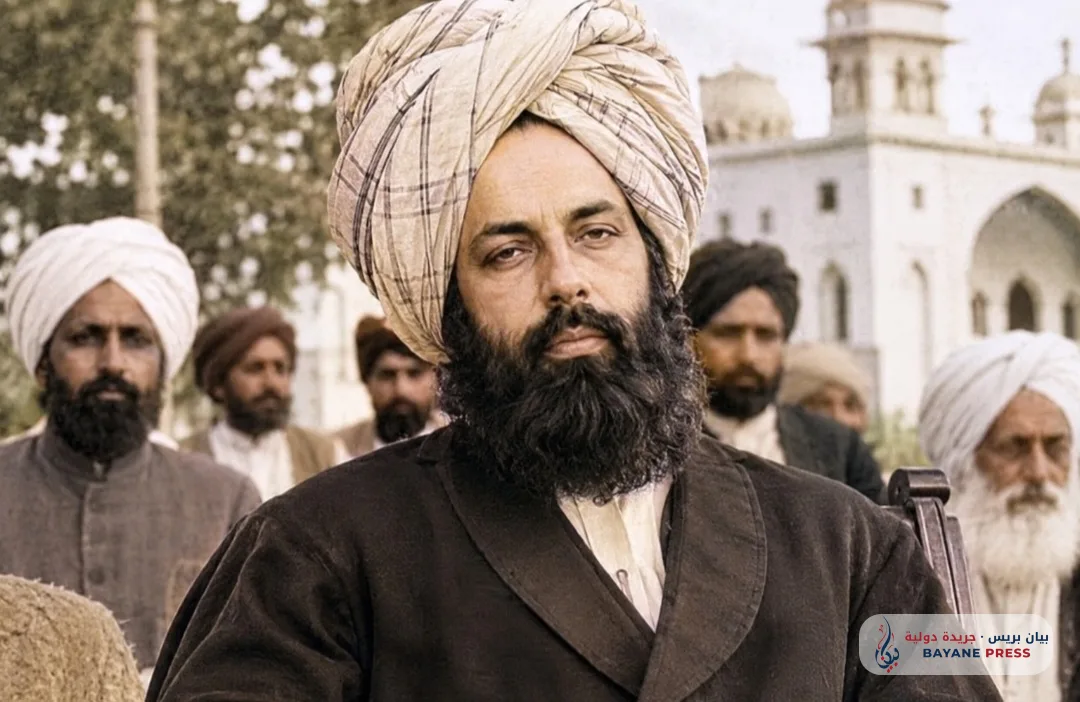
On February 13, 1835, corresponding to the 14th of Shawwal in the year 1250 AH, specifically in the town of Qadian located in the Indian Punjab province, about seventy kilometers northeast of Lahore, Mirza Ghulam Ahmad bin Ghulam Murtada was born into a feudal family whose historically documented roots trace back to the Mongol Barlas tribe of Persian culture—the exact same tribe to which Tamerlane belonged, even though Ghulam Ahmad later claimed, based on his own revelations, that his lineage was purely Persian. His great-grandfather, Mirza Hadi Baig, had emigrated from the city of Kesh near Samarkand in the 16th century during the reign of the Mughal Emperor Zahir al-Din Babur, and settled in Punjab, where the Mughal court granted him dozens of villages. Among the rare details absent from many biographies is that Ghulam Ahmad was not born alone; he was a twin with a sister who entered the world a few hours before him, named "Jannat," though she passed away just days after her birth. He grew up in a troubled aristocratic environment, as his family had lost most of their feudal properties to the Sikh Ramgarhia confederacy before his father, Mirza Ghulam Murtada, recovered Qadian and four neighboring villages from the Sikh Maharaja Ranjit Singh in exchange for his military and medical services. The father later displayed absolute loyalty to the British Crown during the Indian Rebellion of 1857, when he equipped, at his own expense, fifty horsemen with their mounts to support English forces—a stance that later formed one of the cornerstones of his son's political and doctrinal position rejecting armed jihad and advocating obedience to the British government.
In his youth, Ghulam Ahmad grew up introverted, shunning amusement, and enamored with seclusion in the mosque and hours of reading. He received his early education in Qadian from private tutors, studying the Holy Quran and the basics of Persian under the teacher "Fadl Ilahi" at the age of seven, then learning the rules of Arabic and logic from Fadl Ahmad, and later from Gul Ali Shah in his early adulthood. He also studied the principles of traditional Unani medicine under his father, who was a skilled physician, which explains his later fascination with formulating medicines and medical pastes. Around 1852, his father married him to his maternal cousin, "Hurmat Bibi," when Ghulam Ahmad was about seventeen years old. However, this first marriage remained tense and cold from its early years due to differences in temperament and his wife's refusal to accept his reclusive tendencies. Although he fathered two sons with her, Mirza Sultan Ahmad and Mirza Ghulam Ahmad, it eventually led to a long estrangement lasting decades before he officially divorced her late in life. The historical irony is that his eldest son, Sultan Ahmad, remained opposed to his father's prophetic claims throughout his father's life and only joined his movement many years after his father's death.
Under pressure from his father, who aimed to recover the family's confiscated properties through the English courts, Ghulam Ahmad was forced in 1864 to leave his seclusion in Qadian and move to the city of Sialkot to work as a minor clerk and administrative assistant on a meager salary in the British Deputy Commissioner's office. He stayed there for four years, until 1868, an era that shaped his argumentative persona. In Sialkot, he sat for the law exam and failed it, but on the other hand, he rubbed shoulders with Protestant missionaries belonging to the Church of Scotland mission, led by Reverend "John Taylor" and Reverend "Thomas Butler." He would sit with them after working hours and debate the texts of the Old and New Testaments. There, he also forged close ties with the city's notables, foremost among them Sheikh Nur Muhammad, the father of the philosopher-poet Sir Muhammad Iqbal—a family connection that linked him to the Iqbal family, before Iqbal later adopted an intellectual stance opposing his movement in the following decades.
Ghulam Ahmad returned to Qadian in 1868 following the death of his mother, "Chiragh Bibi," entering a vortex of exhausting legal disputes on behalf of his father in an effort to reclaim the family lands. He lost most of these cases, saddling the family with heavy debts and deep sorrow for his father, Ghulam Murtada, who died in June 1876. This was followed years later by the death of his eldest brother, Mirza Ghulam Qadir, in 1883, who had been managing the family's affairs. The death of his father, and then his brother, marked the most dangerous psychological turning point in Ghulam Ahmad's life. Relying entirely on them financially, he was gripped by an intense fear of poverty and ruin, and he claimed at the time that he received divine inspiration reassuring him with the Quranic verse:
"Is not Allah sufficient for His servant?"
This phrase was later engraved on the bezel of his personal ring. Indeed, he even tried to sell a precious gemstone bezel inherited from his father to a merchant in Amritsar to sustain himself, living through years of severe austerity and subjecting himself to harsh regimens, surviving on just a few morsels of food a day for eight or nine consecutive months. Some researchers believe these practices may have contributed to worsening his bouts of headaches, dizziness, and visual and auditory hallucinations—symptoms some accounts linked to his early contraction of chronic diabetes, accompanied by excessive urination and insomnia.
In 1880, his influential public emergence began when he published the first parts of his famous book "Barahin-e-Ahmadiyya," aiming to refute the Hindu "Arya Samaj" movement led by Dayananda Saraswati and Christian missionary missions. He promised readers and financial contributors the publication of fifty volumes containing three hundred rational and textual arguments in defense of Islam, earning widespread praise at the time from traditional Indian scholars who saw him as a staunch defender of the faith. However, he stopped at the fourth volume in 1884 and did not issue the fifth volume until 1905, explaining his long hiatus with the odd justification that the difference between fifty and five was merely a single zero, and that God fulfilled His promise in five volumes instead of fifty. During this period, specifically on November 17, 1884, he married his second wife, "Nusrat Jahan Begum," in Delhi, who was about thirty years younger than him. He fathered ten children with her; five died in infancy and five survived, including his future second successor, Mirza Bashir-ud-Din Mahmud Ahmad, and his biographer, Mirza Bashir Ahmad.
The decade spanning from 1882 to 1891 witnessed a gradual escalation in Ghulam Ahmad's spiritual claims. He began by declaring himself a "Mujaddid" (renewer) of the fourteenth Islamic century and an inspired figure receiving divine communications and addresses, as recorded in the volumes of "Barahin-e-Ahmadiyya."
Then, on March 23, 1889, in the city of Ludhiana—specifically in the house of the Sufi Ahmad Jan—he formally established his community by taking the first "Bay'ah" (pledge of allegiance) from forty men, the first of whom was his lifelong companion, the physician Hakim Nur al-Din Bherwi. However, the greatest doctrinal earthquake occurred in 1891, when he published three consecutive books: "Fath-e-Islam," "Tudhih-e-Maram," and "Izala-e-Auham." In them, he declared the natural death of Jesus, son of Mary, claiming that Jesus did not die on the cross and was not raised physically, but rather fainted and was treated with a medical ointment known in his writings as "Marham-e-Isa" (Ointment of Jesus). According to the narrative adopted by Ghulam Ahmad, Jesus then secretly migrated eastward in search of the ten lost tribes of Israel, traveling through Persia and Afghanistan until he settled in Kashmir, where he died at the age of one hundred and twenty. He identified Jesus' grave within the "Roza Bal" shrine in the Khanyar quarter of the Kashmiri city of Srinagar—a shrine locally known as "Yuz Asaf." From this, Ghulam Ahmad concluded that he himself was the "Promised Messiah" and the "Expected Mahdi," resurrected with the spirit and likeness of Jesus, rather than in his physical person.
Among the intriguing and hidden aspects of his personal and prophetic life, rarely detailed in general writings, is the case of "Muhammadi Begum," a young female relative of his from the city of Hoshiarpur and the daughter of Mirza Ahmad Baig. Ghulam Ahmad sought her hand in marriage in 1886, linking his marriage to her with a definitive divine prophecy announced in printed pamphlets, asserting that God had married her to him in heaven and that this decree could not be averted. He also warned her father that he would die within three years if he married her to anyone else, that any man who married her would die within two and a half years, and that she would ultimately end up in his chaste protection. However, the family rejected his proposal and married her in April 1892 to a young man named Sultan Muhammad. The husband did not die within the specified timeframe; instead, he lived a long life, participated in World War I, and lived until 1948—a full forty years after Ghulam Ahmad's own death. This incident remained one of the most embarrassing dilemmas in his history, as he later tried to interpret the prophecy by claiming that the divine threat was conditional upon repentance, sparking widespread controversy over whether the prophecy came true and how it was interpreted.
At the dawn of the 20th century, specifically in November 1901, Ghulam Ahmad took his most extreme step by issuing his treatise "Aik Ghalati Ka Izala" (Correction of an Error), in which he explicitly declared himself a prophet and messenger, coining the term "shadowy and reflectional prophethood"—meaning prophethood acquired through complete annihilation in following the Prophet Muhammad (PBUH), without independent legislation, according to his phrasing. This shift later paved the way for his followers to split into two factions after his death: Qadianism, which affirmed his literal prophethood, and Lahorism, which restricted his status to that of a renewer (Mujaddid). Nor did it stop there; in a lecture delivered in Sialkot in November 1904, he declared that he also represented the spiritual manifestation of the awaited "Krishna" in Hinduism. Over the years, he engaged in famous debates and mubahalas (mutual invocations of divine judgment), including his 1893 debate in Amritsar with the Christian missionary Abdullah Atham, his prophecy regarding the death of the extremist Hindu leader "Pandit Lekhram," who was assassinated by stabbing in 1897, and his cross-continental correspondence in 1902 with the American "John Alexander Dowie," who claimed prophethood in the US state of Illinois and founded the city of Zion. This culminated in his final historic announcement on April 15, 1907, directed at the prominent Sunni scholar Abu al-Wafa Thanaullah Amritsari, in which Ghulam Ahmad issued a printed statement inviting God to destroy the liar and fabricator between them during the lifetime of the truthful one, through a fatal disease not caused by humans, such as the plague or cholera.
The health and physical condition of Mirza Ghulam Ahmad in his final years were full of meticulous details recorded by his son Mirza Bashir Ahmad in his encyclopedia "Sirat-ul-Mahdi." He suffered from severe weakness in his right eye, which was almost completely shut, and a permanent chill in his limbs, which he alleviated by wearing woolen socks even in the scorching Indian summer. He also relied on traditional medical stimulants and tonics that he formulated himself, such as "Al-Taryaq al-Ilahi" (The Divine Antidote), musk and ambergris pastes, and medicinal opium extracts common in Unani medicine at the time, to relieve diabetes pain and nervous diarrhea. In late April 1908, he traveled with his family and a number of his senior followers to the city of Lahore, staying at the residence of "Khwaja Kamaluddin," and later moving to a house on Brandreth Road. There, he devoted himself to writing his final book entitled "Paigham-e-Sulh" (Message of Peace), which called for religious reconciliation between Hindus and Muslims under the British umbrella.
On the evening of May 25, 1908, hours after submitting the manuscript of his final book,
"he suffered a severe bout of continuous diarrhea coupled in his final hours with intense vomiting, to the extent that he diagnosed his own condition to his son-in-law Mir Nasir Nawab, stating that he had contracted epidemic cholera." His physical strength deteriorated at an astonishing speed during the night, despite the efforts of physicians—including Dr. Muhammad Ismail and Dr. Mir Muhammad Hussain—to revive him with stimulant injections. At dawn on May 26, he completely lost the ability to speak, with only faint murmurs escaping him, until he breathed his last in the morning of that day, between 10:15 and 10:30 AM, according to contemporary accounts, at the age of approximately seventy-three. This was just about thirteen months after he issued his challenge of mutual imprecation (mubahala) against Sheikh Thanaullah Amritsari, who outlived him by forty years. His body was placed in a wooden coffin and transported the same day by train from Lahore to the "Batala" railway station, from where it was carried on shoulders for eleven miles to Qadian. He was buried on May 27 inside the "Bahishti Maqbarah" (Heavenly Graveyard), which he had established in 1905, setting strict religious and behavioral conditions for burial therein, foremost of which was that a member must bequeath one-tenth of their wealth and property to the community. Thus closed the chapter of an individual who sparked one of the most violent doctrinal and intellectual earthquakes in the Indian subcontinent and the modern Islamic world.




Comments (0)
No comments yet. Be the first to react!