


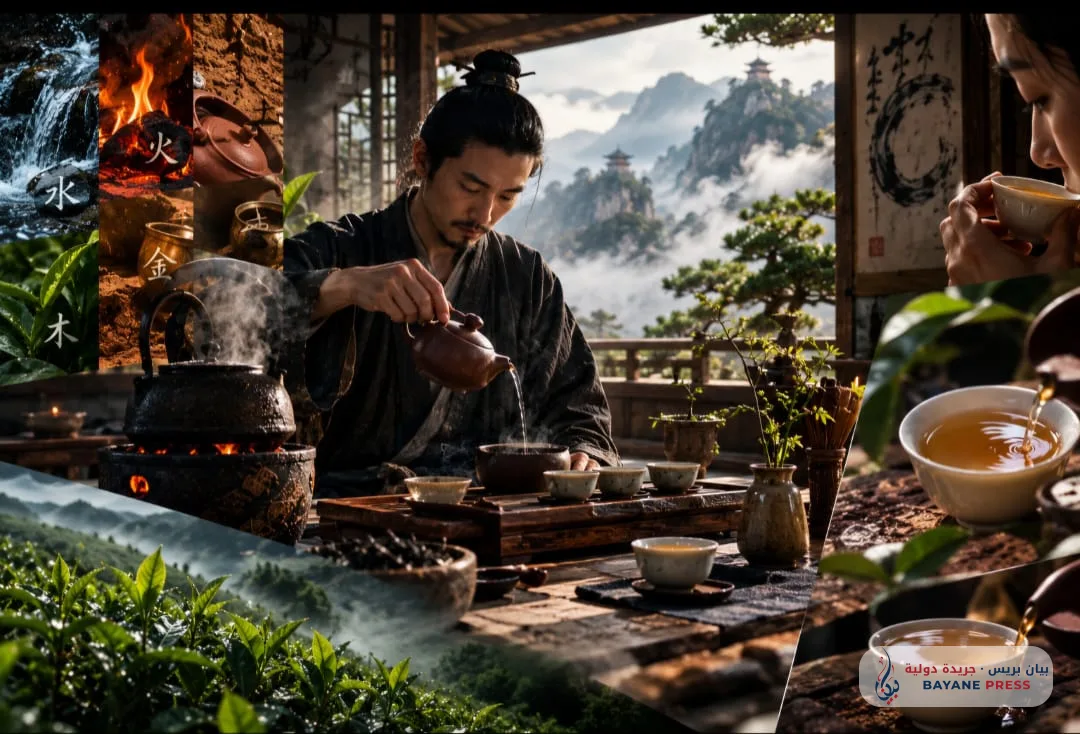
In the spaces of the Far East, a sip of tea has transformed from a mere biological necessity aimed at quenching thirst or stimulating dulled senses into a highly complex and deep behavioral and philosophical system known as the «Tea Way.» Its highest kinetic and spiritual expressions unfold in the «Gong Fu Cha» ritual, which originated in China's Fujian and Guangdong provinces and whose ripples have spread across all of Asia. The term «Gong Fu» here does not refer to common martial arts; rather, in its original linguistic and philosophical sense, it points to supreme mastery and refined skill acquired through the accumulation of time, arduous effort, and immense patience. The gathering is not a passing occasion for superficial chatter, but rather a precise formulation of a silent cosmic harmony uniting the five great elements of the universe: the boiling water represents liquidity and life; the blazing fire in the charcoal stove embodies energy and transformation; the purple clay teapot from Yixing (Zisha) signifies the earth element; silver or bronze vessels invoke metal; while the dried green leaves represent the wood element. Thus, the entire universe meets within a compact space no larger than a small wooden table.
Preparing tea according to this method demands exceptional mental presence that dispels inner distraction and summons Daoist philosophy, which views emptiness as the origin of existence and the locus of its efficacy. The teapot fulfills its purpose only thanks to its hollow inner cavity, and the small cup grants its flavor only when emptied of all prior fullness. The practitioner holds the teapot with fluid, slow movements devoid of tension and pretense, first rinsing the vessel with hot water to raise its temperature and prepare it for the leaves. Then, they drop in the crumpled leaves, awakening them with a quick splash of water that is poured out immediately, known as «washing the tea»—a symbolic step to purify the plant and inhale its initial fragrance before the true extraction begins. When the water is poured for the second time, the teapot rises and falls in regular circular orbits to ensure an even distribution of heat without producing any abrupt collision or sound that might scratch the overarching serenity enveloping the place. This performance reflects strict discipline, shifting the body from random kinetic tension to the smoothness and inner stillness of nature.
This concentrated extract is served in delicate white porcelain cups that can barely hold more than a single sip, compelling the seated guest to abandon habits of rapid swallowing and consumerist breathless pacing, and instead engage in a deliberate, introspective tasting experience that tracks the shifts in flavor through successive draws. The first sip caresses the tip of the tongue with a fleeting bitterness that quickly turns in the throat into a subtle sweetness called «Hui Gan,» while the third and fourth pours reveal complex layers of wild floral aromas, metals, and the breath of fog-shrouded mountain forests where the bushes grew and nourished themselves on dew. At its core, this ritual is a purifying practice that trains the senses to catch subtle nuances and discover the richness hidden within the simplest things. It is a quiet spiritual protest against the noise and breathless pace of the modern world, returning humanity to the point where silence meets hot water, turning a single sip of tea into a profound journey through the layers of the soul and a clear mirror reflecting the unvarnished truth of transient existence.


Comments (0)
No comments yet. Be the first to react!