


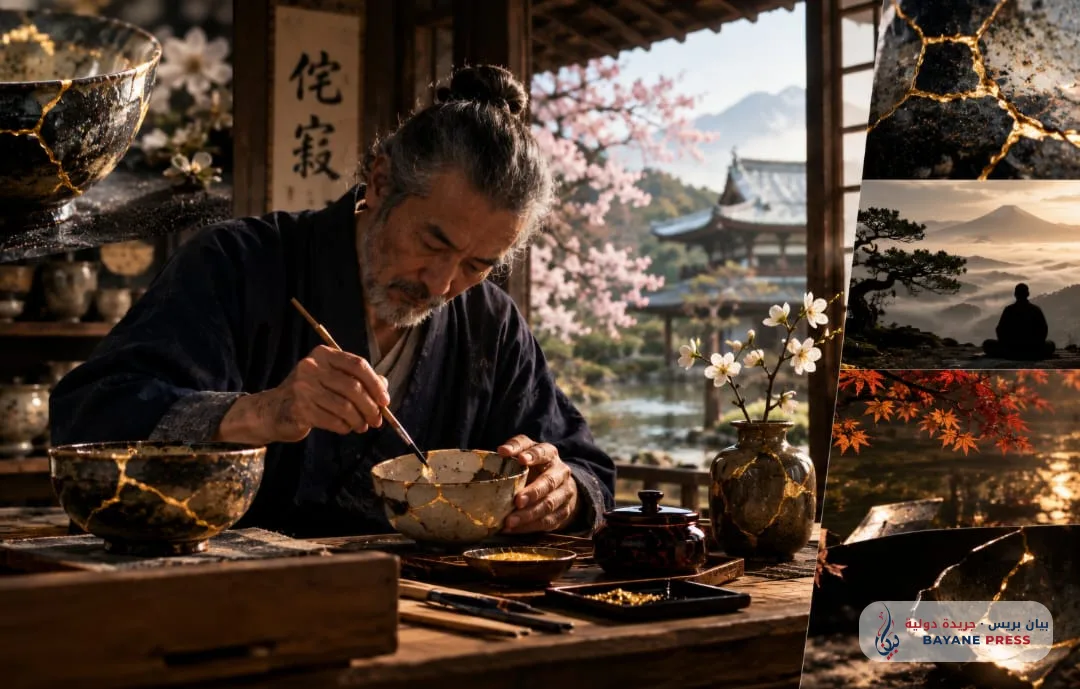
In Japanese aesthetic philosophy, a crack or fragmentation is not considered the tragic end of a material object's life, but a crucial turning point that inaugurates its most mature and sincere history. From this precise spiritual perspective crystallized the art of «kintsugi», an ancient tradition dedicated to repairing the cracks in ceramics and broken vessels using natural resin from the «urushi» tree mixed with pure gold, silver, or platinum powder. This art does not seek camouflage or visual deception to pretend that the impact never happened; rather, it deliberately aims to emphasize the impact of the blow and highlight the fractures with radiant golden scars, making the restored vessel a unique work that surpasses in its aesthetic and metaphysical value its original, virginal state before the fall. This approach is rooted in the core of the «wabi-sabi» doctrine, a current of taste and philosophy born from the heart of Zen Buddhism, which embraces humility, the acceptance of imperfection, and the deep listening to the transience and fugacity of things as the essence of aesthetic perception, in a fundamental break with classical Western systems that deified strict geometric symmetry, impregnable solidity, and the sustainability of a freshness immune to decay.
The documented historical emergence of this tradition dates back to the late 15th century, during the Muromachi period, when the Shogun «Ashikaga Yoshimasa» sent an exquisite Chinese tea bowl that had cracked back to his homeland to be repaired. The bowl returned held together by crude and ugly metal staples that detracted from its splendor and deprived it of its serene spirit, which provoked the shogun's discontent and led Japanese artisans to seek a different approach that would not limit itself to restoring utilitarian function, but would elevate the breakage to the rank of plastic illumination. From that moment on, the repair process transformed into a slow contemplative ritual requiring many months of purifying the urushi material, applying successive layers, and patiently waiting for it to dry in humid, dark environments before scattering the glittering powder particles along the crack. This technique was a civilizational manifesto that saw time as a collaborative aesthetic agent and the hand of destiny as a complementary and non-destructive element; for the vessel that has not witnessed a stumble still lacks its own history, prisoner of a cold perfection untouched by the trial of existence.
This ontological perspective extends beyond the limits of ceramics to shape a comprehensive understanding of the human being and their relationship with fragility. In the Japanese cultural imaginary, the human being is a creature predisposed to change and fracture, and their real history is not a record of error-free victories, but the result of the psychological and existential crises they have suffered and managed to piece back together with dignity and patience. The golden scar becomes here a metaphor for the transcendent consciousness of suffering; the wound that is recognized and re-embraced transforms into a source of strength and intrinsic beauty, in contrast to forced denial attempts that bury blows beneath garments of cosmetic falsehood. The art of kintsugi intersects with the concept of «mono no aware», the sweet melancholy that permeates the soul upon perceiving the disappearance of petals and the falling of leaves in autumn; if the vessel were immortal and unbreakable, and if human life were eternal and not subject to annihilation, the present moment would lose its density and its unique charm. Thus, the golden scar acquires its epic dimension as a document of loyalty to time and a living witness that true beauty is not born in the towers of absolute perfection, but springs from the courage to stand amidst the ruins and extract light from the very core of the fracture.




Comments (0)
No comments yet. Be the first to react!