


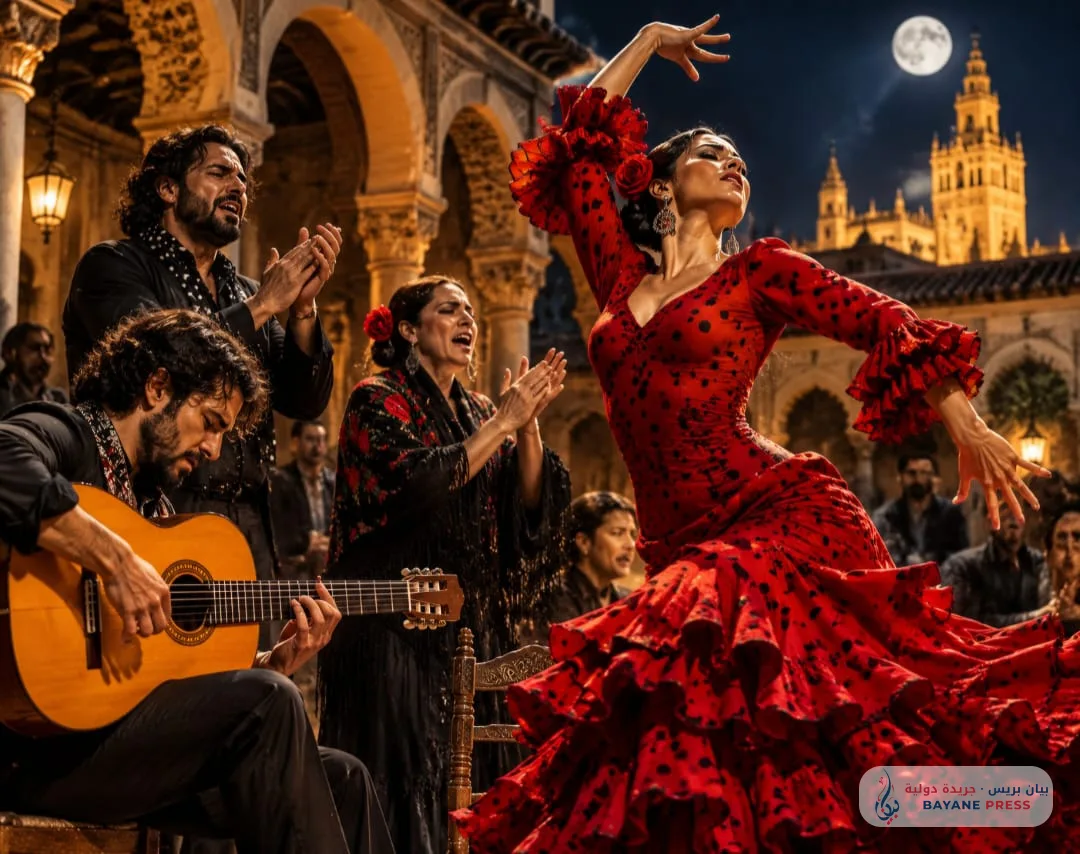
Flamenco art in southern Spain cannot be read as a mere folkloric musical pattern destined for superficial enjoyment or abstract motor display; it is rather an existential and tragic cry that encloses centuries of historical oppression and buried melancholy, where the tributaries of Romani culture merged with Moorish vestiges, Sephardic Hebrew chants, and the songs of helpless Andalusian peasants. To explain the overwhelming force that seizes the performer and the spectator in moments of maximum epiphany, the Spanish soul coined an enigmatic and profound concept that the poet Federico García Lorca crystallized in his famous historical lecture: the concept of «duende». The duende is not the angel that descends with its luminous clarity to pour blessings from above, nor is it the «muse» inspiration of classical Greece that traces geometric and serene lines; it is a telluric and profound being that springs from the soles of the feet, adheres to the blood, and demands an implacable face-to-face combat against the edge of nothingness and death. It is that hidden energy whose scorching intensity everyone perceives, but whose essence not even the greatest philosophers manage to define with the tools of cold logic.
When the duende settles into a gathering of cante jondo, known as «cante jondo», all academic rules and previously polished technical skills crumble, leaving the cantaor naked before their own spiritual wounds and those of their wandering ancestors across the centuries. The throat then becomes the stage of a breathtaking tear and the tones emerge broken, with a rasp that recalls the friction of stone against stone. The flamenco cantaor does not seek melodic and sweet purity, but rather seeks the harrowing sincerity that forces the listener to shudder. At that precise moment, the boundaries between joy and pain vanish, and sadness transforms into a supreme inner ecstasy that purifies the soul of its impurities through something akin to Greek tragic catharsis, but with an Andalusian nuance imbued with the aroma of death and the earth. This singing is accompanied by guitar playing that is not limited to supporting the voice, but strikes with the violent blows of the «rasgueo» to imitate the heartbeats of a cornered heart, while the tapping of knuckles on the instrument's wood evokes the pulse of the earth and summons absent souls from the darkness of oblivion.
As for dance, the irruption of this mysterious force turns the body of the bailaora or bailaor into a living bolt of lightning that defies gravity and combats disappearance. The feet that strike the ground with the force of «taconeo» do not do so to exhibit muscular prowess, but as if excavating into earthly memory to awaken the dead; the arms that snake through the air do not draw ornamental shapes, but fight against invisible ghosts in a space charged with metaphysical tension. The flamenco performer wears her long skirt and moves like a wild plant twisting under the lash of ruthless winds, and when the rapture reaches its zenith, she launches the inherited Andalusian cry «¡ole!» —a linguistic deformation and an internal invocation to the divine Name that Spaniards bequeathed from centuries of Andalusi coexistence— to consecrate herself as a collective confession of the overflow of meaning and the transcendence of the limited human instant toward the cosmic horizon. Understood thus, flamenco is not a celebration of cheap joy, but the courage to look straight into the eyes of imminent death, transforming inescapable transience into an overflowing vital energy that extracts unshakeable artistic immortality from the fragility of the body.

Comments (0)
No comments yet. Be the first to react!