

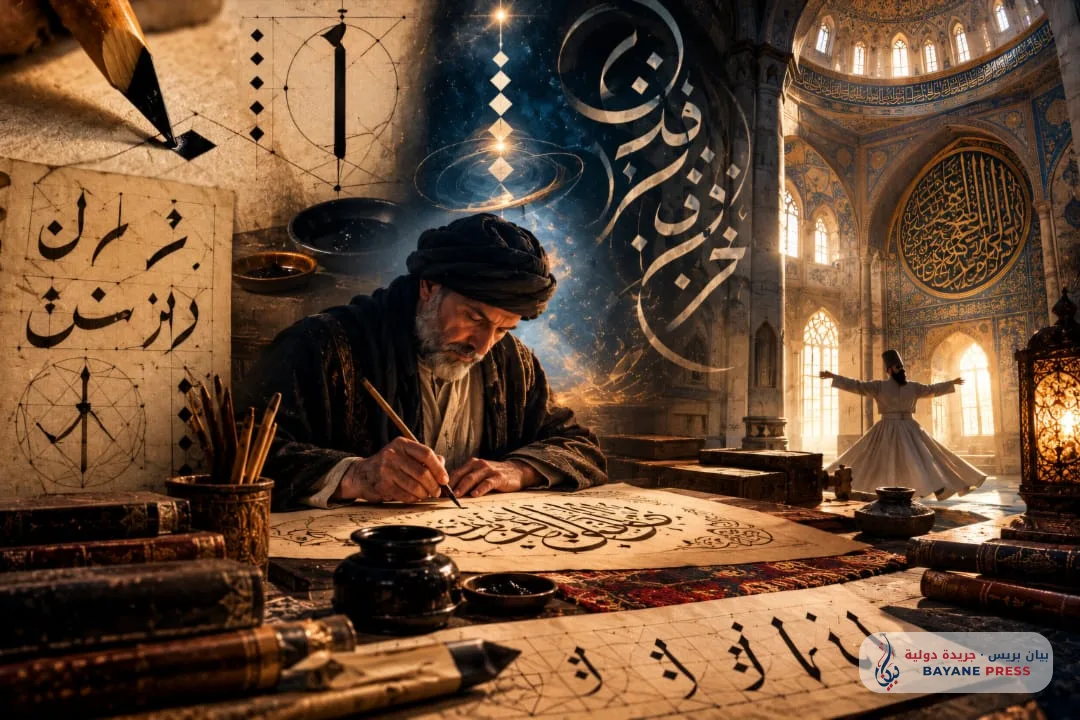
Throughout its long historical trajectory, the art of Arabic calligraphy was not merely a technical tool for fixing texts, perpetuating chronicles, and administrative correspondence, but gradually ascended to become the highest expression of visual art in Islamic civilization and an abstract spiritual geometry that seeks to translate the invisible and absolute into linear rhythms dancing upon the whiteness of paper. This path reached its decisive theoretical and practical maturity during the Abbasid era at the hands of the eminent vizier and calligrapher Ibn Muqla, who laid the foundations of what became known as the «proportioned script» (al-Khat al-Mansub), being followed in its consolidation and development by Ibn al-Bawwab and Yaqut al-Musta'simi. It was then that the stroke of the letter ceased to be an individual, spontaneous effort dictated by the naked eye, transforming instead into a rigorous mathematical and metaphysical science that takes the square «dot» as its absolute unit of measurement —drawn by the bevelled tip of the reed pen with millimetric precision—, from which the golden proportions of the letters and all their spatial dimensions branch out.
This sumptuous aesthetic theory is based on considering the dot as the geometric center and the primary cause of all forms. If the dot moves in a straight and descending trajectory, it engenders the letter «alif», whose length is determined by a specific number of square dots (usually ranging between five and seven dots depending on the chosen reed). From the vertical length of this alif, the diameter of a surrounding imaginary circle is traced, becoming the sole geometric pattern from which the movements, cavities, and arcs of all other letters emanate, such as the ba, the ra, the nun, and the dal. This subtle mathematical system merges with the philosophical and Sufi vision of the universe: the dot symbolizes uniqueness and the simple divine essence from which multiplicity emanates and beings are formed; the alif represents unperturbed divinity, existential constancy, and purity untouched by change; while the rest of the curved letters reflect celestial cycles and the manifestations of the human soul in its descent and ascent, making the manuscript page ultimately appear like a microcosm in whose veins flows a hidden cosmic movement harmonized by breaths and measurements.
Mastery of this art is not acquired through automatic motor acquisition, but rather demands moral elevation and mystical discipline that turns the calligrapher into an intermediary through whom luminous movement descends. The sharpened reed only obeys its author after constant polishing; black ink is prepared in silent retreats from lampblack and pure oil soot mixed with gum arabic and rose water so that it remains pure and endures unaltered across the centuries; and the calligrapher's body submits to a sitting posture and respiratory harmony reminiscent of the highest states of contemplative meditation, where breath is held while stretching the stroke of the letter or drawing its great circumference so that neither the hand trembles nor the balance of the dot is altered. Hence emerged the historical renunciation of figurative and corporeal representation in sacred spaces, in favor of unleashing the reins of the written word to fill the walls of mosques and domes. The Arabic letter, with its movements and extensions, its interlacing and oppositions, its alternation between heaviness and lightness, elongation and contraction, erects a mihrab of pure abstraction that liberates the mind from the shackles of perceptible matter and gently guides it toward the contemplation of the beauty of infinite meaning.

Comments (0)
No comments yet. Be the first to react!