


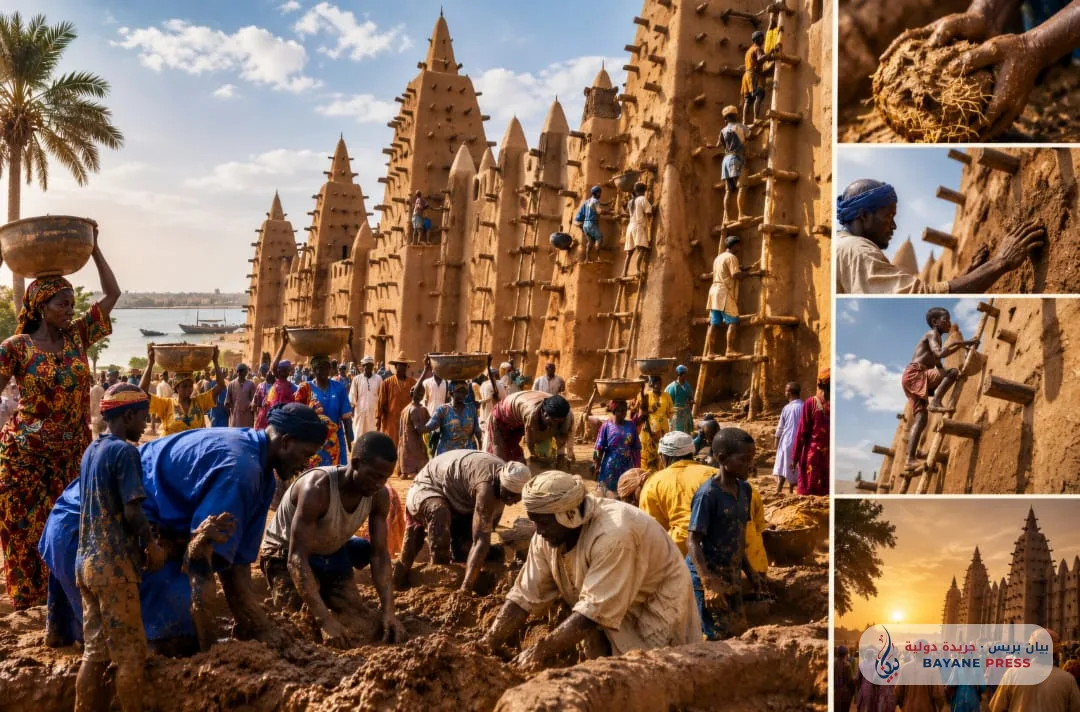
Across the plains of West Africa, stretching along the banks of the Bani River in Mali, the Great Mosque of the city of "Djenné" stands as one of the most extraordinary manifestations of earth architecture in human history, defying modern standards that measure the eternity of monuments by the solidity of stone and the strength of reinforced concrete. This imposing work was built entirely with "banco", an organic mixture composed of silty clay sedimented by river floods, mixed with cattle dung, straw, rice husks, and baobab seed extracts, which provide cohesion thanks to their natural plasticizers. This Sudanese and osmotic architecture is distinguished by its unique capacity to live in perfect harmony with the harshness of the semi-desert environment; its thick mud walls absorb abrasive temperatures during daylight hours to maintain interior spaces in a humid coolness, and then gently release that accumulated heat into the cold bosom of the desert night, turning the building into a living biological lung that beats and breathes in tune with the rhythms of the earth and the changing seasons.
However, this beautiful environmental harmony pays the price of an inevitable structural fragility in the face of the torrential tropical rainy seasons that lash the region every year; the currents cause the erosion of the outer layer of the walls and the sliding of their mud, leaving the monument threatened with disappearance if abandoned to the pure logic of nature. Precisely from this periodic vulnerability arises a majestic and peerless anthropological rite in the world, known as the "Crepissage" festival or the annual replastering of the Great Mosque. Thus, on the morning of a specific day announced by the city's council of elders and the guild of traditional builders, all of Djenné rises in an overwhelming popular outcry that dissolves class differences and individual conflicts; thousands of men, women, elders, and children participate in an epic of solidarity that reshapes the architectural body of their city and renews the unwritten pact uniting the community with its sacred land and shared history.
On that morning, the mosque square transforms into a cosmic beehive overflowing with movement and rhythmic chants; children and young people wade into pools of fermented mud with their bare feet and hands to give it the required viscous consistency, while girls and women carry water in large vessels from the riverbanks to the mixing sites, at the same time as the sturdiest young men compete to climb the palm trunks protruding from the mosque's facades, known as "toron", architecturally designed to serve as permanent scaffolding and an integral part of the temple's ornamental and structural framework. These climbers ascend loaded with balls of wet mud to smooth the damaged facades under the direct and strict supervision of the master masons, the "barey", who inherit the secrets of this complex craft from generation to generation. This comprehensive restoration barely lasts a few hours, but its symbolic impact extends to recharge the collective memory with a renewed identity, proving that survival is not achieved by enclosing oneself in inert materials disconnected from the vital cycle, but through repetitive and tireless human action that refuses to surrender to destruction and recreates its spiritual home from the very earth from which it was born.
Comments (0)
No comments yet. Be the first to react!