


The plenary session in which the first chamber of Parliament granted its confidence to the government of Fatima Zahra Mansouri, with 204 votes in favor and 127 against, was not a simple routine constitutional procedure to activate Article 88 of the Magna Carta, but rather constituted, in my view, the official announcement of the birth of a political phase of extreme complexity. In it, the first woman to chair the executive branch in the history of Morocco walks across an implacable economic, social, and political minefield. The scenario captured by the cameras and documented by the national and international press gave no quarter to initial conventionalisms; for the government born from the womb of the September 23 elections is fully aware that the legitimacy of the ballot boxes —with a turnout rate that did not exceed 38.02%— does not grant a blank check, and that the warm applause from the quadruple majority blocks is not enough on its own to hide the harsh reality of the deep chasms opened over the past five years in the fabric of the middle class and vulnerable strata.
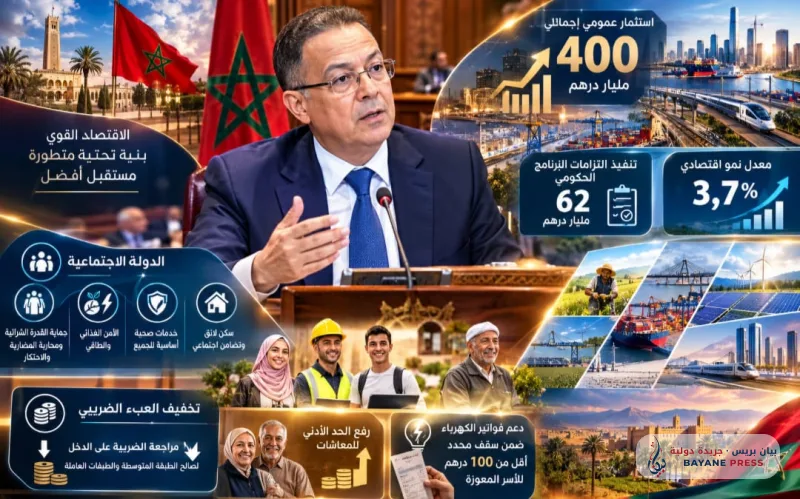
When analyzing the architecture of the governmental program with a horizon set for 2031, I observe that the head of Government opted for flight forward through an attractive basket of social and fiscal promises designed to absorb popular malaise and repair lost trust. The commitment to gradually raise direct social support up to a ceiling of 1,000 dirhams, double the widow's pension from 50% to 100%, cover the electricity bill of up to 100 dirhams for needy families, reduce the maximum personal income tax (IR) rate from 37% to 30%, in addition to rehabilitating 100,000 rural homes and training and integrating 100,000 young people per year, are eye-catching titles that stir the aspirations of the street. However, a rigorous political and economic reading places us before a flagrant mathematical paradox: How can a government that voluntarily renounces nearly 4,900 million dirhams in tax revenues due to the income tax cut commit to additional social expenditures estimated in billions and promise a comprehensive reform of pension funds without altering the retirement age, contribution rates, or the pension calculation base, while simultaneously limiting the budget deficit to 3% by betting on an ambitious annual growth rate of 5%? It is an equation that, on paper, resembles a financial adventure more than conservative technocratic planning.
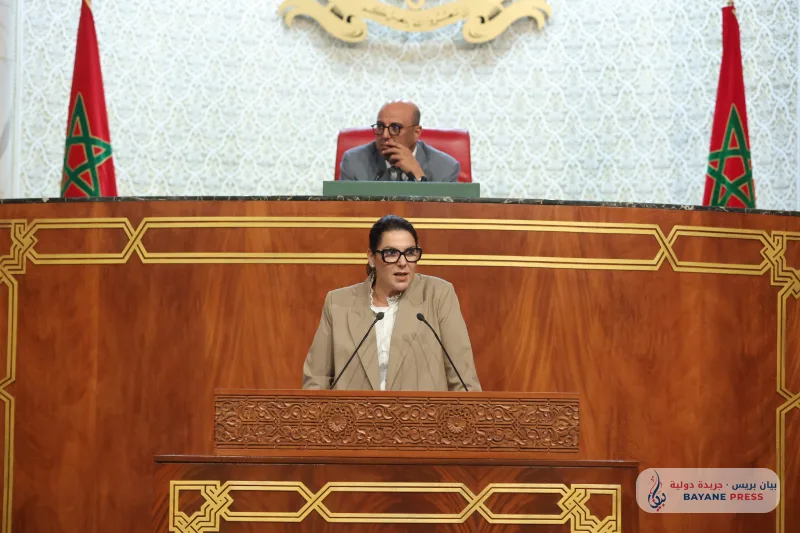
Perhaps what gave the debates and replies their unprecedented dramatic tone was the political paradox generated by the new parliamentary map. The National Rally of Independents (RNI), which steered the previous government, suddenly found itself in the opposition trenches defending, through its group leader Yassine Akacha, the legacy of Aziz Akhannouch. In a striking approach, they considered that the adoption by the new executive of its predecessor's options constituted the greatest recognition of its success, before castigating Mansouri's document under the accusation of excluding 26% of the national territory from development calculations and burying the «Green Generation» agricultural strategy. At the other end of the opposition, Idriss Azami Idrissi, on behalf of the Justice and Development Party (PJD), did not miss the opportunity to settle scores with yesterday's allies, today dispersed among the seats of power and those of the opposition. He drew the weapon of the Constitution and the reports of the Court of Auditors, questioning the executive on the destination of the fallacy of the «million jobs» and the whereabouts of the 280,000 million dirhams spent under the banner of supporting purchasing power and the importation of bovine and ovine livestock, without the small livestock farmer or the ordinary citizen having seen their impact on the markets. For their part, the interventions of the Harakati Group and the representatives of the left, voiced by MP Benjelloun, coincided in the demand to raise the interprofessional minimum wage (SMIG) to 5,000 dirhams, exempt the small farmer from taxes, and protect the public health service against the voracity of privatization, in an atmosphere charged with points of order and altercations that exhausted the patience of the chamber's president, Ahmed Touizi.
Nevertheless, the decisive political moment, in my opinion, materialized on Thursday, when Fatima Zahra Mansouri took off the gloves of soft diplomacy during her reply turn and decided to wage combat with heavy artillery to prove that she is not a mere consensus facade for a hybrid coalition. With acute political cunning, she turned the tables on yesterday's ally, the RNI, by confronting Yassine Akacha with the balance sheet of ten whole years of her party's hegemony in the agriculture, health, and education sectors, revealing the backroom secrets of the previous government by stating that her party demanded support for small and medium-sized enterprises, but the decision was imposed in favor of large corporations. No less implacable was when she directed her gaze toward the PJD seats to delve into the files of the billions from the rural development fund, the problems of construction on collective lands, and the ins and outs of the 2015 elections, launching her most prominent political projectile:
«The discourse of victimhood and control no longer works, and double standards destroy trust... The PAM is a red line and no one has immunity before justice»
Fatima Zahra Mansouri
By describing corruption as «a cancer that obstructs the lives of citizens» and calling on the entire political class to engage in self-criticism in the face of voter apathy, Mansouri projected herself as a firm leader who accepts neither blackmail from her rivals nor demagogy regarding the cleanliness of her hands.
However, this rhetorical value cannot hide the structural fragility that I perceive at the heart of the governmental majority itself. While the Authenticity and Modernity Party (PAM), through the intervention of MP El Sabari, and the Istiqlal group, led by Idriss El Sentissi alongside the interventions of Barouki and Mekaoui, fiercely defended the program from their position as main partners, the entry of the Socialist Union of Popular Forces (USFP) and the Party of Progress and Socialism (PPS) into the coalition harbors ticking time bombs. The calculated phrase uttered by El Hassan Chokra on behalf of the socialists, noting that «we will be partners in the government's success and the first to sound the alarm on stumbles», combined with Meryem Wahassa's approach on behalf of the progressive group regarding the demands for territorial justice and the simplification of rural construction procedures, confirms in my reading that both progressive allies have one foot in the government and another in the street, and that they will not accept bearing the electoral cost of unpopular measures that budgetary constraints may impose in the coming months.
My vision of the immediate future stems from the firm conviction that the true test for Mansouri's government has not yet begun, and that the battle of parliamentary investiture is merely a brief stroll compared to the fierce disputes that await it during the debate on the first budget law. In this term, the executive will face an unprecedented two-headed opposition: one represented by RNI, which has just left power equipped with all the numerical keys, the nooks and crannies of the files, and the secrets of the administration capable of cornering current ministers in each control session; and a second head represented by the PJD, the Popular Movement, and the left, experts in the art of social mobilization and in capturing the pulse of a street furious over the high cost of living and unemployment.
Faced with this parliamentary and social pincer, I consider that Fatima Zahra Mansouri does not possess the luxury of time nor the privilege of hiding behind technical committees. Either she translates her red lines and her incendiary language during the first one hundred days into sweeping sovereign decisions that strike at monopoly lobbies in the food and meat markets, take the law on the criminalization of illicit enrichment and conflict of interest out of the freezer, and dismantle the bureaucratic siege on rural housing and small businesses, or her generous promises will turn into an indictment of political accusation that will corner her under the dome of Parliament and exhaust her capital in the street before reaching the halfway point toward the year 2031.
Comments (0)
No comments yet. Be the first to react!