


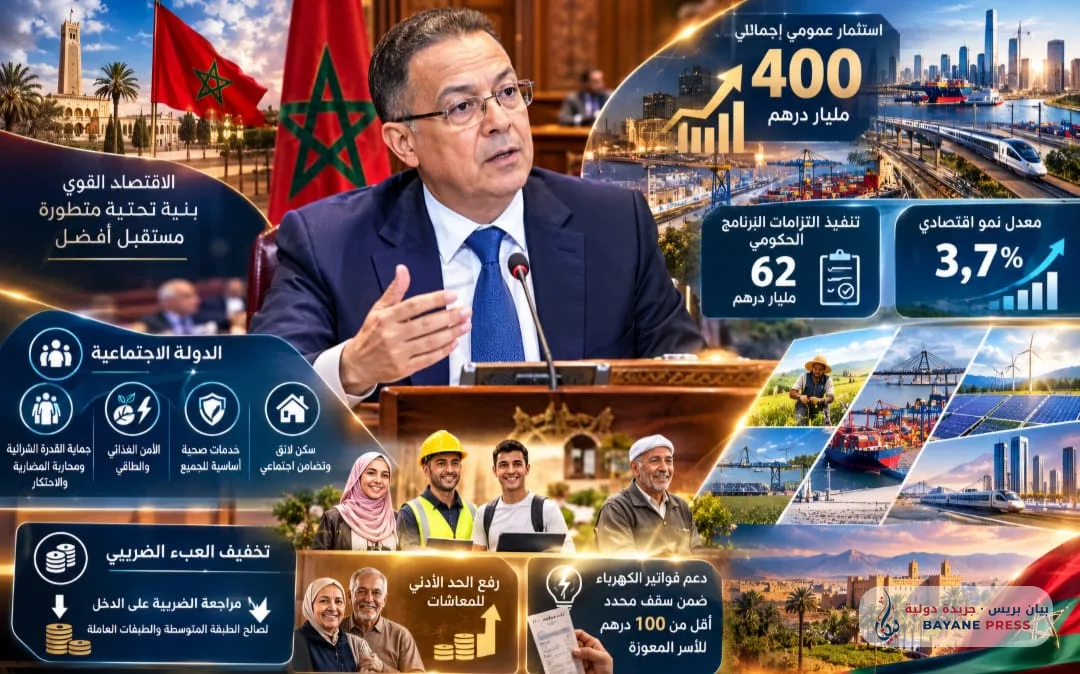
The arguments and interventions presented by Fouzi Lekjaa, Minister Delegate in charge of the Budget, before the Moroccan Parliament constitute a true mirror of public policy orientations and the state's strategic choices. These appearances are not limited to being mere cold figures, but reflect an integrated economic and social philosophy aimed at balancing the rigor of macroeconomic balances with the needs of building the social state. Upon delving into the details of his words, it becomes clear that the discourse addressed to the public is based on an analytical vision that deconstructs current challenges and offers practical responses backed by official figures and indicators, far from populist speeches or empty promises.
The economic backdrop of Lekjaa's speech begins with the observation of an unprecedented total public investment of four hundred billion dirhams, a figure with profound strategic implications indicating that the state has not relinquished its historical and central role as the main engine of the national economy and primary investor to compensate for any potential deficiency in the private sector, especially in light of volatile international geopolitical and economic conditions. This massive investment is not an end in itself, but a means to create dynamism in infrastructure and provide the appropriate conditions to revitalize the economy. This objective is complemented by the allocation of a budget close to sixty-two billion dirhams to implement the commitments of the government program, reflecting a clear political and institutional willingness to fulfill the contracts undertaken before citizens, alongside a realistic and studied commitment to achieving an economic growth rate of around three point seven percent, a rate that expresses prudent optimism based on an accurate evaluation of various productive sectors, both agricultural and non-agricultural.
Regarding the social dimension, which represents the core of government stakes, Lekjaa has taken pains to broaden the concept of the social state to move it beyond the strict realm of direct aid or access to basic health services, encompassing a deeper and broader understanding that strikes at the heart of the citizen's purchasing power and protects them from all forms of speculation, monopoly, and conflicts of interest, giving top priority to the country's food and energy security. By breaking down the practical measures targeting vulnerable groups, wage earners, and pensioners, it is evident that the government is working on precise financial engineering aimed at revising income tax to ease the tax burden on the middle and working classes, in addition to structural measures that include increasing the minimum pension to guarantee a dignified life for groups that have concluded their professional careers, and approving direct and indirect support measures such as covering electricity bills within a specific limit of less than one hundred dirhams for needy families, these precise details being...
Comments (0)
No comments yet. Be the first to react!